Imagine sending a message to Voyager 1 and waiting two full days for the reply — not because anyone is ignoring you, but because the words themselves need a day to get there and another day to come back.
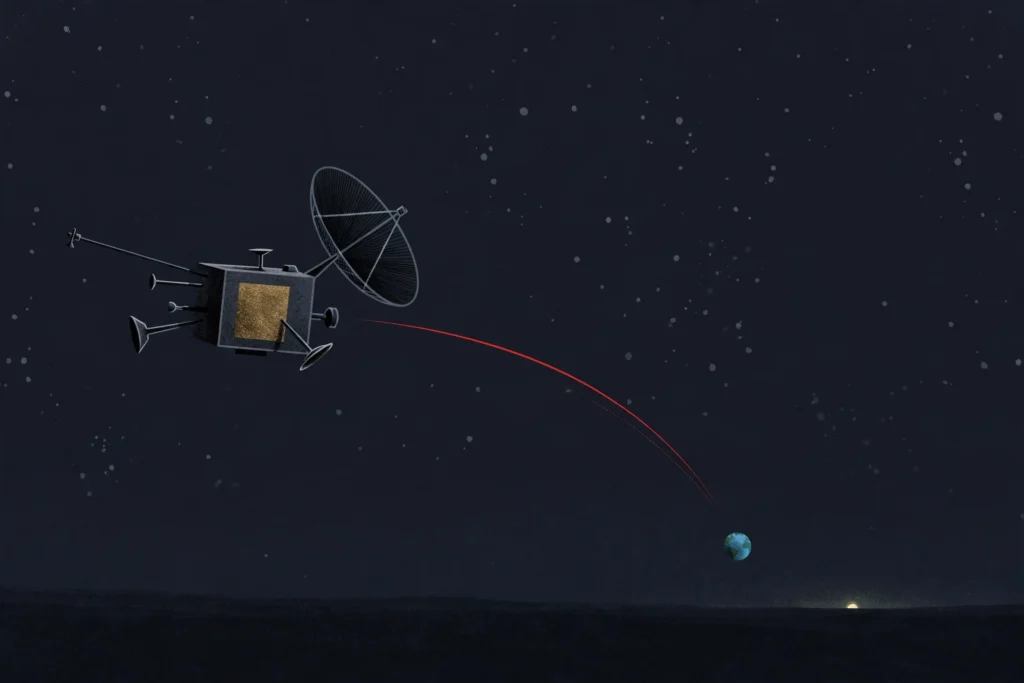
That is life for the small team at NASA’s Jet Propulsion Laboratory who still fly Voyager 1. On Wednesday, November 18, 2026, their spacecraft will cross a line no human-made object has ever reached: one light-day from Earth.
At 10:16:07 UTC — 3:16 in the afternoon in Pakistan — Voyager 1 will sit 25.902 billion kilometres from home: 173 times the distance between the Earth and the Sun. A beam of light leaving Earth at that moment would need a full 24 hours to catch up with it.
According to NASA, Voyager 1 will be the first human-made object ever to travel that far. Nothing on board will change when it crosses the line. There is no border to pass through, no alarm that sounds. The probe will simply keep coasting outward, exactly as it has done for 49 years.
But the number matters. It is a way of measuring just how far humanity’s farthest messenger has gone — and how thin the thread connecting it to us has become.
What Voyager 1 One Light-Day Actually Means
A light-day is a distance, not a time. It is the distance light travels in 24 hours: about 25.9 billion kilometres. Light moves at 299,792 kilometres every second, so in a single day it covers a span so large that most of us cannot picture it.
The Moon is about 1.3 light-seconds away. The Sun is about eight light-minutes away. Pluto, the most distant world in our solar system, sits roughly five and a half light-hours away. Voyager 1 is about to be a full light-day away.
There is a practical side too. Every exchange with Voyager 1 now takes two days: one day for the question to arrive, one day for the answer to return. If a command does something unexpected, nobody on Earth finds out until 48 hours after it was sent.
The Moment Voyager 1 Reaches One Light-Day
NASA has worked out the crossing to the second: November 18, 2026, at 02:16:07 Pacific time — 05:16 Eastern, 10:16 UTC — is when Voyager 1 will be exactly one light-day from Earth.
The spacecraft is moving at about 61,000 kilometres per hour, roughly 17 kilometres every second. It left the Sun’s neighbourhood long ago. On August 25, 2012, it crossed the heliopause, the outer edge of the protective bubble the Sun blows around the solar system, and entered interstellar space.
Voyager 2 entered interstellar space in 2018, but it is not as far away. NASA estimates it will not reach one light-day until November 2035.
Voyager 1 is drifting toward the constellation Ophiuchus. In about 40,000 years, it is expected to pass within roughly 1.7 light-years of a star called Gliese 445. Nobody will be watching by then. The spacecraft will be silent long before that.
Spaceflight is setting records closer to home too — the ULA Vulcan rocket recently returned to flight carrying 40 Amazon Leo satellites.
A Spacecraft Older Than Most of Its Controllers
Voyager 1 launched from Cape Canaveral on September 5, 1977. It was built for a five-year trip to Jupiter and Saturn, taking advantage of a rare alignment of the outer planets that happens only once every 176 years.
It did far more than its designers promised. It flew past Jupiter in 1979 and Saturn in 1980, sending back the first close-up images of those worlds. Then it kept going, past the edge of the solar system and into the space between the stars.
The spacecraft, about the size of a small car, holds roughly 69 kilobytes of memory in its computers — less than a single photo on a modern phone. Its transmitter puts out about 23 watts, roughly the power of a refrigerator bulb.
Yet that faint signal still reaches Earth, spread across a span hundreds of millions of kilometres wide by the time it arrives. The probe sends data at about 160 bits per second, so each bit of science reaches us carried by only a few hundred photons.
Most of the people who fly it now were not born when it launched. Suzanne Dodd, the Voyager project manager at JPL, leads a small team that nurses the ageing spacecraft along, switching off heaters and instruments to stretch its shrinking power supply.
Talking Across a Two-Day Gap
Keeping Voyager 1 alive is an exercise in patience. A command sent today arrives tomorrow. The confirmation comes back the day after that. There is no real-time control, no second chance if a command is mistyped.
That fragility showed only last month. In October, the Deep Space Network failed to detect Voyager 1’s signal during two scheduled attempts, on October 18 and 19. Contact was restored, but the scare was a reminder of how thin the link has become.
The Deep Space Network is a set of giant dish antennas in California, Spain and Australia, managed by JPL. They are the only ears big enough to hear a 23-watt whisper from 25.9 billion kilometres away. As the distance grows, the signal only gets weaker.
Closer to Earth, SpaceX’s Starship Flight 15 also made headlines this week, deploying 26 Starlink V3 satellites after its booster catch was called off.
Power is the other slow countdown. Voyager 1’s radioisotope generator fades a little every year, so engineers switch things off in a careful order, saving the last watts for the science that matters most.
Two Instruments Still Listening in Interstellar Space
Voyager 1 launched with ten science instruments. Only two remain on today: the magnetometer, which measures magnetic fields, and the plasma wave instrument, which listens to the thin gas of interstellar space.
The rest have been switched off as power declined — the cosmic ray subsystem in 2025, the low-energy charged particle instrument in April 2026.
What the two surviving instruments measure cannot be measured any other way. No other spacecraft is out there, so every reading is a first — a direct sample of the environment beyond the Sun’s protective bubble, a region no telescope can touch.
That is why the mission keeps going. Voyager 1 is not just a record-breaker. It is the only probe humanity has ever placed in interstellar space, and it is still reporting back from a place we cannot reach any other way.
How NASA Is Marking the Voyager 1 One Light-Day Milestone
NASA is treating the crossing as a moment for the whole world to share. On Tuesday, November 17, the agency invites everyone to take part in “Shine Bright for Voyager’s Light-Day” — a symbolic wave of golden light encircling the planet after sunset.
NASA has built a website that lets a phone or tablet flash “VGR”, Voyager’s call sign, in Morse code. Participants can point their screens at the sky and share the moment on social media, tagging NASA.
Then on Thursday, November 19, at noon Eastern time, JPL will host a moderated discussion in its von Kármán Auditorium — the same hall that hosted Voyager briefings during the grand tour nearly half a century ago.
The panel will include Nicky Fox, NASA’s associate administrator for science; JPL chief scientist Jonathan Lunine; Voyager project manager Suzanne Dodd; and project scientist Linda Spilker. They will discuss both Voyagers, the science they are still gathering, and the challenge of keeping them operating for so long.
The event will also preview an upcoming NASA+ documentary about Voyager, planned for release in 2027 to mark the mission’s 50th anniversary.
Full details of the events are in NASA’s advisory on the Voyager 1 one-light-day activities.
What Happens Next for Voyager 1
The milestone is not an ending. Voyager 1 will keep flying outward at 17 kilometres per second. In a few years, even the last instruments will have to be switched off as power runs out, and NASA expects the spacecraft to fall silent sometime in the 2030s.
The satellites overhead are a reminder of how crowded near-Earth space has become — read our guide to the Starlink satellites passing overhead.
But for now, it is still talking. On Wednesday, a signal that left Earth a day earlier will finally arrive at a spacecraft 25.9 billion kilometres away. And a day after that, the answer will come back.
That is what one light-day means. Not a finish line, but a measure of how far a machine built in 1977 — with less memory than a phone photo — has carried humanity’s voice into the dark, and how it is still answering.