On Friday evening, Elon Musk did what he usually does when he wants the world to notice something: he posted about it.
“A petition is underway to reinstate Jensen and I’m signing it too,” the Tesla and SpaceX chief wrote on X.
By Monday morning, the petition calling for Jensen Huang’s return had gathered more than 157,000 signatures. It had the backing of some of the most powerful names in Silicon Valley.
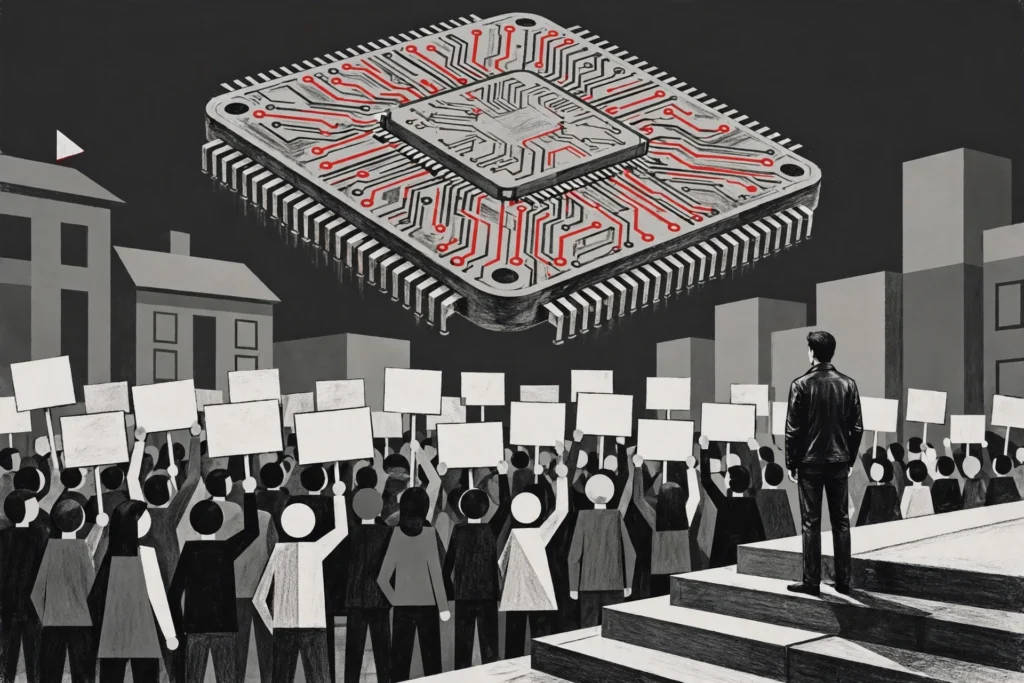
The campaign is called “Bring Jensen Back”. Its target is Nvidia’s board. Its message is simple: the man who built the AI chip empire should be allowed to defend himself — and then return to the job he held for more than three decades.
Whether the board is listening is another question entirely.
The “Bring Jensen Back” petition gathers speed
The open letter at the heart of the campaign asks Nvidia’s board to reinstate Jensen Huang while an independent investigation establishes the facts behind his departure, according to Le Temps, which first reported the scale of the petition on Monday.
More than 157,000 people had signed by the time the Swiss newspaper published its report. The number had already passed 132,000 by Sunday, according to The New Indian Express, and it kept climbing through the weekend.
The signatures are not only from outsiders. More than 7,500 signatories say they are Nvidia employees — roughly 18 percent of the company’s entire workforce. That is an extraordinary figure for an internal campaign about a chief executive who resigned in disgrace less than a week earlier.
The names at the top of the list are just as striking. Alongside Musk, Epic Games chief executive Tim Sweeney and Y Combinator president Garry Tan have publicly backed the call for Huang’s return. Musk went further on Saturday, warning that some “critical deals will be lost” without Huang at the helm.
Silicon Valley assembles a war room for Jensen Huang
Behind the petition sits something more organised. The Financial Times reported on Sunday that Huang’s allies have assembled a “war room” of technology executives to lobby Nvidia’s board for his reinstatement.
According to the report, Huang himself has discussed the possibility of returning with people close to him, even as the board conducts its own independent investigation into the circumstances of his departure. One supporter told the Financial Times that the war room would also seek backing from the White House.
“Everyone that matters in tech outside the frontier labs loves Jensen,” the ally said, adding that Huang supported the effort.
The campaign has heavyweight financial backing too. Altimeter Capital founder Brad Gerstner and Atreides Management chief Gavin Baker have already urged the board in an open letter to keep the door open to Huang’s return, citing the uncertainty hanging over the company after his sudden departure.
His supporters argue that no successor can replace that institutional knowledge overnight, least of all in the middle of an export-control investigation, a congressional inquiry and a quarterly earnings report.
Washington wants a clean break instead
If Silicon Valley wants Huang back, Washington is pushing in the opposite direction — and it is pushing hard.
US Treasury Secretary Scott Bessent appeared on Fox News’ Sunday Morning Futures, three days after Huang’s exit, and called for a “dramatic shake-up” at Nvidia. He urged the board to look outside the company for its next chief executive.
Bessent also set a deadline. Nvidia, he said, must clarify within the next 10 days whether it knowingly allowed shell companies to circumvent US export restrictions and supply China with its most advanced AI processors. The company must also share the findings of its internal investigation into Huang’s conduct.
It was the sharpest public intervention yet from a senior member of the Trump administration, and it landed on the same weekend as the comeback campaign’s biggest push.
What a Jensen Huang return would actually take
For all the momentum behind the campaign, the obstacles to Huang’s return are formidable — starting with the structure of the company itself.
Unlike the founders of some other technology giants, Huang does not hold a controlling stake in Nvidia. He cannot override the board’s decisions, and the board is under no obligation to follow a petition, however large.
The board has already begun exploring succession options. Arm chief executive Rene Haas has been approached as a potential replacement, according to the Financial Times, and Nvidia’s November 12 announcement said the search would consider both internal and external candidates.
The company is currently being steered by interim chief executive Colette Kress, who is also Nvidia’s chief financial officer. She takes the helm at a brutal moment: Nvidia reports its latest quarterly earnings on Tuesday.
Then there is the investigation itself. The board’s independent inquiry into the circumstances of Huang’s departure is still running, and its findings could settle the question one way or the other.
The petition asks the board to bring Huang back while that investigation runs its course — a request the board has so far shown no sign of granting.
The scandal that ended a 32-year reign
Huang resigned on November 12, days after reports emerged of extramarital affairs — one with a subordinate, and another with a businesswoman suspected of links to Chinese intelligence.
The personal scandal arrived on top of a far larger one. Megaspeed, a Singapore-based company, is accused of funnelling billions of dollars’ worth of Nvidia’s most advanced AI chips into China in breach of US export controls.
The affair allegations and the chip-smuggling claims have fused into a single crisis that now involves the Justice Department, Congress and multiple foreign governments.
Huang has agreed to testify before Congress. House committee chairs have required him for a closed-door transcribed interview on December 1, with Nvidia’s general counsel Tim Teter due the following day. The Senate Banking Committee has requested his testimony on December 3.
Fresh allegations keep surfacing. Taiwanese prosecutors have accused an Nvidia employee of helping to smuggle AI chips into China, and Nvidia has appealed to Taiwanese officials over the case, according to Bloomberg. Malaysia is separately probing whether Megaspeed re-exported Nvidia hardware through its territory.
No charges have been brought against Huang himself, and Beijing has denied the espionage claims.
What happens next in the fight for Nvidia
The next 48 hours will tell the campaign how much leverage it really has.
Nvidia’s earnings on Tuesday are the first test. Interim chief executive Kress will have to reassure investors, customers and suppliers that the company can function without the founder who defined it — while the petition to bring him back passes 160,000 signatures and counting.
Thursday brings another milestone, though not Nvidia’s own: Anthropic, one of the AI labs that buys Nvidia’s chips in vast quantities, is expected to begin trading on the stock market at a valuation of roughly $1.33 trillion.
Then comes Bessent’s 10-day deadline. Whatever Nvidia tells the Treasury about its export controls — and whatever its internal investigation concludes about Huang — will shape whether Washington treats the company as a victim of a rogue scheme or a participant in one.
For now, the “Bring Jensen Back” campaign has achieved something remarkable: it has made the return of a disgraced chief executive a serious public debate, backed by the richest man in the world and nearly a fifth of Nvidia’s own workforce.
Whether a petition can overrule a board, an investigation and the Treasury Secretary is a different question — and the answer will arrive sooner than anyone at Nvidia would like.