

Future Tech

RIP ChromeOS? Here’s Why It Will Stay Until 2034
Future Tech, Laptops & PCs, News

RIP ChromeOS? Here’s Why It Will Stay Until 2034

Introduction to ChromeOS and Its Legacy ChromeOS has been a significant player in the laptop industry, especially in education. Launched in 2011, the OS provided a lightweight, secure platform for students and professionals. Over the years, it gained a loyal following, even though it never overtook Windows or macOS. Now, with Google planning Aluminum OS, the future of ChromeOS is a hot topic. Google’s Aluminum OS and the Timeline Google is currently developing Aluminum OS, a combined platform merging Android and ChromeOS. According to court documents, this new OS is expected to roll out fully by 2028. The transition will not immediately replace ChromeOS, as many older devices may not support Aluminum OS. Therefore, ChromeOS will continue receiving updates for existing devices. ChromeOS 10-Year Support Commitment One of the biggest reasons ChromeOS will remain is Google’s 10-year update commitment. All Chromebooks are guaranteed a decade of support from their launch date. For instance, devices released in 2024 will still receive updates until 2034. This ensures security and stability, which is particularly important in educational institutions and businesses. Security Implications for Chromebook Users Security is a critical factor for ChromeOS longevity. Without updates, devices risk vulnerabilities, as seen with Windows 10 after support ended. By continuing ChromeOS updates, Google protects users from malware and exploits. Students, educators, and professionals can safely rely on Chromebooks for years to come. ChromeOS in Education and Workspaces ChromeOS laptops have found their niche in classrooms and offices. Their lightweight design, long battery life, and easy-to-manage interface make them ideal for daily use. While Aluminum OS promises to expand functionality, ChromeOS’s simplicity ensures that existing users remain productive. The OS is particularly effective for cloud-based work environments. Compatibility Concerns with Aluminum OS Not all Chromebooks will be compatible with Aluminum OS. Older devices may lack hardware support, which means Google must maintain ChromeOS updates until 2034. This dual-system period ensures users are not forced to upgrade hardware prematurely. It also allows a smooth transition without compromising functionality or security. Market Position of ChromeOS Although ChromeOS is not as mainstream as Windows or macOS, it holds a steady market share. Its affordability and ease of use make it appealing to education systems worldwide. Even with Aluminum OS on the horizon, ChromeOS devices will continue serving students and professionals who need a reliable, low-maintenance computing experience. Court Documents Reveal ChromeOS Lifespan Recent court filings show Google is legally bound to maintain ChromeOS support until at least 2033. This means that even with Aluminum OS’s release in 2028, ChromeOS updates will continue for another six years. The timeline to fully phase out ChromeOS is now projected for 2034. Users can expect a seamless experience without sudden loss of service. Implications for Businesses and IT Departments Businesses relying on Chromebooks can plan for long-term support. IT departments benefit from predictable update schedules, reducing security risks. Organizations can implement new technologies gradually without worrying about unsupported devices. ChromeOS’s stability ensures minimal disruption in professional and educational settings. The Future of ChromeOS vs Aluminum OS Aluminum OS promises a unified experience across Android and Chromebook devices. However, ChromeOS will remain crucial for older devices and secure environments. The coexistence period will allow Google to refine Aluminum OS while still honoring its support commitments. This hybrid approach keeps users safe and productive. Conclusion ChromeOS is far from being discontinued. With 10-year update guarantees, security concerns, and hardware limitations for Aluminum OS, ChromeOS will remain in use until 2034. Users can confidently continue relying on their Chromebooks, knowing Google is committed to maintaining updates and support.

RIP ChromeOS? Here’s Why It Will Stay Until 2034 Read Post »
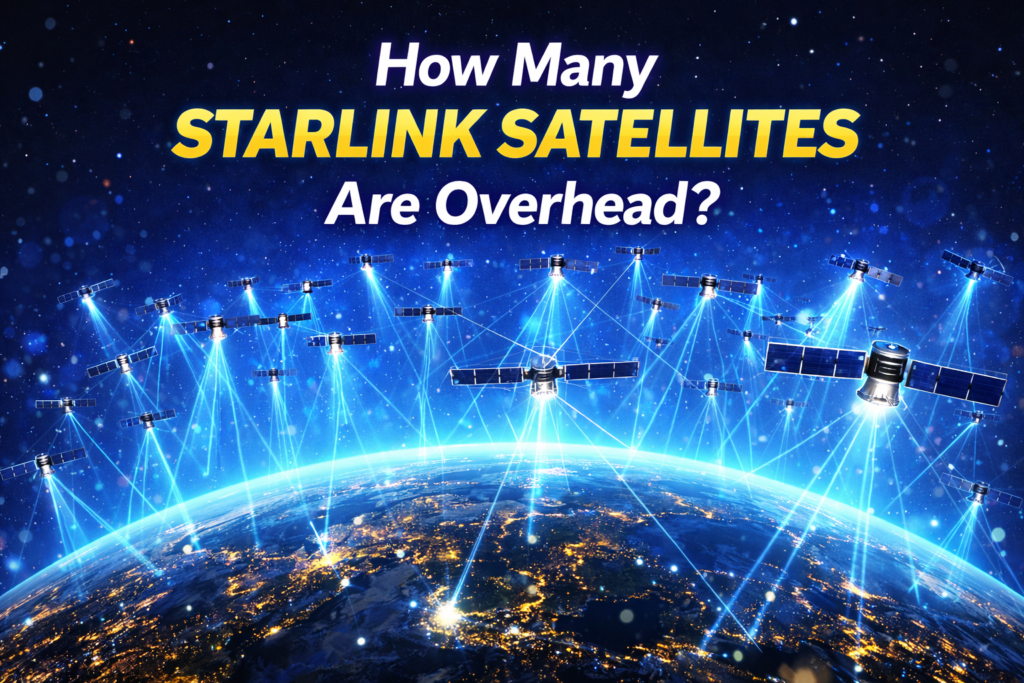
Starlink Satellites Overhead
Future Tech, Internet & Apps, News

Starlink Satellites Overhead: How Many Are Flying Above You Right Now?

Starlink has become one of the most talked-about satellite constellations in the world. With thousands of satellites orbiting the Earth, the network promises high-speed internet access even in the most remote regions. For consumers and enthusiasts, a common question arises: how many Starlink satellites are overhead at any given time? The answer depends on your location, time of day, and the orbital paths of the satellites. The current Starlink constellation comprises nearly 10,000 satellites, with around 8,300 operational in orbit. SpaceX plans to expand this number dramatically, potentially reaching a million satellites in the future. This ambitious expansion aims to enhance global connectivity, enable satellite-to-phone communication, and provide internet access to underserved regions worldwide. Understanding Starlink Satellite Coverage The visibility of Starlink satellites depends heavily on your geographic location. For example, in Redmond, Washington, simulations show that between 24 and 42 satellites regularly pass overhead. In lower-latitude regions like Fort Lauderdale, Florida, this number may range from 17 to 36 satellites. These satellites beam high-speed internet signals to users on the ground, even in areas where traditional broadband is unavailable. SpaceX’s Starlink satellites orbit at altitudes ranging from 340 kilometers to over 550 kilometers. Each satellite can be visible for a short window of time, typically lasting between 1.6 to 4 minutes, depending on elevation and orbit. The number of satellites in view can also increase as SpaceX deploys additional satellites approved by the US Federal Communications Commission (FCC). How Starlink Satellites Provide Internet Access Each Starlink satellite functions as a relay, transmitting data between users and ground stations. By creating a dense network of satellites, SpaceX ensures overlapping coverage, allowing for continuous internet access even when individual satellites move out of sight. Currently, Starlink offers internet service to rural and remote areas, as well as critical locations in war zones like Ukraine. SpaceX has also introduced direct-to-cell satellite designs, which can connect directly to smartphones without traditional ground hardware. These satellites are particularly useful for emergency communications, disaster relief, and regions with limited infrastructure. The evolving constellation highlights how satellite internet is transforming global connectivity. Tracking Starlink Satellites Overhead For enthusiasts and users, tracking the Starlink constellation has become an intriguing activity. Tools like NCAT and Satellitemap.space provide real-time visualization of satellites above your location. Using these platforms, users can simulate the movement of satellites across the sky, giving insight into when they are in view and how long they remain observable. Observing Starlink satellites can be challenging, as they are often dim compared to brighter celestial objects like the International Space Station. Some newer satellite models use reflective coatings or mirror films to reduce brightness, minimizing light pollution for astronomers while maintaining visibility for users. The Starlink Satellite Mega-Constellation SpaceX has regulatory approval to launch an additional 7,500 Starlink satellites, which would bring the total operational satellites to nearly 19,400. Beyond that, the company plans a futuristic orbiting data center system, deploying up to one million satellites. These satellites are designed to run AI applications, connect via laser links, and route data globally. The expansion will improve internet speeds, reduce latency, and increase coverage, particularly in areas with limited terrestrial internet infrastructure. However, the growth of the constellation also raises concerns about orbital congestion, potential collisions, and space debris management. Starlink Satellites and Night Sky Observations Astronomers and astrophotographers have raised concerns regarding the impact of Starlink satellites on night sky observations. While the satellites provide significant connectivity benefits, they can interfere with astronomical imaging due to their reflective surfaces. SpaceX has taken steps to mitigate these effects by darkening satellite exteriors and adjusting orbits to reduce visibility during critical observation times. Night sky enthusiasts note that Starlink satellites are usually more visible to camera lenses than to the naked eye. The “Starlink train,” a series of satellites moving in a line during deployment, is often the most noticeable phenomenon. Despite these challenges, satellite tracking apps allow users to enjoy observing Starlink satellites without compromising scientific or recreational activities. Starlink Satellites in Action: Real-World Use Cases Starlink satellites have become vital in areas where conventional internet is unreliable. In Ukraine, they have supported communication during wartime. In Iran, citizens use the service to bypass government restrictions and remain online. The number of satellites passing overhead at any given time can vary, with some regions seeing up to 55 satellites in view. Beyond emergency scenarios, Starlink enables remote work, online education, and digital nomad lifestyles. With consistent in-orbit coverage, users can maintain connectivity in remote forests, deserts, and mountainous regions, effectively bridging the digital divide. Safety and Collision Concerns The rapid expansion of Starlink satellites has prompted discussions about orbital safety. As more private and government-operated mega-constellations are launched, the risk of collisions grows. SpaceX has equipped its satellites with thrusters to maneuver away from potential collisions, and they perform thousands of propulsive maneuvers annually to maintain safe orbits. Experts warn that with a million satellites in low Earth orbit, even a low failure rate could generate thousands of defunct satellites, adding to the space debris problem. To address this, SpaceX is developing Stargaze, a space traffic management system to monitor and avoid collisions. The Future of Starlink Satellites The future of Starlink promises a blend of technological innovation and operational challenges. As SpaceX continues to expand its constellation, internet speeds will improve, connectivity will reach new frontiers, and AI applications will become more integrated. Simultaneously, regulatory oversight, collision mitigation, and light pollution concerns will require careful management. For users tracking Starlink satellites overhead, the expanding constellation represents both a marvel of engineering and a glimpse into a connected future. Satellite internet is no longer a novelty; it is an integral component of global digital infrastructure. Conclusion: Starlink Satellites Overhead and Global Connectivity Starlink satellites overhead are reshaping the way we connect to the internet. With thousands of satellites currently in orbit and plans for a mega-constellation of up to one million, SpaceX is bridging gaps in connectivity, supporting emergency communications, and offering unprecedented access to high-speed internet. […]

Starlink Satellites Overhead: How Many Are Flying Above You Right Now? Read Post »

What Is the Reality of Starlink Mini on the Road
Future Tech, Gadgets & Reviews, How-To

Starlink Mini Review: What Is the Reality of Starlink Mini on the Road?

The Starlink Mini has quickly become a must-have for travelers, digital nomads, and tech enthusiasts. Unlike traditional home satellite dishes, the Starlink Mini is portable, compact, and designed for on-the-go internet access. For those planning long drives or road trips in areas with poor cell service, it promises uninterrupted connectivity. But how does it perform in real-world conditions, and what is the reality of Starlink Mini? Starlink Mini Overview: Portable Satellite Internet Solution The Starlink Mini is a smaller, portable version of the full Starlink satellite system. It allows users to set up high-speed internet in areas where mobile networks fail. The device is lightweight, fits into a backpack, and can run on multiple power sources. This versatility makes it ideal for road trips, remote outdoor adventures, or mobile offices. Setting Up the Starlink Mini for Road Trips Proper setup is crucial to maximize the benefits of Starlink Mini. Most users employ a vehicle rooftop mount, such as the Trio Mini Speed Mount or SavageUTV Mini Mount, for stability during motion. Powering the device through a 12V adapter or battery pack ensures continuous internet without relying on a fixed power outlet. Accessories like window pass-throughs prevent wind noise and secure cables, making the Starlink Mini truly travel-ready. In-Motion Internet Performance: Does It Really Work? One of the standout features of the Starlink Mini is its in-motion internet capability. During long drives, the device maintains high-speed connectivity, even in challenging environments such as canyons, forests, and mountainous terrain. Testing revealed speeds comparable to home fiber internet, enabling video calls, streaming, and work tasks without interruptions. This makes it ideal for families, remote workers, or anyone who needs reliable connectivity on the move. Starlink Mini Accessories: Enhancing Portability and Stability The Mini’s performance improves with key accessories. Magnetic mounts like the Trio Mini and SavageUTV mounts ensure the dish stays secure at high speeds. Battery adapters allow off-grid use, while pass-through window gaskets prevent noise and maintain safety. These additions are essential for achieving seamless connectivity during road trips or outdoor adventures. Power Solutions for Starlink Mini: Independence from Vehicle Battery Running the Starlink Mini from a car’s 12V outlet works, but it ties the device to the vehicle’s engine. For longer trips or stationary setups, independent power sources like portable batteries or tool batteries are recommended. Hot-swappable solutions enable continuous operation without interruptions, making the Starlink Mini perfect for digital nomads or extended road trips. Real-World Experience: Staying Connected in Remote Areas During a 246-mile road trip to Yellowstone National Park, the Starlink Mini maintained consistent connectivity through multiple states. Even when traditional cell service disappeared, the device allowed streaming, video calls, and online work. Families benefited from entertainment for children, while adults could remain productive, highlighting the Mini’s practical advantages beyond simple internet access. Security and Portability: Balancing Convenience and Safety Portability comes with responsibility. Magnetic mounts make it easy to remove and relocate the Starlink Mini, but this also creates a risk of theft during stops. Users should secure the device in vehicles or use lockable mounts for long-term setups. Understanding these considerations ensures a safer and more effective Starlink Mini experience. The Starlink Mini Advantage for Remote Workers For remote workers or digital nomads, the Starlink Mini is a game-changer. High-speed satellite internet eliminates location-based limitations, enabling work from virtually anywhere. Video conferencing, cloud storage access, and real-time collaboration are possible even in areas far from urban infrastructure. This capability highlights the reality of Starlink Mini as more than a novelty—it is a practical productivity tool. Entertainment on the Go: Keeping the Family Happy Families on long trips benefit greatly from Starlink Mini’s reliable connectivity. Children can watch shows and play online games, reducing the stress of long drives. Meanwhile, adults can manage work or leisure streaming simultaneously. This dual utility demonstrates the versatility of Starlink Mini for both work and personal use. Lessons Learned: What Road Testing Taught Us The Starlink Mini excels in maintaining consistent connectivity, but setup and planning are key. Proper mounting, secure cabling, and reliable power solutions enhance performance. The reality of Starlink Mini shows that it is not a plug-and-play device; it requires thought and preparation, but the payoff is unmatched freedom in remote connectivity. Final Verdict: What Is the Reality of Starlink Mini? After extensive testing, the reality of Starlink Mini is clear: it delivers portable, high-speed internet in areas where cellular networks fail. With the right accessories and planning, it supports work, entertainment, and family needs. While it requires some investment in mounts and power solutions, its performance on the road justifies the cost. For those who travel frequently or need reliable connectivity off-grid, Starlink Mini is an indispensable tool.

Starlink Mini Review: What Is the Reality of Starlink Mini on the Road? Read Post »

Scroll to Top