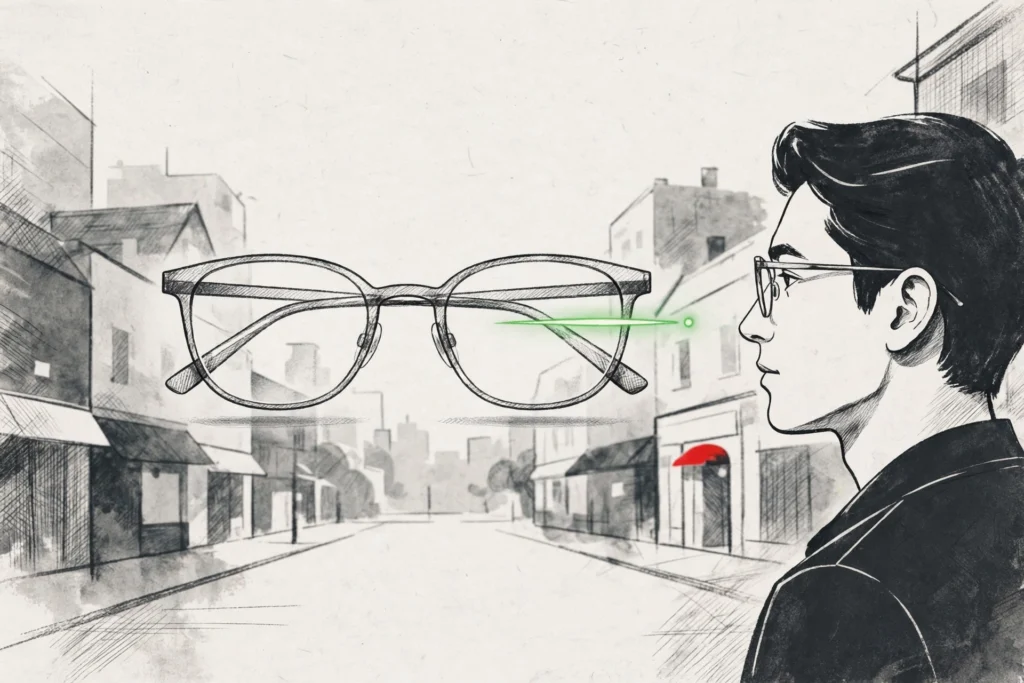
She is standing on a street she has never walked before, in a city whose language she does not speak. The sign above the shop is a mystery, and the menu in the window is even more so.
She does not reach for her phone. She just asks out loud — and the voice in her glasses answers, quietly, in her ear.
The sign says the shop closes at six. The dish on the menu is the one the locals order. That small, ordinary moment is the future Apple is building toward.
According to Bloomberg’s Mark Gurman, as reported by The Verge, Apple’s first smart glasses are finally coming together. The company is targeting an announcement at WWDC in June 2027, with shipments beginning before the end of that year.
The Apple smart glasses have been among the worst-kept secrets in the tech world for years. Now, for the first time, the plan has a shape: a launch window, a design direction, and a clear idea of what the glasses will — and will not — do.
What Apple’s Smart Glasses Will (and Won’t) Do
Let’s start with what the glasses are not. They are not augmented reality glasses. The first model will have no AR display, which means no floating windows, no holograms, and no digital overlays painted onto the world in front of you.
Instead, the glasses are built around cameras, microphones and speakers — and above all, around Siri. They watch and listen, and they talk back. You ask a question about what you are looking at, and Siri answers in your ear.
That puts Apple on the same road as Meta’s Ray-Ban glasses and Google’s Android XR eyewear, but with a different engine. Apple’s bet is that the new, rebuilt Siri — the one gaining fine-grained control over apps — is the feature that makes glasses worth wearing.
Siri AI Is the Whole Point
Everything about the glasses comes back to Siri. The revamped assistant is adding the ability to control specific features inside iPhone apps, and that work is the foundation of the whole project.
According to Gurman’s reporting, the glasses will use their cameras to answer questions about your surroundings. Point them at a building and ask what it is. Open the fridge and ask what to cook. Ask for directions, or have a foreign sign translated on the spot.
The idea is that you never open an app at all. You speak, Siri understands what you are looking at, and the answer arrives in your ear.
Apple is opening Siri AI to developers through App Intents — small hooks that let the assistant reach into an iPhone app and use one of its features, like booking a table or ordering a coffee.
Apple opened that door on November 3, when it gave all developers access to Siri AI in the iOS 27.3 betas. The timing is no accident. By the time the glasses arrive, developers will have had months to build the integrations the glasses depend on.
The N50 Prototypes: Thinner Than Ray-Bans
Inside Apple, the glasses carry the codename N50. The prototypes are running a pared-down version of visionOS, the operating system from the Vision Pro, on a processor based on Apple’s older smartwatch chips.
They are reportedly slightly thinner than Meta’s second-generation Ray-Ban glasses — a detail that matters, because nobody wants to wear a computer on their face. Style is one of the three things Apple is said to be emphasising, alongside privacy and audio quality.
The cameras sit in oval openings set flush into the frame, with a front light that shows when the glasses are in use or charging. Employees who have tested them describe the sound quality as industry-leading, with support for phone calls, music and FaceTime audio.
There is also a curious accessory in testing: a flat, rectangular magnetic charger, roughly the size of a Tic Tac, that can top up the glasses while you are still wearing them. Whether it makes it into the shipping product is still unclear.
No Apps on the Glasses — Your iPhone Does the Work
Here is the part that will surprise people who remember the Vision Pro. The glasses will not run apps. There is no App Store for them, and developers will not build software that lives on the frames.
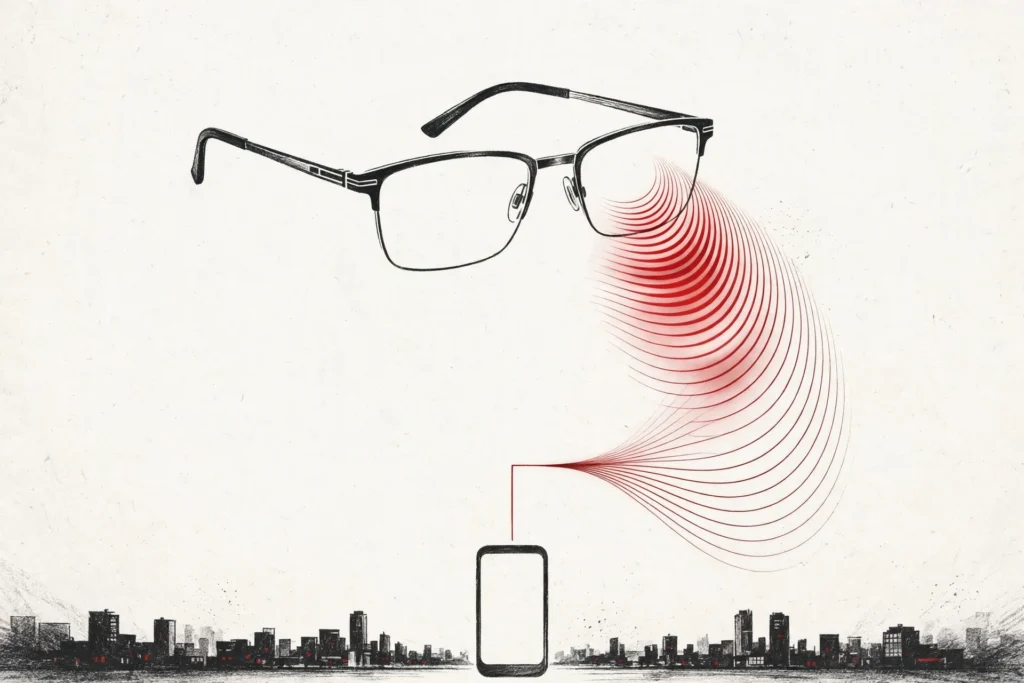
Instead, the heavy computing happens on a nearby iPhone. The glasses are, in effect, a set of eyes and ears for the phone in your pocket. That is the same architecture Google and Samsung have settled on for their own smart glasses — the app lives on the phone, and the glasses are the interface.
Wi-Fi gives the glasses a little independence. Certain functions that sit outside third-party apps, such as audio playback, keep working when the iPhone is not nearby. But they are not a standalone device, and they will need a recent iPhone to work at all. There is no Android support.
That dependence is a deliberate trade-off. By leaning on the iPhone, Apple keeps the glasses thin, light and cheap to build — and it keeps the experience inside the ecosystem it already controls.
Privacy, Sound and the Tic Tac Charger
Privacy is the second pillar of the pitch, and Apple knows it has to be. Glasses with cameras have a trust problem, and the company is reportedly planning to process environmental audio and visual sensor data locally, inside the Secure Enclave, in ways that avoid recoverable recordings.
The approach echoes Apple’s recent Audio Intelligence features, which analyse sound on the device rather than sending it to the cloud. The message is the same: the glasses can see and hear, but what they capture does not leave your face.
The front light on the frame is part of that promise. It tells the people around you when the cameras are active — a small, visible signal that Apple hopes will make the glasses socially acceptable in a way Google Glass never was.
And then there is the sound. Apple is putting unusual emphasis on audio quality, and the glasses are expected to handle calls, music and FaceTime audio as well as any earbuds. If the glasses are going to live on your face all day, they have to sound good doing it.
A Crowded Race Apple Is Joining Late
Apple is not first to this race, and it knows it. Meta’s Ray-Ban glasses are already in their second generation, and Samsung’s Intelligent Eyewear — built with Google and sold through Warby Parker and Gentle Monster — goes on sale this December, with prices starting at $395.
Even the small players are moving. AROTI’s R1 glasses, announced earlier this month, weigh just 27 grams and promise translation and meeting notes with no camera at all.
Apple’s answer is scale. It has the iPhone in hundreds of millions of pockets, a rebuilt Siri that developers are already learning to feed, and a brand that can make a new category feel normal.
The question is whether arriving in late 2027 is late enough to matter — or whether the ecosystem does the work that timing cannot.
There is also a risk Gurman flags openly: the software and AI work is running late, and it could push the 2027 plan back. The hardware, by most accounts, is largely settled. The software is the thing that could slip.
What Happens Next
The calendar, for now, has not moved. Apple is still aiming for a WWDC reveal in June 2027 and shipments before the end of the year, with the timetable described as a company goal rather than a firm commitment.
Between now and then, the work that matters most is not happening in a hardware lab. It is happening in the iOS 27.3 betas, where developers are building the Siri integrations the glasses will depend on. Every App Intent written for the iPhone this spring is, in effect, a feature for the glasses next year.
Watch the developers, then. If Siri integrations start appearing in the apps you already use, the glasses are on schedule. If they do not, the delay Gurman warns about may already be underway.
And if the plan holds, the woman on the unfamiliar street will not need to reach for her phone at all. She will just ask — and the glasses will answer.