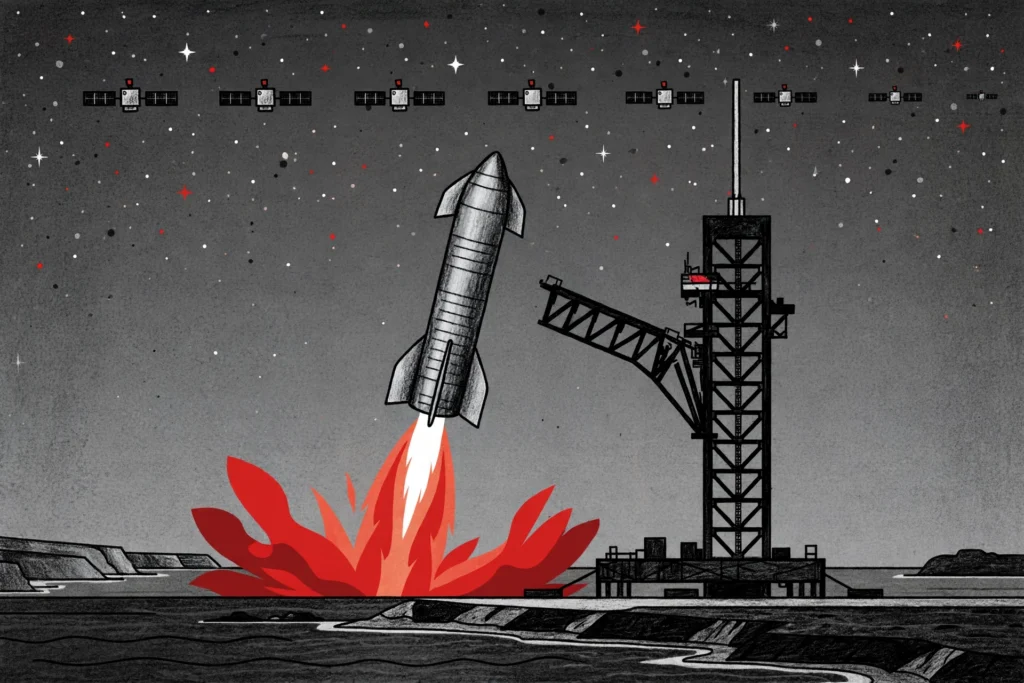
High above the Texas coast, two steel arms stood open against the evening sky. They had one job: catch the returning booster of Starship Flight 15 as it fell back to Earth. On Friday evening, the rocket never came home.
SpaceX’s Starship Flight 15 lifted off from Starbase, Texas, at 5:47 p.m. ET on November 13, carrying 26 next-generation Starlink V3 satellites. The launch itself was clean. What followed was a split result: the satellites reached orbit, but the Super Heavy booster missed its catch and came down in the Gulf.
It was a night of firsts and near-misses. The mission aimed to do something no rocket has ever done — recover both stages of an orbital launch vehicle. One half of that dream survived the evening. The other half is still circling the planet, waiting for its own turn.
What Starship Flight 15 Was Supposed to Do
Starship is the largest and most powerful rocket ever flown, standing 124 metres tall. SpaceX wants it to be fully reusable: the Super Heavy booster returns to the launch tower, and the Ship — the upper stage — does the same.
Flight 15 was the boldest test of that plan yet. About six and a half minutes after liftoff, the booster was meant to fly back to Starbase and settle into the tower’s catching arms. Then the Ship would deploy its satellites, circle the Earth, and return for a catch of its own.
No orbital rocket has ever been fully recovered. If both catches had worked, Friday would have been a landmark in spaceflight history. Instead, the mission delivered half a triumph and a reminder of how hard the second half is.
The stakes were visible even before liftoff. The launch window opened at 4:45 p.m. CT, and SpaceX had 75 minutes to get the rocket off the ground. A Federal Aviation Administration ground stop for an air traffic control issue briefly hung over the afternoon, but it did not stop the countdown.
The Booster Catch That Never Happened
The trouble came fast. Roughly seven minutes after liftoff, with the booster on its way back toward Starbase, SpaceX called off the catch. An unspecified issue had appeared, and the company chose not to risk the tower.
The booster was diverted out over the Gulf of Mexico, where it exploded, according to Ars Technica. Florida Today’s live coverage reported that the booster splashed down in the Gulf after the catch was aborted.
SpaceX had built the abort option into the plan from the start. The company said during its webcast that it would only attempt a catch if it was safe to do so. If anything looked wrong, either stage could be sent to splash down over water instead.
That caution is why the Ship carries the name it does. Ship 42 is dubbed “Don’t Panic”, a nod to the idea that a splashdown is always an acceptable outcome. On Friday, that philosophy was tested within minutes — and it held.
The missed catch was the first attempt at recovering the newest version of the Super Heavy booster. SpaceX has caught boosters before, but a tower catch had not been seen since Flight 8 back in March 2025. The gap shows how much of the programme has been focused elsewhere since then.
Starlink V3 Satellites Reach Orbit
While the booster was heading for the Gulf, the Ship was climbing. About 26 minutes into the flight, SpaceX polled its teams and gave the go-ahead to send the Ship into orbit. It became only the second Starship ever to reach orbit.
The first was Flight 14, which also deployed operating Starlink V3 satellites. Flight 15 was meant to repeat that success and add the double catch on top. The satellite half of the mission went almost exactly to plan.
At around 35 minutes into the flight, the Ship began deploying its cargo: 26 Starlink V3 internet satellites, released one by one through a narrow hatch in the lower part of the vehicle. The first satellite was out by 6:25 p.m. ET.
By 7:09 p.m. ET, SpaceX confirmed that all 26 satellites had been deployed and had made contact. Every one of them was in orbit and healthy, ready to use its onboard thrust to climb to its working altitude.
The V3 satellites are the next generation of Starlink‘s internet constellation. Once fully deployed, their solar arrays stretch 60 metres across — far larger than earlier Starlink spacecraft. They are built to carry far more data, and Starship is the only rocket big enough to carry 26 of them at once.
Ship 42’s Long Night in Orbit
After the deployment, Ship 42 settled into a long, quiet coast. The plan calls for it to circle the Earth 14 times over about 22 hours, giving SpaceX time to check the vehicle and its heat shield before the return.
The heat shield was a focus of this flight. SpaceX installed extra tile attachment mechanisms in the areas most at risk of losing tiles, and used curved tiles across much of the shield to cut down heating in the gaps between them.
Re-entry is the hardest part of the mission. The Ship must survive temperatures that melt most materials, then steer itself back to the tower with enough precision to be caught. That is why the catch attempt is scheduled for Saturday afternoon, not Friday night.
If all goes well, the Ship will return to Starbase at about 3:15 p.m. local Texas time on Saturday, November 14 — roughly 22 and a half hours after liftoff. If anything looks unsafe, SpaceX will send it to deorbit over the ocean instead.
Why the Double Catch Matters
Catching a rocket sounds like a stunt, but it is really about money. A rocket that lands on legs needs heavy landing gear, and one that splashes down needs refurbishment. A rocket caught by its launch tower can, in theory, be refuelled and flown again quickly.
That speed is what SpaceX is chasing. The company wants Starship to fly the way aeroplanes fly: land, refuel, and go again. Every part of the vehicle that survives a flight is a part that does not need to be built again.
The booster is the bigger prize in that equation. It is the largest part of the rocket, with 33 engines, and losing one on every flight would make the economics far harder. The catch on Friday was the first try with the newest booster design, and it did not work out.
The context is bigger than one flight. SpaceX is also building enormous AI computing campuses in Texas and Arizona, and Starlink is the backbone of its satellite business. Starship sits at the centre of both ambitions: it is the only vehicle that can launch the satellites and the hardware at the scale the company wants.
What Happens Next for Starship
The immediate question is the Ship. If Ship 42 is caught on Saturday afternoon, Flight 15 will still end as a major success — a satellite delivery plus a full orbital recovery of the upper stage. If it splashes down instead, the mission will be remembered for its satellites alone.
Either way, SpaceX will study the booster failure. The company has not said what the unspecified issue was, and it may take days before the cause is clear. What is clear is that the abort system worked as designed: the booster was steered away from the tower and the ground crew.
The longer story is geography. Starbase in Texas has been Starship’s only home, but Florida is coming. SpaceX says the launch tower at Kennedy Space Center’s Pad 39A will be ready to support a launch later this month, and its Gigabay is ready to receive its first Super Heavy booster.
Two more launch pads are under construction at Cape Canaveral’s Launch Complex 37, and the first Starship hardware is already being ferried from Texas to Florida by barge. The first Florida launch will come in the “very near future”, according to SpaceX.
The satellite race is crowded. Amazon’s Leo satellites flew on ULA’s Vulcan rocket just days ago, and Starship needs a fast launch pace to keep Starlink ahead. That pace depends on catching both stages.
Friday night ended with a rocket in the Gulf and a spacecraft circling overhead. By Saturday afternoon, SpaceX will know whether the second half of the dream held up. The satellites, at least, are already doing their job.
Source: Florida Today live coverage of Starship Flight 15, with additional reporting from Ars Technica.