Friday the 13th lived up to its reputation at Cape Canaveral. Fuel was already flowing into the rocket, the countdown was ticking toward a 12:54 p.m. liftoff, and a crowd of watchers had gathered along Florida’s Space Coast.
Then, about three hours before launch, the call came down: scrub. A power interruption at a nearby nitrogen plant had knocked out the high-pressure pumps feeding the rocket, and there was no way to fix it inside the window.
The rocket itself was fine. Its 40 satellites were fine. So the United Launch Alliance simply reset the clock. Today, Saturday, November 14, the Vulcan rocket gets its second chance — and this time, the stakes are bigger than a single launch.
When Vulcan lifts off from Space Launch Complex 41, it will end a nine-month grounding, carry the largest batch of Amazon Leo satellites ever flown, and kick off one of the biggest launch partnerships in the satellite broadband race.
Vulcan’s Long Road Back to the Pad
Vulcan has not flown since February 12, 2026. That day, the rocket was carrying a national security mission called USSF-87 when observers spotted sparks streaming from its nosecone during ascent.
The flight still reached orbit, but the United Launch Alliance, known as ULA, confirmed an anomaly in one of the rocket’s solid boosters. It was not the first such problem, either.
The same nozzle issue had shown up in October 2024, during only the second Vulcan flight. Two strikes on the same hardware were enough. ULA grounded the fleet and went back to the drawing board.
Engineers traced the trouble to the GEM-63XL solid rocket boosters, the strap-on motors that give Vulcan much of its lifting power. Fixing them meant months of testing, redesign and review before the rocket could be trusted with a payload again.
That work is now done. A launch readiness review on November 11 cleared the mission for flight, and ULA says the rocket and its spacecraft came through Friday’s scrub completely healthy.
For a rocket that has flown only four times since its debut in January 2024, every launch still matters. All four of those flights succeeded, but Vulcan has yet to prove it can fly the heavy, high-cadence schedule ULA has promised its customers.
The Biggest Amazon Leo Launch Yet
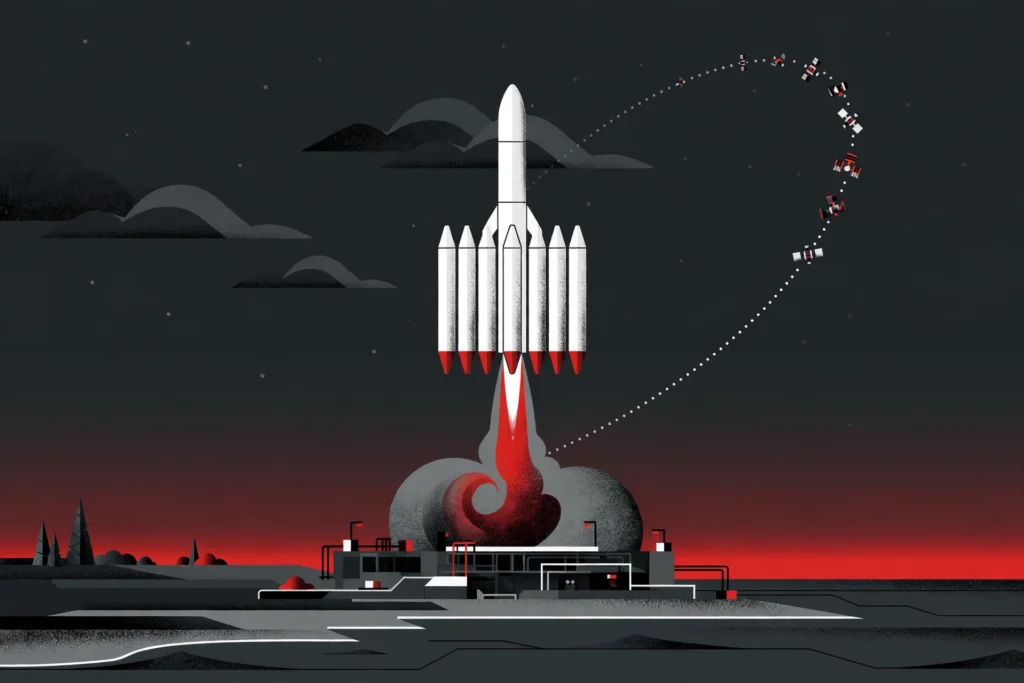
Saturday’s mission, called LV-01 or Leo Vulcan 1, will carry 40 Amazon Leo satellites into low Earth orbit. It is the largest batch of Leo satellites ever launched at once.
Once those 40 are deployed, the Amazon Leo constellation will number 432 satellites in orbit. As of early November, 368 of them were already in their operational orbits, with six having burned up on re-entry.
The mission is also the first of up to 38 Vulcan launches Amazon has booked with ULA. Across those flights, Vulcan is set to carry more than 1,500 first-generation Leo satellites — more than any other rocket in Amazon’s programme.
The satellites were prepared inside a brand-new building, the Amazon Vertical Integration Facility, known as VIF-A. It was built specifically to process Leo missions, and LV-01 is the first Vulcan to roll out of it.
The next mission is already taking shape. LV-02 is being prepared in a sister facility, VIF-G, and Amazon says it should launch within weeks of a successful LV-01.
A Rocket Built for Heavy Lifting
Saturday’s flight uses the most powerful version of Vulcan, the VC6L configuration. The rocket stands 65 metres tall — about 215 feet — and will fly with six solid rocket boosters strapped to its sides.
Two Blue Origin BE-4 engines power the first stage, burning liquid oxygen and methane. Together with the six boosters, they will produce about 17.2 meganewtons of thrust at liftoff, enough to carry up to 27,200 kilograms to low Earth orbit.
Above the first stage sits the Centaur V upper stage, tuned for low-orbit missions. After the boosters and the main stage fall away, Centaur will guide the satellite stack toward its destination.
The target is a circular parking orbit 450 kilometres above Earth, tilted 51.9 degrees to the equator. The satellites will separate in 21 separate deployment events, the first about one hour and 17 minutes after liftoff.
The whole deployment sequence will take around 25 minutes and 40 seconds. From there, the satellites will drift to their final operating positions and join the growing constellation.
Amazon Leo vs Starlink: The Broadband Race Heats Up
Amazon Leo is Amazon’s answer to SpaceX’s Starlink, the satellite network that already beams internet to millions of customers around the world. Leo aims to do the same: deliver fast broadband from orbit, especially to places where ground-based internet is slow, expensive or simply absent.
The idea is not new. Satellite internet already works for travellers and remote homes today, as our Starlink Mini review shows. What Amazon is building is a rival network at the same scale, starting from almost nothing.
Amazon is years behind Starlink in orbit, and it knows it. The company has spent billions building satellites, ground stations and launch contracts, and its Federal Communications Commission licence comes with a deadline.
Amazon won an extension from the FCC in June this year, pushing back a requirement to have half of its constellation in orbit by July 30, 2026. The extension bought time, but the clock is still running.
That is why the Vulcan partnership matters so much. Thirty-eight launches is a huge commitment, and it gives Amazon a second heavy-lift workhorse alongside the other rockets in its fleet.
For ULA, the deal is just as important. Vulcan is the company’s flagship rocket, built to replace the retired Atlas V and Delta IV. A steady stream of Leo missions gives it the regular flight rate it needs to prove itself.
According to NASASpaceFlight, the mission also doubles as a certification flight for this Vulcan configuration with the US Space Force. A clean flight would open the door to more national security launches.
How to Watch the Vulcan Launch
The launch window opens at 12:32 p.m. Eastern Time on Saturday, November 14, and closes 29 minutes later at 1:01 p.m. That is 5:32 p.m. in London and 10:32 p.m. in Pakistan.
ULA will stream the launch live on YouTube, with coverage starting about 20 minutes before the window opens. Florida Today will also carry live updates from the Space Coast.
People across central Florida should be able to see the rocket climb into the sky a few minutes after liftoff. The flight path takes it northeast over the Atlantic, and on a clear day the six boosters make for a bright, noisy spectacle.
If the weather or a technical issue forces another delay, ULA has backup opportunities in the days ahead. But after Friday’s scrub, the team will be keen to get this one off the ground.
What Happens Next
If LV-01 flies cleanly, the pace should pick up fast. Amazon says LV-02 will follow within weeks, and the VIF-A facility was designed to turn missions around quickly.
For Vulcan, success would close the book on a difficult nine months. The rocket’s booster problem is fixed, its biggest customer is waiting, and its launch manifest is full.
For Amazon, it would be another step toward a constellation that can finally compete with Starlink. Forty satellites at a time, the gap is closing.
And for everyone watching from Florida’s beaches and rooftops, it is a reminder of what a Saturday afternoon at the Space Coast is for: a 65-metre rocket, six boosters, and a sky full of new satellites.