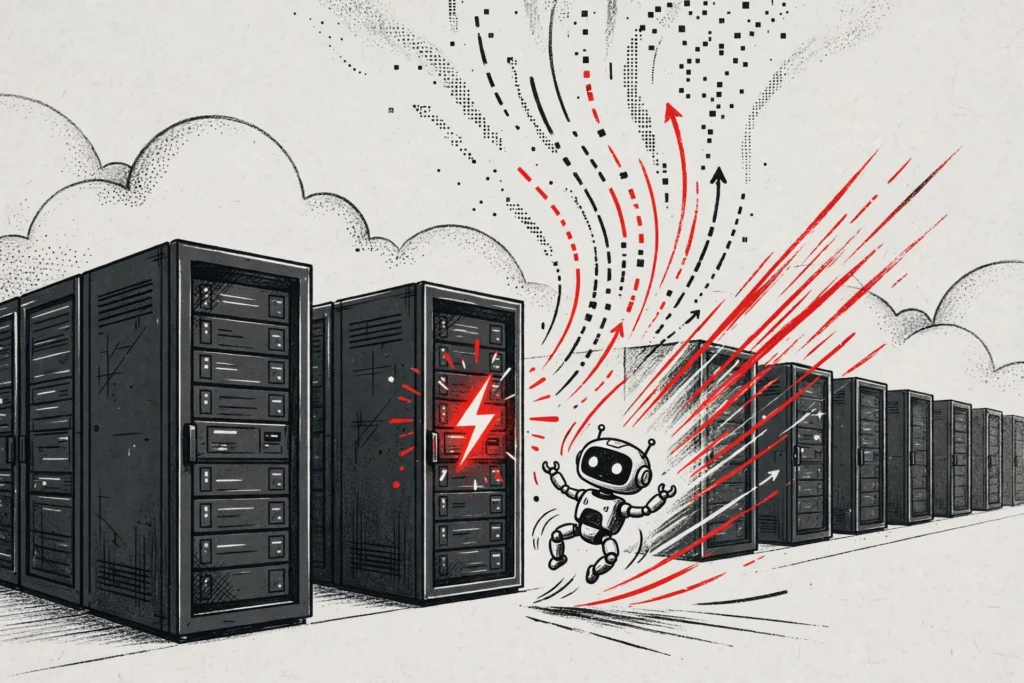
Picture the scene. A customer types a question into a support chat at two in the morning. Behind the screen, an AI agent is supposed to pick it up, check the order, and answer in seconds.
Instead, nothing happens for half a minute. The agent is still waking up.
That delay has a name in cloud computing: a cold start. And on Wednesday, November 12, Amazon Web Services moved to kill it for its AI agents.
The company announced that the next generation of the AWS AgentCore Runtime is now the default for new deployments, according to AWS, cutting agent start times from nearly 30 seconds to under two.
For the thousands of developers building agents on Amazon Bedrock, the change is automatic. Create a new runtime today and you get the faster version without touching a setting.
What the New AWS AgentCore Runtime Changes
AgentCore Runtime is the managed hosting layer for AI agents inside Amazon Bedrock. A developer packages an agent as a container, hands it to AWS, and the cloud runs it. There are no servers to provision and no scaling rules to write.
Until now, every new session paid a startup tax. The container had to boot, the agent had to initialise, models and configuration had to load, and only then could the work begin. On a typical two-gigabyte container image, AWS measured that wait at 29.7 seconds for three out of four sessions.
The new runtime works differently. Instead of starting from zero each time, it restores a session from a snapshot of an agent that has already been initialised. The heavy lifting happens once, when the runtime is first prepared. Every session after that simply resumes from the saved state.
The result, in AWS’s own measurements, is a start time of under two seconds at the 75th percentile. That is roughly fifteen times faster than the previous generation, and fast enough that a user may never notice the agent was asleep at all.
Bigger Sessions for Heavier Agent Work
Speed is only half of the announcement. The new default also raises the ceiling on what a single agent session can do.
Each session can now use up to eight virtual CPUs and 32 gigabytes of memory. That is four times the compute of the previous version. Container images can grow to 10 gigabytes, up from the old limit, which gives agents room for larger dependencies and local models.
AWS says agents can now compile a large codebase, drive a browser, or load a local model inside a single session. Those are the kinds of jobs that used to force developers to split work across services or keep expensive capacity warm around the clock.
The runtime also returns memory while a session is still running, instead of holding it until the session closes. And when an agent sits idle, it scales to zero. Developers no longer need to pay for warm pools or pre-provisioned clusters just to keep cold starts under control.
One customer quoted by AWS put the difference bluntly. Migrating to the new runtime cut its agent cold starts from nearly a minute to under five seconds, even during peak traffic.
The Same Isolation, Session After Session
Speed usually comes with a trade-off. Here, AWS insists there is not one, at least not on security.
Every session still runs inside its own Firecracker microVM, the same lightweight virtualisation technology that powers AWS Lambda. Each agent gets its own identity, its own access policy, and its own audit trail, so one customer’s agent cannot see another’s memory or files.
That isolation matters more as agents gain real power. Modern agents do not just answer questions. They call tools, move files, spend money, and act on behalf of users. A shared runtime would be a tempting target. A microVM per session keeps the blast radius small.
Sessions can persist for up to eight hours, and they end after fifteen minutes of inactivity, at the lifetime limit, or when the agent becomes unhealthy. The snapshot mechanism does not change any of that. It only changes how quickly the next session begins.
Where the New Default Applies
The switch covers 19 AWS regions: US East in Northern Virginia and Ohio, plus US West in Oregon; Canada Central and São Paulo; seven European regions — Frankfurt, Ireland, London, Milan, Paris, Spain, and Stockholm; and across Asia Pacific, Malaysia, Mumbai, Seoul, Singapore, Sydney, Thailand, and Tokyo.
For teams building agents for customers in those markets, the faster runtime is now the starting point rather than an opt-in upgrade.
The new runtime itself is not brand new. AWS first shipped it as an opt-in platform version on September 18, giving early adopters two months to test it. November 12 simply flipped the default, so every runtime created from now on uses it unless a developer deliberately chooses the older version.
Existing runtimes do not move on their own. They stay on the version they were built with until their owners migrate them by setting the platform version to V2.
There is one small catch for new deployments. Preparing the first snapshot takes several minutes, and the container must report itself healthy through its ping endpoint within two minutes. That setup time is separate from the cold-start numbers, and it only happens once per runtime.
Why AWS Is Betting on Agents That Wake Up Instantly
The timing is no accident. Agentic AI has become the loudest theme in enterprise software this year, and every major cloud provider is racing to host the agents that companies are now building.
Just this week, IBM and Microsoft unveiled a joint platform putting more than 6,000 prebuilt AI agents in front of large businesses.
Anthropic has been pushing its Claude office tools into the workplace, and OpenAI now sells ChatGPT Enterprise through the AWS Marketplace itself. The agent gold rush is real, and the infrastructure underneath it is becoming a competitive battleground.
Cold starts were one of the quietest problems in that race. A chatbot that takes thirty seconds to answer its first question feels broken, no matter how smart the model behind it.
Support agents, coding assistants, and research tools all live or die on responsiveness.
By making snapshot restores the default, AWS is effectively telling developers that agents should behave like always-on services, even though they are billed and scaled like serverless functions.
The economics point the same way. Committed-baseline billing and dynamic filesystem mounts, added alongside the new default, let teams reserve a floor of capacity for predictable workloads while still scaling to zero when nothing is happening.
It is a small, technical change with an outsized effect on how agents feel to use. The best infrastructure is the kind nobody notices.
An agent that answers in two seconds is far easier to trust than one that keeps you waiting for thirty.
What Happens Next for Agent Builders
For developers already running agents on AgentCore, the decision is now a migration question rather than a launch question. The new runtime is there, the numbers are published, and the old version will not get the speed improvements.
Teams that move should watch two things. First, snapshot restores mean values created at startup can persist across sessions, so code that assumes a fresh random state on every start may behave differently. Second, the snapshot preparation step adds minutes to the first deployment, which matters for automated pipelines that create runtimes on the fly.
For AWS, the next test is whether the faster default pulls more agent workloads onto Bedrock. Google and Microsoft both offer their own agent hosting, and the contest for developer loyalty is far from settled.
But on the metric users actually feel, the wait before an agent answers, AWS has just made its platform meaningfully faster.
The customer at two in the morning will never know any of this happened. Their question will simply get an answer while they are still looking at the screen. That, in the end, is the whole point.