Picture the scene. A steel spacecraft, fifty metres tall, drops out of the Texas sky after a full day in orbit.
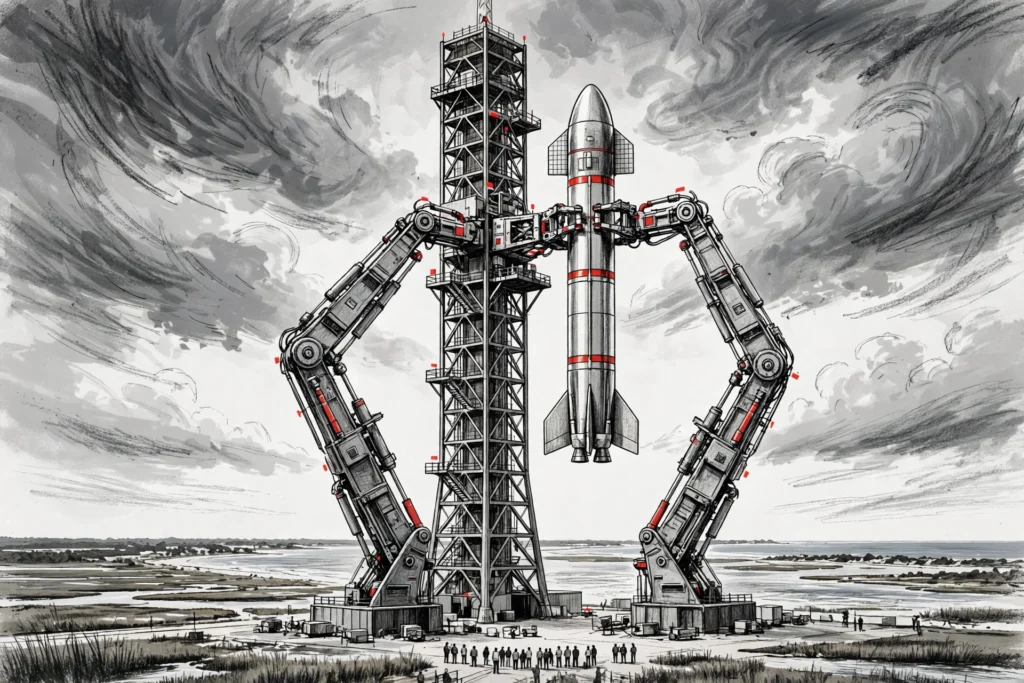
It is falling fast — faster than sound — and below it waits a launch tower with two giant steel arms held open. In the final seconds, the ship flips upright, fires its engines, and slows to a hover.
Then, instead of landing on legs, it simply stops. The arms close around it, and the spacecraft hangs in mid-air, caught like a ball in a glove.
That is what happened at Starbase on Saturday, November 14, when SpaceX caught Starship Ship 42 in the tower’s arms. No spacecraft returning from orbit has ever been caught like this before.
Starship Ship 42 Completes a 22-Hour Flight
The mission began the day before. Starship Flight 15 lifted off from Orbital Launch Pad 2 at Starbase, Texas, at 22:47 UTC on Friday, November 13 — 4:47 p.m. local time.
It was the fifteenth Starship test flight, and only the second operational one. The plan was bold: catch both stages — the Super Heavy booster and the ship itself — back at the launch site.
Ship 42, a Block 3 Starship nicknamed “Don’t Panic”, reached orbit about 27 minutes after liftoff. The name is a nod to Douglas Adams, whose book The Hitchhiker’s Guide to the Galaxy made the number 42 famous.
Once in orbit, the ship deployed 26 Starlink V3 satellites over about 42 minutes, three of them carrying cameras to inspect its heat shield.
Then Ship 42 settled into a long coast. It circled the Earth roughly 14 times at about 276 kilometres, staying in orbit for more than 22 hours — a new record for the longest Starship flight.
The Booster Half of the Story Went Wrong
The mission was supposed to end with two catches. The first one did not happen.
About six and a half minutes after liftoff, the Super Heavy booster, Booster 22, was due to fly back and be caught by the same arms that later grabbed the ship.
Instead, the booster detected a problem with its guidance, navigation and control systems on the way down. It aborted the catch automatically and diverted offshore.
According to SpaceX, the booster also suffered engine underperformance and low fuel during its landing burn. It lost structural integrity shortly before reaching the water, and its flight termination system was activated.
A fireball erupted as the booster came down in the Gulf of Mexico. SpaceX spokesperson Dan Huot said on the webcast that the team did not yet know why it could not be brought back.
Booster 22 was the first Block 3 Super Heavy to attempt a tower catch; SpaceX had already caught three earlier boosters. But the booster was only half the mission.
Three Checkpoints Stood Between Ship 42 and the Tower
While the booster was falling into the Gulf, Ship 42 was still circling the planet, healthy and on schedule. The real test was still to come.
SpaceX had built three decision points into the ship’s long coast. Each one was a chance to call off the catch and send the ship to a safe splashdown instead.
The first check came about an hour and a half into the flight, near Hawaii. The second came more than seven hours in, near Chile. Both passed without drama.
The final check, also near Hawaii, came at just over 20 hours and 41 minutes into the flight. Only then did flight controllers commit to bringing the ship home to Starbase.
The caution was deliberate: the return path crossed populated areas in northern Mexico and southern Texas, and controllers could end the reentry early if anything went wrong. Residents near Starbase had been warned to expect sonic booms.
The Catch Itself Took Just Seconds
At about 21:35 UTC on Saturday, Ship 42 fired its engine for a short deorbit burn. The burn lasted only ten seconds, but it was enough to start the long fall home.
Reentry began at 22:10 UTC. The ship plunged through the atmosphere belly-first, its heat shield glowing, steering with its flaps as it bled off speed.
By 22:29 UTC it had gone transonic, then subsonic. The tower at Starbase was waiting, arms open, just as it had been for the booster the day before.
At 22:32 UTC the landing burn began. The ship flipped from horizontal to vertical, throttled from three engines down to two, then down to one.
Seconds later, at 21:20:03 UTC — 3:20 p.m. local time — the tower’s arms closed around it. Ship 42 was caught, upright, at Orbital Launch Pad 2.
The whole mission lasted 22 hours, 32 minutes and 32 seconds from liftoff to catch. It was the first successful upright landing of an upper-stage rocket after reaching orbit, and the first time any ship has been caught by a launch tower, according to the mission record.
Why Catching Starship Ship 42 Matters So Much
SpaceX has caught boosters before, but catching the ship is a different problem entirely. A booster comes back minutes after launch, from just above the atmosphere. A ship comes back after a day in orbit, at many times the speed, after surviving the heat of reentry.
That is why this catch matters. A fully reusable Starship — both stages caught, inspected, refuelled and flown again — is the whole point of the programme.
Throwing away the ship after every flight would keep costs high and flight rates low. Catching it means SpaceX can turn the vehicle around quickly, without legs, without a landing pad, and without hauling it back from the ocean.
It also matters for NASA. A version of Starship is the lander NASA has chosen to return astronauts to the Moon under the Artemis programme, and the same vehicle is central to Elon Musk’s plans for Mars — ambitions that depend on the same rapid-reuse economics driving SpaceX’s wider expansion.
Neither of those ambitions works if the ship cannot come home in one piece. On Saturday, for the first time, it did.
Musk Gave the Ship Catch Only 50-50 Odds
Even SpaceX did not treat this as a sure thing. In September, Musk estimated the chance of success on the first ship-catch attempt at “at least 50 or 60 percent”.
On October 29, he went further, saying Ship 42 would be the first ship caught by the tower. The prediction came true — but only after the booster half of the plan had already failed.
The ship had been rehearsed: in September it was lifted by the tower arms in a simulated catch, and in October it ran a six-engine static fire lasting more than 60 seconds. It rolled out to the launch site on November 12.
The Federal Aviation Administration issued the Flight 15 licence on launch day itself, November 13, including permission for both stages to return.
What Happens Next for Starship
The catch does not finish the job. SpaceX still needs to prove it can catch a Block 3 booster, after Booster 22’s failure, and then do both catches on the same flight.
That was the original goal of Flight 15: the first full recovery of an orbital launch system, with both stages caught at the same pad. The ship half is now proven; the booster half still waits, and engineers will want answers on its guidance issue and low fuel.
Meanwhile, SpaceX is preparing launch infrastructure in Florida, with a tower at Pad 39A ready later this month — the same kind of rapid expansion seen in ULA’s return to flight for Amazon’s Leo constellation.
Flight 16 will be the next chance to put the two halves together. If it succeeds, Starship becomes the first launch system in history to recover every part of itself from an orbital flight.
For now, though, the image that will last is the one from Saturday afternoon: a spacecraft the size of a building, hanging motionless in the arms of its own launch tower, after a day in space. As the ship’s own name puts it — don’t panic. It worked.