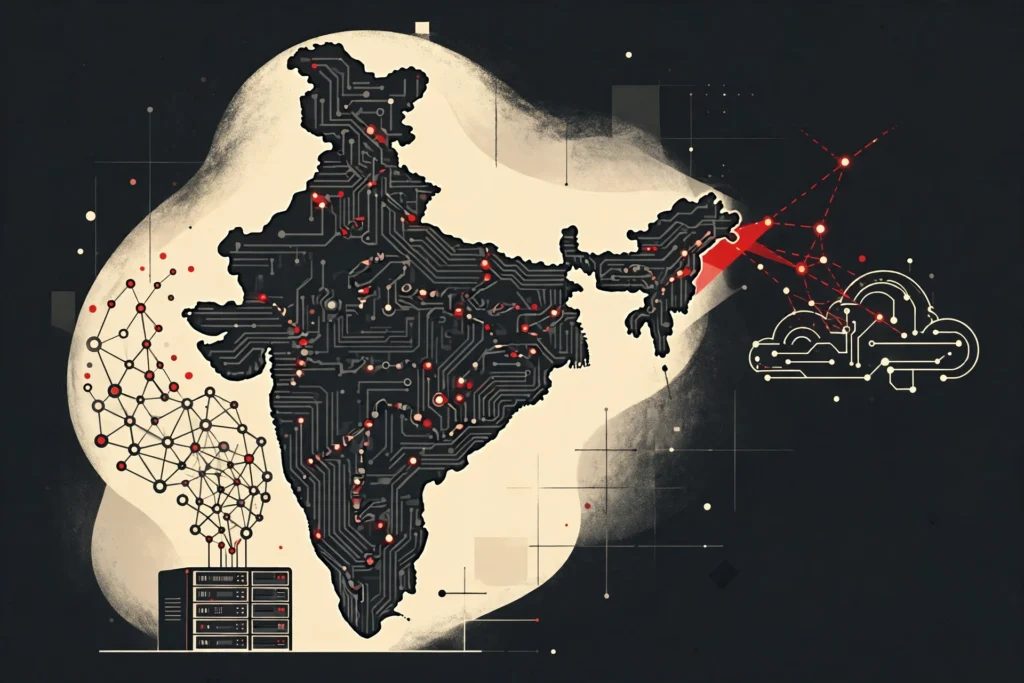
What OpenAI India Data Residency Actually Changes
Picture a compliance officer at a Mumbai bank, staring at a loan application that an AI assistant could summarise in seconds. The technology is ready. The lawyers are not.
The bank’s rules say customer data must stay inside India, and until this week, sending that application to OpenAI’s API meant it travelled overseas to be processed.
So the AI sat unused, and the officer kept reading by hand. OpenAI has now removed that roadblock. According to The Hindu, the company announced on Thursday, November 12, that supported API requests from India can be processed entirely inside the country, with the model doing its thinking on servers in India too.
The change covers the GPT-6 Luna model at launch, and it turns a storage promise into something much more useful: the data no longer has to leave India at all. Until now, OpenAI’s India data residency offer, which began in May 2025, covered where eligible customer content was stored.
That helped companies meet local rules about keeping records at home, but the actual work — the model reading a document and writing a reply — still happened elsewhere. The new step closes that gap.
Both the processing of a request and the computation that produces the answer now take place in India for supported workloads, and the content involved stays in the country as well.
For most ordinary users, nothing changes. This is not a consumer ChatGPT feature. It is aimed squarely at businesses and developers that build on OpenAI’s API, and at the regulated industries that have been waiting on the sidelines because of where their data is allowed to travel.
GPT-6 Luna First: What Runs in India — and What Does Not
The launch is deliberately narrow. At the start, only the GPT-6 Luna model can run inside India through OpenAI’s Responses and Chat Completions APIs, the two main ways developers send work to the model.
Those APIs accept text and image inputs and return text, which covers the everyday business tasks OpenAI keeps highlighting: summarising documents, drafting replies, and helping employees analyse information.
OpenAI’s hosted tools are not part of the deal for now, so developers cannot combine regional processing with the company’s built-in tooling. And the rollout applies to direct API use only.
It does not automatically extend to ChatGPT, to other GPT-6 models, or to the rest of OpenAI’s product line. ChatGPT’s workplace push is moving on a separate track, with the enterprise version now sold through Amazon’s AWS Marketplace.
A company that wants its customer data processed in India has to set it up deliberately: create a new API project, select India for both storage and processing, and send its requests through the India regional endpoint. That narrow scope is honest, and it matters.
A bank that assumes every OpenAI product now runs in India would be wrong. But for the specific workloads that qualify, the promise is complete — the request, the model’s thinking, and the stored content all stay put.
The Fine Print: Zero Data Retention and a 10% Premium
There is a gate on the door. According to OpenAI’s documentation, regional processing in India is available only to organisations with approved, active Zero Data Retention — a setting under which OpenAI does not keep the content of API requests for training or for later review.
A weaker setting, known as Modified Abuse Monitoring, is not enough.
Companies have to apply for Zero Data Retention and be approved before they can switch on the India option. There is also a price tag. The India region supports standard pay-as-you-go usage only, and OpenAI lists a 10 percent premium for GPT-6 Luna regional processing.
That means keeping the work inside India costs a little more than running the same request through OpenAI’s global infrastructure. For a small startup, the extra cost might sting.
For a bank or insurer that cannot legally send the data abroad at any price, it is simply the cost of being allowed in the door at all.
These conditions explain why OpenAI describes the launch as being for “eligible” businesses and developers. Eligibility is not just about where a company is based. It is about whether its data handling already meets OpenAI’s strictest retention standard, and whether it is willing to pay the premium for the privilege.
Why Banks and Fintech Firms Care Most
The financial sector is the obvious first audience. India’s central bank, the Reserve Bank of India, requires payment and financial data to be processed and stored locally, and those rules have kept many banks and fintech companies from putting customer documents through foreign AI services.
A loan file, a claim form, or a customer’s message to support is exactly the kind of sensitive material that regulators want kept at home. Nitin Bawankule, OpenAI’s head of enterprise in India, put the point plainly when the launch was announced.
Local inference, he said, gives businesses more control over where their supported workloads run and removes a practical barrier to adoption. It gives more companies a way to put OpenAI’s tools to work, and gives Indian developers and startups more scope to build for their own needs and for enterprise customers.
The logic reaches beyond finance. Healthcare providers, insurers, government contractors, and any company handling data that regulators or clients insist stays in India face the same question: where does this request actually go?
Until now, the honest answer was “outside India,” and that was enough to stop the project. Now, for one model and two APIs, the answer is different.
India, Australia and Japan: A Wider Residency Push
India is not getting this capability alone. OpenAI said the launch is part of a wider expansion of its API inference residency offering, with India, Australia, and Japan the latest markets to receive it. Inference residency already existed in other parts of the world, and the three new countries join that list together.
The pattern is easy to read. Governments around the world are writing data localisation rules, and the big AI companies are responding by building regional versions of their services rather than arguing with the rules. Google, Microsoft, and Amazon have all spent years opening local cloud regions for the same reason.
OpenAI, whose business began as a single global API, is now following the same path — one country, one model, one carefully controlled rollout at a time. That also explains why the company is starting with GPT-6 Luna rather than its whole catalogue.
Running a frontier model inside a country means placing real computing capacity there, and capacity is expensive. Starting with one model lets OpenAI test demand, learn how the regional setup behaves, and expand only where the business case holds up.
What Happens Next for OpenAI in India
The launch sits inside a bigger India push. Earlier this year, OpenAI introduced OpenAI for India, an initiative covering AI infrastructure, enterprise adoption, skills, and local partnerships.
As part of it, the company partnered with the Tata Group to develop domestic AI data centre capacity — the physical foundation that makes promises like in-country inference possible in the first place.
The obvious question now is what comes next. Will more models join GPT-6 Luna in India? Will the hosted tools follow? And will the premium shrink as more capacity comes online? OpenAI has not answered those questions yet, and it would be a mistake to assume the answers.
But the direction is clear: the company is treating data residency as a product feature, not a compliance chore, and India is one of the first places it is building that feature out.
It also fits a company moving fast on several fronts at once: OpenAI has been rolling out AI security tools for enterprises, while its enterprise business grows — the company reported about $10 billion in revenue in the third quarter of 2026. For the compliance officer in Mumbai, the change is concrete rather than abstract.
The loan application that once had to travel abroad can now be read, summarised, and answered by a model running inside India. The AI still does the work in seconds. The difference is that the data never leaves the country — and for the first time, the lawyers have nothing to object to.


