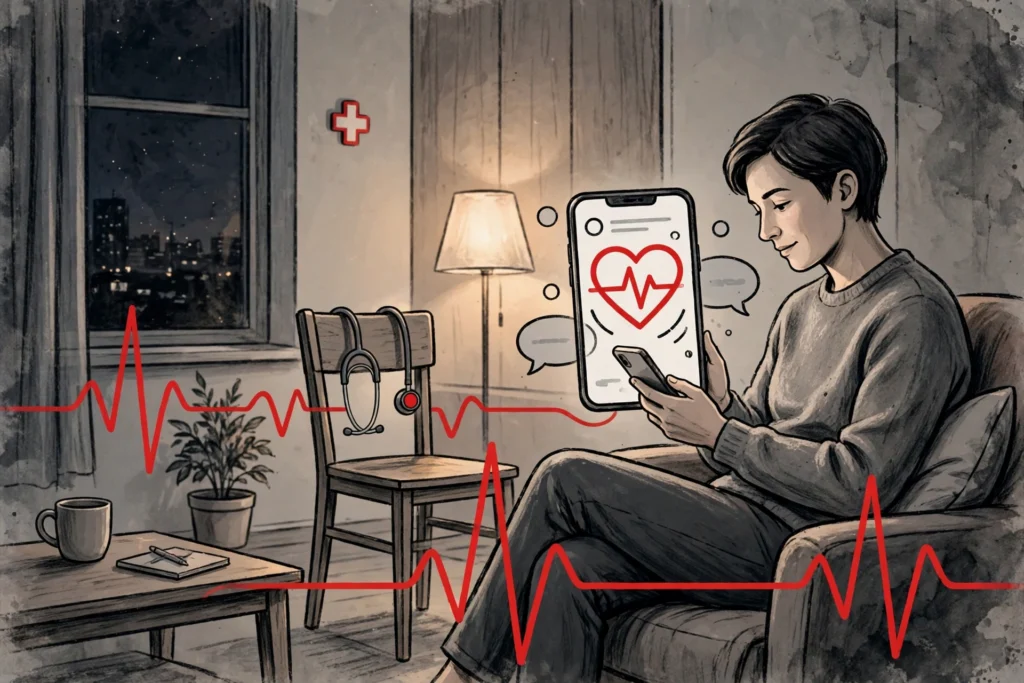
It is two in the morning, and your chest feels tight. You reach for your phone — not to call a doctor, but to ask a chatbot what it might mean. That quiet, late-night question is exactly what the Apple Health AI Usage Study wants to understand.
Millions of people now ask AI about their health every week. The questions range from the mundane to the frightening: a strange rash, a lab result full of jargon, a symptom that will not go away. Apple has watched this habit grow — and on November 15, it decided to study it properly.
The company announced the Apple Health AI Usage Study, a virtual research project run with clinical AI company OpenEvidence. Up to 200,000 people across the United States will take part, asking a dedicated app their health questions and grading the answers they get back.
What the Apple Health AI Usage Study Actually Does
Participants download a free study app and start asking it the kinds of health questions they would normally type into a search bar or a chatbot. The answers come from OpenEvidence, a clinical AI platform used by doctors, and each one is grounded in peer-reviewed medical literature.
Every answer carries links to the sources behind it — journals such as The New England Journal of Medicine, JAMA and Nature. The idea is simple: if an AI tells you something about your health, you should be able to see exactly where it got the information.
After each answer, participants rate it. Was it accurate? Detailed enough? Easy to understand? They also take monthly surveys about how the tool fits into their daily lives. The study will run for more than 12 months.
The app can also do something a web search cannot. With permission, it can look at the health data a participant chooses to share from Apple Health — resting heart rate, activity, sleep, or lab results — and shape its answers around that personal context.
Apple says the study will also test whether the AI can help people prepare for a visit to their own doctor, turning a confusing pile of symptoms and numbers into a clearer conversation.
Who Can Join — and What You Have to Give Up
Enrollment opened on November 15, the same day Apple announced the study, and the app is already available to download in the United States. But the door is not open to everyone.
Participants must be at least 21 years old and live in the US. They need an iPhone 15 Pro or later running iOS 26 or newer, with Apple Intelligence switched on.
The study is capped at 200,000 people — a large number, but less than half the 400,000 who joined Apple’s Heart Study in eight months back in 2019.
The app is deliberately separate from the Health app and from Siri. It does not use Apple Intelligence to answer questions, and it is not a doctor. Apple is explicit: the study app is not meant to diagnose or treat any condition, and it cannot replace a clinician’s advice.
That separation matters. Apple is not launching a health chatbot. It is launching a year of watching people use one — and learning from what they do.
Why Apple Is Studying Health AI Before Selling It
Health has become one of AI’s biggest use cases almost by accident. Earlier this year, OpenAI said users were asking more than 300 million health-related questions each week, according to TechCrunch. People are already trusting chatbots with their bodies. The question is whether that trust is earned.
Clinical AI is already moving fast elsewhere too, from transcription tools that turn doctor visits into notes to chatbots answering patient questions directly. But a confident wrong answer about health is worse than no answer at all, and that is the risk Apple wants to measure.
Large language models can be wrong, vague, or misleading — and in health, the stakes of a mistake are higher than in almost any other field. Apple acknowledged the risk in its announcement, noting that consumer health tools powered by large language models “may at times offer responses that are incomplete or unclear.”
That is why the study exists. Rather than shipping a feature and finding out later that it confused people, Apple wants the evidence first. “At Apple, we believe responsible innovation starts with scientific rigor and clinical grounding,” said Sumbul Desai, Apple’s vice president of Health and Fitness.
The timing is no coincidence either. Code found in the iOS 27.3 beta suggests Siri AI may one day read sleep, workout and medication data from the Health app — a feature Apple has not announced. A study like this one is exactly the kind of groundwork that comes before a feature like that.
The Privacy Promises — and the Fine Print
Health data is the most personal data most people own, so the study’s privacy rules will be watched closely. Apple says the study was designed “from the ground up with privacy protections, transparency, and clinical guardrails.”
Study data will not be used to train AI models, Apple says. Data is anonymized before it is sent to a secure third-party cloud provider, and OpenEvidence deletes the query and response data after 24 hours. Participants decide for themselves whether to share any HealthKit metrics or survey answers at all.
The app also has safety guardrails. If a question raises a red flag — something that sounds urgent or serious — the app is designed to detect it and suggest that the person follow up with a provider or other resources.
There is one odd detail worth noting. The App Store listing for the study app rates it 18+, even though the study itself only accepts people aged 21 and over. It is a small mismatch, but it hints at how quickly this project came together.
OpenEvidence: The Clinical AI Behind the Answers
OpenEvidence may not be a household name, but in American medicine it is close to one. The platform gives doctors AI-generated answers grounded in the medical literature, and its growth has been extraordinary.
In January 2024, just 355 US clinicians were using it each month. By June 2026, that number had reached 703,265. Over 30 months, the platform has handled 271 million queries. In September 2026, a $250 million funding round valued the company at roughly $15 billion.
That reach is the point of the partnership. Patients and doctors are increasingly using the same kinds of tools — but, as UCSF professor Robert Wachter put it, they are “being built and tested in separate worlds.” This study brings the two sides together.
“When patients and doctors draw on versions of the same trustworthy tools, patients arrive prepared, conversations improve, and next steps happen seamlessly,” Wachter said. “Connecting these tools, and rigorously studying what works, is how we’ll get there.”
What Happens Next
For now, the study is open, and the clock is running. Over the next year or more, Apple and OpenEvidence will gather answers to four questions: what makes people trust a health AI, how good its answers really are, whether people understand them, and how the tool changes the health decisions they make.
The findings are meant to shape not just Apple’s products but the wider industry’s approach to health AI. Apple has not said whether the answering feature will eventually appear in the Health app or in Siri — and TechCrunch notes that it is not clear yet whether Apple wants that at all.
What is clear is the direction of travel. Apple already has the health data, the devices, and the audience. What it has been missing is the evidence that an AI can be trusted with people’s health. Two hundred thousand volunteers are about to help it find out.
The study app is available to download now for eligible users in the United States. For everyone else, the results — when they eventually arrive — may matter more than the app itself.