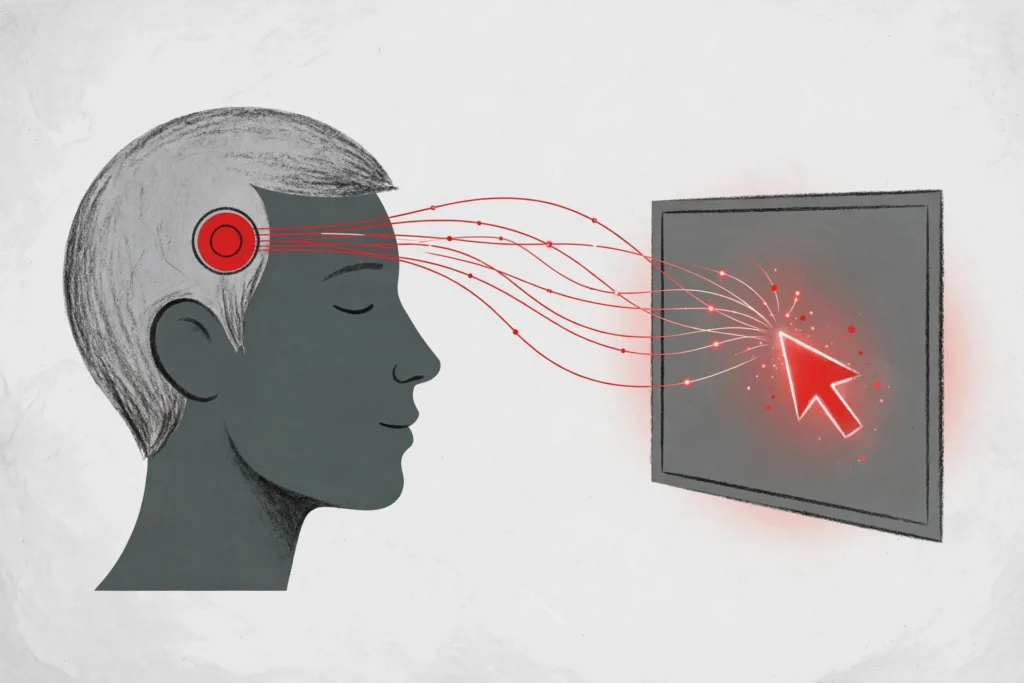
Bradford Smith could no longer speak, type, or lift a hand. ALS had taken nearly every voluntary muscle he had, until a coin-sized chip in his skull let him communicate again, using only his thoughts. Now Neuralink FDA approval has cleared the way for that same technology to be tested in a far bigger trial.
The company announced on November 25 that the US Food and Drug Administration has given it the green light to launch LINK, the first pivotal trial for an implantable brain-computer interface in the United States. It is the biggest regulatory step Neuralink has taken since its first human implant less than three years ago.
For a company that began as Elon Musk’s most science-fiction venture, the announcement was notably sober. There were no promises of telepathy for everyone, no dates for a consumer launch. There was a trial, a patient group, and a careful list of what still has to be proved.
What the Neuralink FDA Approval Actually Covers
The LINK Pivotal Study will test Neuralink’s brain-computer interface, or BCI, in people living with severe paralysis caused by ALS. The goal is to measure two things at once: whether the system is safe over the long term, and whether patients can reliably control digital devices by thought alone.
The trial focuses on functional outcomes that improve independence in daily life, according to Neuralink. That means the questions are practical, not abstract: can a participant send a message, browse the web, or operate a computer without touching anything?
Enrollment is now open, and the study will run across multiple clinical sites in the United States. Neuralink has not said how many people it plans to enroll, or which hospitals will take part. As of late Wednesday, no record of the study had appeared on ClinicalTrials.gov.
How the LINK Trial Will Work
The system at the centre of the trial has three parts. The N1 implant sits in a small opening in the skull. A surgical robot called R1 then threads 64 ultra-thin, flexible electrodes into the brain, giving the system 1,024 recording sites in total.
Those electrodes listen to the electrical activity linked to intended movement. Software decodes the signals and turns them into commands, moving a cursor, selecting letters, or operating an app. The person does not need to move a muscle; imagining the movement is enough.
The hardware is designed to be largely invisible. Once the implant is in place, it charges wirelessly and communicates with an external device over Bluetooth, so there are no wires passing through the skin.
For someone with ALS, that loop can be the difference between silence and conversation. The disease attacks the nerve cells that control voluntary muscle movement, and as it progresses, many patients lose the ability to speak, write, or even blink on command.
Health data is becoming a bigger part of consumer technology too. Apple’s iOS 27.3 beta hints at Siri AI reading sleep, workout, and medication data, a reminder that the boundary between phones and bodies is blurring from both directions.
From a First Implant to 30 Participants
LINK does not start from zero. It builds on Neuralink’s early feasibility studies in the United States, Canada, and the United Kingdom, where more than 30 people have received implants and logged thousands of hours of real-world use.
The first human implant went to Noland Arbaugh in January 2024. He was paralysed from the shoulders down after a diving accident, and within weeks he was playing chess and video games using only his thoughts.
Since then, participants have used their implants to pursue higher education, express their creativity, play video games, and communicate with loved ones, according to Neuralink. Each of those hours gave the company data on how the system holds up outside a laboratory.
Bradford Smith’s case mattered most for LINK. He was the first participant with ALS, and his progress showed the system could work for the very people the pivotal trial is designed to help. That evidence is part of what persuaded the FDA to allow the larger study.
Why ALS Patients Come First
ALS is a brutal, fast-moving disease. It destroys the motor neurons that carry instructions from the brain to the muscles, while usually leaving thinking and awareness intact. People can become locked inside bodies that no longer respond, even as their minds stay sharp.
There is no cure, and most people live only two to five years after diagnosis. In the United States, roughly 30,000 people are living with the disease at any one time. For many of them, communication is the first thing they lose, and the thing they miss most.
That is why ALS is the natural first test for a device built to restore independence. If thought-controlled computing works for people with the most severe paralysis, the case for wider use becomes far stronger.
Medicine is where some of the most ambitious AI work is landing right now, from DeepMind’s AlphaGenome 2 reading DNA cell by cell to robots working on factory floors with Gemini Robotics 2.5.
What “Pivotal” Means, and What It Doesn’t
A pivotal trial is the late-stage study a medical-device maker runs to gather the evidence it needs before asking regulators for permission to sell. It is bigger, longer, and more rigorous than the early feasibility studies that came before it.
Crucially, the FDA’s decision is not an approval of the implant itself. The N1 remains an investigational device, available only through authorised clinical research. Completing LINK successfully would let Neuralink apply for marketing authorisation, but it would not guarantee it.
Bloomberg reported last year that Neuralink was internally aiming for approval of its Telepathy device, the name for its device-control function, around 2029. LINK is the study that would have to make that timeline possible.
The company also registered a second feasibility study, PRIME2, this month, covering up to 10 people at up to five sites. The pipeline is widening even as the main event begins.
The Race to Read the Brain
Neuralink is not alone. Synchron has been testing a stent-like device threaded through blood vessels, avoiding open-brain surgery altogether, and Precision Neuroscience is working on a thin film that sits on the brain’s surface. Each approach trades invasiveness for signal quality in a different way.
What sets LINK apart is its stage. No other implantable brain-computer interface in the United States has reached a pivotal trial. For a field that spent decades as laboratory science, that is a genuine milestone.
The risks are real, too. Brain surgery carries infection and bleeding risks, electrodes can shift or degrade, and a device meant to last for years must prove it can. The trial will track long-term safety and reliability across every site.
Investors and rivals will be watching the safety data closely. A clean pivotal trial would not only help Neuralink, it would validate the entire idea that implanted interfaces can move from research labs into hospitals.
What Happens Next
Enrollment is open now, and Neuralink says it will expand access to the study over time. Adults living with ALS can join the company’s patient registry to learn whether they qualify. The company thanked participants, families, clinicians, and regulators for making the step possible.
The coming months will bring the details the announcement left out: how many people enroll, which hospitals participate, and how the first results look. For now, the signal is clear. Thought-controlled technology has moved from demonstration to a formal test of whether it is safe and effective enough for the market.
Bradford Smith put it more simply. The implant gave him freedom, hope, and faster communication. LINK will find out how many more people it can do the same for.
Source: Neuralink’s announcement of FDA approval for the LINK Pivotal Study.