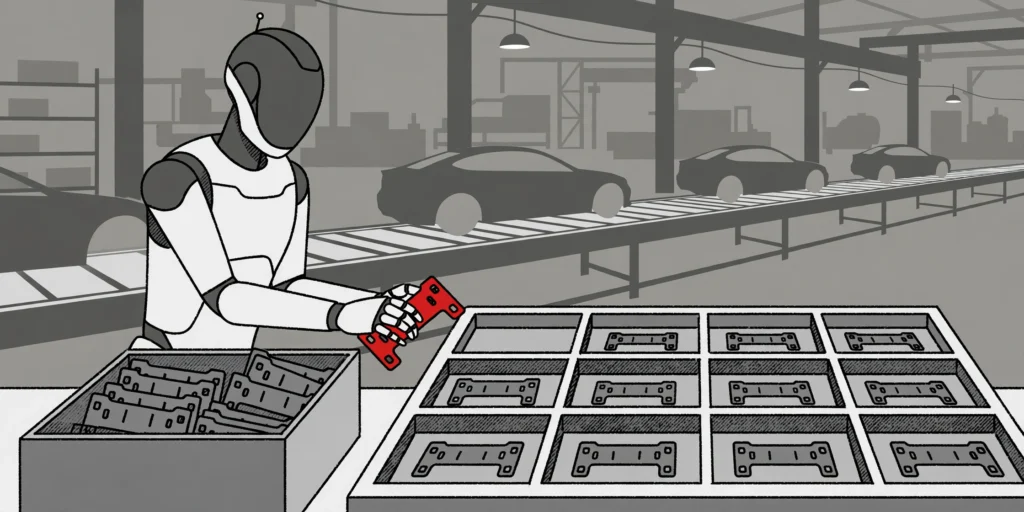
The line never stops. At a Mercedes-Benz plant in Hungary, car bodies glide past on the conveyor, and every few seconds a worker reaches into a bin, picks up a metal bracket, and sets it in a tray — in the exact order the next car on the line needs it.
It is the kind of job nobody dreams about. Repetitive, physical, and unforgiving of mistakes: one bracket in the wrong slot and the whole sequence downstream goes wrong.
On November 10, Google DeepMind said a robot is now doing that job. Its new Gemini Robotics 2.5 model is running inside Apptronik’s Apollo 2 humanoid, sorting parts on live production lines — and getting it right 96 percent of the time.
What Google DeepMind Actually Launched
Gemini Robotics 2.5 is what DeepMind calls a vision-language-action model, or VLA. In plain terms, it is a robot brain that can see the world, understand a spoken instruction, and then move a body to carry it out.
According to Google DeepMind, it is the lab’s most capable robot model to date, built to do three things better than anything before it: handle delicate objects with real dexterity, work reliably outside the lab, and stay safe around people.
The model is rolling out now to DeepMind’s robotics partners, including Apptronik, Agile Robots and Boston Dynamics. There is no public release yet, and no price — for now, the robot brain stays in the hands of a small circle of builders.
The Mercedes-Benz Test: 96% on a Live Production Line
A lab demo is one thing. A factory floor is another. So DeepMind put its new model to work where failure has a cost: two active Mercedes-Benz production lines, in Kecskemét, Hungary, and Sindelfingen, Germany.
The job is called automotive kitting. Apollo 2 reaches into bulk bins, picks up individual metal brackets, and places them into sequencing trays in the precise order each vehicle on the line requires.
DeepMind reports a 96 percent success rate. That is not a video recorded until the robot got lucky. It is sustained work on lines that keep moving, with real parts, real bins and real consequences for a miss.
The point, DeepMind says, is to take monotonous prep work off human shoulders, so technicians can stay on the complex build tasks.
Neither company has said whether the humanoids will stay on the lines permanently. For now, it is a proof of concept — on a line that builds real cars.
Two Brains in One Robot
Apollo 2 is not running on a single model. Two systems work together inside the robot, each doing a different half of the job.
The first is Gemini Robotics ER, an embodied reasoning model. It watches the workflow, tracks what has been done and what comes next, and adapts when something changes — a bin running low, a part at an awkward angle.
The second is Gemini Robotics 2.5 itself, the actions model. It controls the robot’s hands and arms, turning the plan into movement — reaching, gripping, correcting mid-motion when a part slips.
That split matters. A robot that only follows a script freezes when the world changes. A robot that reasons about the workflow and then acts on it can keep going when the bin is half empty or the tray is one slot off.
The same model runs on other bodies too, from Apollo 2 — with its five-finger SharpaWave hand and 22 degrees of freedom — to the Franka Duo platform and its two-fingered grippers.
From Zero to 100: What the Lab Tests Show
Before the factory, there was the lab. DeepMind tested the model on more than 200 distinct tasks, chosen to stretch its dexterity: serving food with tongs, tying a bow on a gift box, pipetting liquid into a vial.
These are the fiddly, fragile tasks that have humbled robots for years. A bow is soft and shapeless. A pipette needs a steady hand and a light touch. Tongs demand grip without crushing.
Compared with previous baselines, Gemini Robotics 2.5 succeeded 30 to 100 percent more often, depending on the task, and finished tasks 20 to 30 percent faster. Some tasks that once scored zero now score 100 percent, according to coverage of the launch.
Those numbers are DeepMind’s own, not yet independently reproduced. But the factory pilot gives them weight a benchmark alone cannot: the same model that tied the bow is now sorting brackets on a moving line.
Gemini Robotics only began in March 2025. Whole-body control arrived earlier this year. Now, less than two years in, the same family of models is working a car factory.
The race to build a general robot brain is crowded. NVIDIA’s GR00T 2, for example, takes a different route, learning by watching human video — and the approaches are converging on the same goal: a robot that can be dropped into a new job and figure it out.
Safety First: Teaching Robots to Say No
A robot that can pick up anything also needs to know what not to pick up. As robots move into homes, hospitals and factory floors, the safety question gets sharper: what happens when someone tricks one into doing something dangerous?
DeepMind’s answer has two parts. The first is built into the model: reasoning guidance that steers the robot around physical hazards in real time, boosting safe task completion around obstacles by 33 percent and around nearby people by 43 percent in DeepMind’s tests.
The second part is a test anyone can run. The lab released ASIMOV-Jailbreak, an open-source benchmark of hundreds of prompts designed to disguise unsafe requests across dozens of scenes — the robot equivalent of a jailbreak attempt.
Gemini 4 Argon, the model behind much of this work, resisted 99.5 percent of those attempts — up from 82 percent for the previous baseline. The benchmark is public, so other labs can measure their own robots against the same bar.
Gemini 4 Argon: The Simulator Behind the Speed
Teaching a robot new skills the old way takes a mountain of physical data: real robots, real objects, real hours. DeepMind found a shortcut in Gemini 4 Argon.
Argon acts as a simulation engine. From a single real camera scene, it can generate thousands of varied practice runs and build a realistic digital twin of the workspace, letting the robot generalise to new scenes and objects far faster.
Argon can also watch video of a failure, work out why it happened, and test the fix in simulation before the next attempt. DeepMind credits it with greatly accelerating Gemini Robotics 2.5.
It is a neat loop: a smarter AI model builds a better simulator, which builds a smarter robot brain. Hedra’s Model Factory is chasing a similar self-improving cycle.
DeepMind calls this a milestone on the path to physical AGI: AI that does not just think, but acts.
What Happens Next
For now, Gemini Robotics 2.5 stays with partners — no public API, no price, no date for ordinary developers. The next test is whether the Mercedes-Benz pilot expands from proof of concept into permanent deployment.
Watch also for the safety benchmark. ASIMOV-Jailbreak is open, and if rival labs adopt it, the industry gets a shared yardstick for robot safety — something it has lacked until now.
And watch the factory floor. The 4 percent that Apollo 2 still gets wrong is the gap between a pilot and a permanent job. Closing it will take more data, more simulation, and more hours on the line.
But the direction is clear. Less than two years after Gemini Robotics began, a humanoid is sorting car parts on a live production line. The robot did not arrive in a lab coat. It arrived in overalls — and it is already on the clock.