XPENG IRON Takes the Stage at the Guangzhou Auto Show
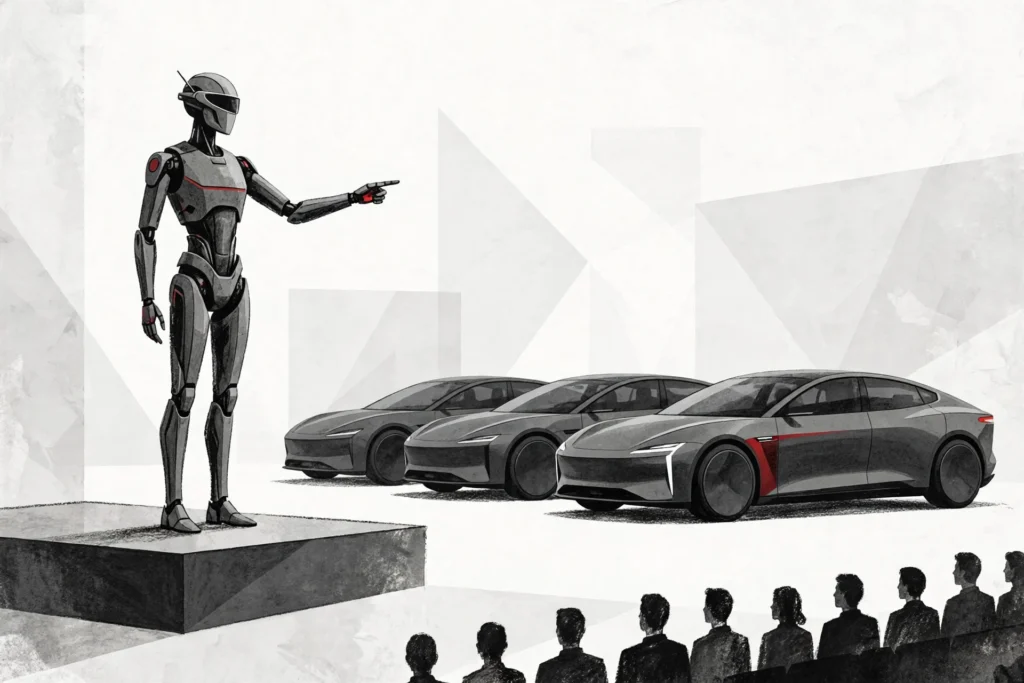
Imagine walking into a car show press conference and finding the host is not a person at all. The figure at the podium is 170 centimetres tall, moves with 76 degrees of freedom, and is about to announce a new research centre. That is exactly what happened in Guangzhou on November 27.
XPENG’s humanoid robot IRON hosted the company’s press conference at the 2026 Guangzhou International Automobile Exhibition, in what the company described as a world first. A robot, in other words, ran the show — and used the moment to unveil the next phase of XPENG’s global ambitions.
The announcements were sweeping. A new Hong Kong research and development centre dedicated to humanoid robotics. IRON’s first jobs in XPENG showrooms early next year, and its international debut in the second half of 2027. Five new vehicle models for overseas markets, a global Robotaxi programme, and megawatt charging stations across three continents.
XPENG is no longer just a Chinese electric car maker with big plans. It is pitching itself as a “Physical AI” company — one that wants its intelligence to live in bodies that move through the real world, not just in software on a screen.
What XPENG IRON Actually Is
IRON is XPENG’s general-purpose humanoid robot, the product of eight years of research and development. The latest version rolled off a newly commissioned production line on September 8, 2026.
The robot stands about 170 centimetres tall and is built to look and move much like a person. It has 76 degrees of freedom across its body, including 21 in each hand — the kind of dexterity a robot needs to pick things up, gesture naturally, and handle everyday objects.
Its brain is three in-house developed Turing AI chips delivering up to 2,250 TOPS of computing power. That processing runs XPENG’s Physical AI foundation model directly on the device, so IRON can carry out tasks on its own without being remotely operated by a human.
At the Guangzhou show, IRON demonstrated service capabilities for the audience: welcoming visitors and introducing vehicles. It was a small, deliberate performance — the robot doing the kind of front-of-house work XPENG says it will soon do for real.
The money behind the programme is serious. In August 2026, XPENG’s robotics business raised more than $900 million in equity financing at a post-money valuation above $6.3 billion. It was the largest single-round private financing in China’s embodied AI industry.
A New Hong Kong R&D Centre for Humanoid Robots
The headline announcement from IRON itself was the establishment of XPENG’s Hong Kong R&D Centre. The facility will focus on humanoid robotics and general-purpose intelligence, and it becomes the company’s ninth research and development centre worldwide.
Choosing Hong Kong is a deliberate signal. The city gives XPENG a base with international talent, strong universities and easier access to global partners, all while staying close to its manufacturing and engineering heartland in mainland China.
The centre matters because humanoid robots are still an unsolved problem. Building a machine that can walk, grasp, balance and reason in an unpredictable environment is one of the hardest challenges in modern robotics, and it needs researchers who specialise in exactly that.
XPENG is betting that its car business gives it an edge. The same AI that drives a car — sensing the world, predicting what happens next, making decisions in real time — can, in theory, drive a robot. That is the core of the company’s “Physical AI” pitch.
IRON’s First Real Jobs Start in 2027
XPENG has laid out a careful, staged plan for putting IRON to work. In the first quarter of 2027, the robot will begin its first showroom assignments at XPENG retail locations in China, greeting customers and presenting cars in everyday retail environments.
Showrooms are a smart first deployment. They are controlled, predictable spaces where a robot can learn to interact with real people without the chaos of a factory floor or a family home. Every conversation is also training data for the next version.
The international step follows in the second half of 2027, when XPENG plans to extend IRON’s deployment overseas, starting with its showroom network abroad. The robot that hosted a press conference in Guangzhou will, within about eighteen months, be welcoming customers in other countries too.
It is a modest start by design. XPENG is not promising robots in homes or hospitals yet. It is promising a robot that can hold a conversation, present a product and navigate a shop floor — and it is putting a date on it.
Five New Models and a Doubling of Overseas Sales
The humanoid robot may have hosted the press conference, but the cars remain the business. XPENG said it is on track to pass 100,000 annual overseas vehicle sales for the first time in 2026, and it aims to more than double that figure in 2027.
To get there, the company plans to introduce five new models across overseas markets in 2027. The New P7 will lead the way, launching in Europe — its first overseas market — in the second quarter of 2027. The next wave begins sooner, with the L05 launching in Thailand in December 2026.
Charging infrastructure is part of the same push. XPENG plans to deploy four X-Energy megawatt charging stations across three continents within three months, accelerating the global expansion of its charging network.
Fast charging matters more than it sounds. Megawatt-level charging can cut a top-up from an hour to minutes, and it is aimed squarely at the long-distance drivers and fleet operators who still hesitate to switch to electric.
Robotaxis Go Global in 2027
The third pillar of the announcement is autonomy. XPENG plans to begin the overseas rollout of its advanced driver-assistance system in the first half of 2027, with a global launch of its Robotaxi programme targeted for the same year.
The company has been testing autonomous driving across Levels 2 to 4, from its NGP intelligent driving system to full L4 Robotaxi operations. At its AI Day in Guangzhou on November 25 — two days before the auto show — it gave media and partners hands-on experience with those technologies, alongside updates on its flying car programme.
Robotaxis are the most competitive corner of the industry. Waymo runs driverless rides in American cities, Tesla has started its own service, and Chinese rivals are expanding fast. XPENG’s answer is to bundle autonomy with its cars, its charging network and its robots into a single Physical AI ecosystem.
Whether that bundle works as a business is the open question. Robotaxis burn enormous amounts of capital before they make any, and regulators in each new market will have their own demands. But XPENG is clearly not waiting for permission to try.
Why This Matters Beyond XPENG
There is a bigger story here than one company’s product roadmap. The Guangzhou announcements show how quickly the centre of gravity in AI is shifting from chatbots to machines that act in the physical world.
Google’s Gemini Robotics 2.5 is already putting humanoid robots to work on Mercedes-Benz production lines, and Nvidia’s GR00T 2 model teaches robots by watching human video. XPENG is making the same bet from the car industry’s side, with its own chips and its own robot.
The Hedra Model Factory points in the same direction: AI systems that improve themselves by operating in the real world, rather than only learning from text on the internet.
That convergence is why a robot hosting a press conference is more than a stunt. It is a demonstration that the companies building the physical side of AI believe the technology is ready to be seen, touched and judged in public — not just described in a research paper.
As Channel News Asia reported, citing XPENG’s announcement, the company’s 2027 roadmap spans AI vehicles, humanoid robotics and autonomous mobility. The Guangzhou Auto Show was the first public test of whether that vision holds together — and IRON, standing at the podium, passed it.


