The Variant That Hides in Plain Sight
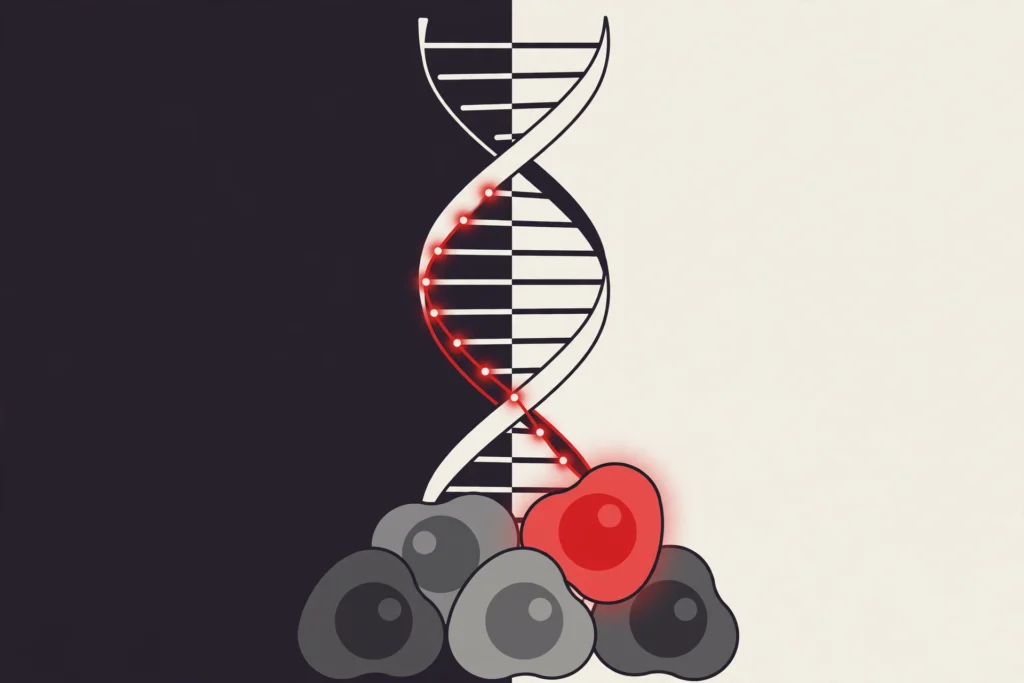
Picture a geneticist staring at a spreadsheet with 10,000 DNA variants, all statistically linked to the same disease. Somewhere in that list sits the one variant that actually causes it. The trouble is, nobody can tell which one — and that is exactly the problem AlphaGenome 2 was built to solve.
That is the daily reality of genome-wide association studies. They flag regions of DNA connected to disease, but the signal is blurry. A variant might matter enormously in one cell type and do nothing at all in another. Averaged across a whole tissue, its effect simply vanishes.
On November 11, 2026, Google DeepMind announced a model built to cut through exactly that blur. It is called AlphaGenome 2, and it reads DNA the way the body actually uses it: one cell type at a time.
What AlphaGenome 2 Actually Does
AlphaGenome 2 is a deep-learning model that predicts how a DNA change affects gene activity in one specific cell type or state. Feed it a stretch of DNA up to a million letters long, name a condition — a heart muscle cell, an activated immune cell — and it predicts what happens there.
The model was trained on more than 107 million individual cell profiles from human and mouse data, covering 68 tissues. By learning from single cells rather than tissue averages, it can spot effects that only show up in one specialised cell, or in a cell switched on by disease.
Its predictions cover gene expression, RNA splicing, chromatin accessibility and histone modifications. It also adds DNA methylation as a readout, a capability the first AlphaGenome did not have.
Why Cell-by-Cell Changes Everything
The first AlphaGenome, previewed in June 2025 and published in Nature in January 2026, predicted molecular activity across many tissues at once. It was powerful, but it answered a different question: what does this DNA do on average?
AlphaGenome 2 flips that design. It is what DeepMind calls a conditional model. It takes one condition at a time and feeds that condition through every layer of the network, so the same stretch of DNA can be read differently for different cells.
The difference is practical, not just technical. A variant linked to an autoimmune disease might only change gene activity in a T cell that has been activated by infection. In a bulk tissue sample, that signal drowns. AlphaGenome 2 is built to hear it.
Researchers can even condition the model on their own single-cell experiment, with as few as a few dozen cells, without retraining it. That turns a general-purpose model into a tool tuned to one lab’s exact question.
The Benchmark Numbers: Nearly Twice as Many Causal Variants
DeepMind tested AlphaGenome 2 on TenK10K, a single-cell map of 28 primary immune cell types. The headline result is striking. At 90 percent precision, the new model recovered 30 percent of the putatively causal expression-linked variants. The first AlphaGenome, fine-tuned on single-cell data, managed 16 percent.
It also called the direction of gene effects correctly 43 percent of the time, against 23 percent for its predecessor. In other words, it found nearly twice as many of the variants that actually matter, and it was far better at saying whether a variant turns a gene up or down.
Those numbers still leave most causal variants unfound. DeepMind’s own paper cautions that even at high precision, the model recovers only a minority of the variants that statistical analyses nominate as likely causal. It is a sharper lens, not a finished answer.
A 1.5-Year Experiment Replicated in 30 Minutes
The most vivid validation at launch came from outside DeepMind. Researchers at the Francis Crick Institute used AlphaGenome 2 to replicate a laboratory result on inflammatory bowel disease that had taken a year and a half to produce. The model did it in 30 minutes.
That kind of speed changes how disease research is planned. Instead of spending months testing one variant at a time in the lab, a team can screen thousands of candidates in silico, then spend its bench time on the handful that look most promising.
DeepMind also precomputed two resources for researchers who do not want to run large comparisons themselves. One maps enhancer-to-gene links across 640 primary single-cell reference conditions and 39,323 protein-coding and long non-coding RNA genes.
How to Get Access — and What It Costs
AlphaGenome 2 is available from today for non-commercial research through the AlphaGenome API, according to Unite.ai. Non-commercial use is free, with query rates varying by demand. Commercial research access is in private preview.
DeepMind also plans to bring AlphaGenome 2 Skills to Google Antigravity, its agentic development platform, so the model can be called on inside coding and research workflows.
There is one important boundary. Both AlphaGenome models are for research use only. They have not been validated or approved for clinical or diagnostic purposes, so this is not a tool that will read your personal genome and tell you what is wrong with you.
What AlphaGenome 2 Cannot Do Yet
The new model is more expensive to run than the original, and that has a real consequence. DeepMind says a genome-wide atlas with AlphaGenome 2 is impractical, because each prediction costs more compute.
The first AlphaGenome lives on for that reason. Its Atlas — a catalog of predictions for all 9 billion possible single-letter changes in the human genome — remains the broad reference.
There are scientific limits too. It remains uncertain whether the model can predict responses to gene knockouts, overexpression or dynamic changes in cell state over time. Those are the next frontiers, and DeepMind has not claimed them yet.
For now, the honest framing is this: AlphaGenome 2 is a research instrument that finds disease-linked variants faster and more precisely than anything before it, within clearly stated limits.
Why This Matters Beyond the Lab
Drug discovery lives or dies on picking the right target. Most drug candidates fail because the biology was misunderstood at the start. A model that can point to the exact cell type where a variant acts gives drug hunters a far better starting point.
The same logic applies to understanding diseases that have resisted explanation. Many conditions linked to the immune system, the brain or the gut involve variants that only matter in rare or fleeting cell states. AlphaGenome 2 is designed to find exactly those.
It also arrived on a remarkable day for DeepMind. The same announcement day brought Gemini Robotics 2.5, the company’s most capable robot-brain model, which is already working on Mercedes-Benz production lines. One lab, one day: robots that learn by watching humans, and a model that reads the genome cell by cell.
That pairing says something about where Google’s AI effort is heading. The frontier is no longer just chatbots and code. It is machines that act in the physical world and models that decode the biological one.
What Happens Next
The immediate test will be adoption. Free API access for non-commercial research means labs around the world can start using AlphaGenome 2 this week. The papers and preprints that follow will show whether the TenK10K gains hold up on other diseases and other cell types.
DeepMind has had a remarkable November. Its AlphaProof Code system formally verified Signal’s encryption down to machine code in four weeks, and Gemini 4 Carbon became Google’s strongest generally available AI model.
Commercial access is the slower track. Private preview means pharmaceutical companies and biotech firms are already in line, but public results from that side will take longer to appear.
Longer term, the question is whether DeepMind can close the remaining gaps: predicting what happens when a gene is switched off entirely, or when a cell changes state over hours and days. If it can, the model stops being a variant finder and becomes something closer to a simulator of the cell itself.
For now, researchers have a new instrument, and it is already fast. A year and a half of lab work, compressed into half an hour, is the kind of result that changes how a field plans its next decade.
The genome has always been readable. AlphaGenome 2 makes it readable in the right context, one cell at a time.