The crowd at Cape Canaveral had waited three days for this moment. When the Vulcan rocket finally thundered off the pad on Sunday afternoon, cheers rolled across the Florida coast. For ten minutes, everything looked perfect.
Then the flight went wrong. United Launch Alliance confirmed that its Vulcan rocket suffered an anomaly about ten minutes after liftoff, failing to place 40 Amazon Leo broadband satellites into orbit. The satellites, and the mission, were lost.
The ULA Vulcan launch failure is a heavy blow for both companies. It was Vulcan’s return to flight after a booster problem in February, and the first Amazon Leo mission to fly on ULA’s heavy lifter. Neither company got what it came for.
Ten Minutes That Changed the ULA Vulcan Launch
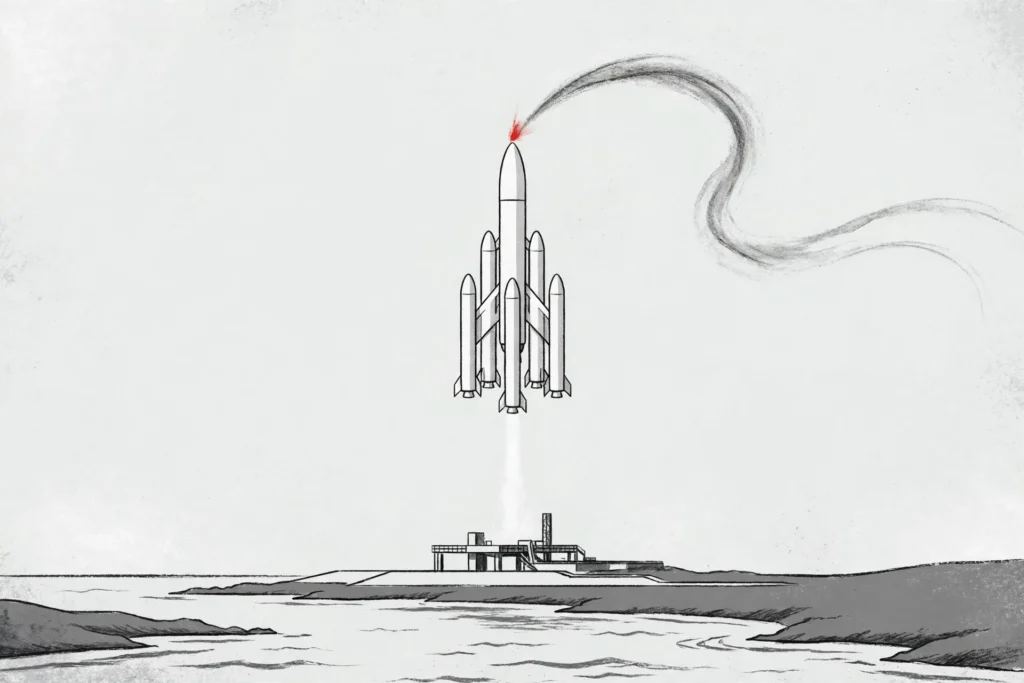
Liftoff came at 12:41 p.m. Eastern Time on Sunday, November 15, from Space Launch Complex 41 at Cape Canaveral Space Force Station. The rocket was the Vulcan VC6L variant, standing 215 feet tall and carrying six solid rocket boosters.
The first part of the flight went exactly as planned. At one minute and 45 seconds, all six boosters separated cleanly at an altitude of 22 miles. The rocket kept climbing on its two main engines, and the crowd below could still see it arcing into the sky.
Then, around the ten-minute mark, something went wrong. ULA’s live coverage ended without the expected milestone calls, and the company soon confirmed the bad news. The rocket had suffered an anomaly and failed to deliver the Amazon Leo satellites to orbit.
According to Florida Today, ULA officials said they had no specific data on the cause yet. The failure happened close to the point where the Centaur V upper stage was due to begin its first long burn, a firing of nearly 12 minutes meant to reach a preliminary parking orbit.
A Long Road to the Launch Pad
The failure stings even more because of how hard this launch was to get off the ground. The mission had already been scrubbed twice before Sunday, once on Friday and once on Saturday.
Friday’s attempt was called off about three hours before liftoff during fuelling. A power interruption at an Air Liquide gaseous nitrogen plant affected the high-pressure pumps at the launch site, and ULA decided not to risk the flight.
Saturday’s window also slipped away, pushing the mission to Sunday. When the countdown finally reached zero on the third try, after a late hold over a computer-checked limit violation, it felt like the hard part was over. It was not.
The mission was also Vulcan’s return to flight after a booster anomaly shortly after liftoff on February 12. That earlier problem had grounded the rocket for nine months while ULA investigated and fixed the issue.
What ULA Said After the Failure
ULA moved quickly to acknowledge the failure, and its statement did not hide behind soft language. The company said the mission had not met its own standard, and it promised a full investigation.
“Every flight generates data, and every flight teaches us something. Since the anomaly just occurred, we don’t have any specific data yet to understand what occurred today,” a ULA media update said, according to Florida Today.
“ULA exists to provide assured access to space for our nation and for the customers who depend on us. That purpose is why we take on some of the hardest missions in spaceflight, and why we hold ourselves to the standard of mission success. Today, we did not meet that standard.”
The company said it would work closely with Amazon and other organisations to find the cause, decide on corrective action, and return to flight as quickly as possible. It also promised customers full visibility into the investigation.
NASA Administrator Jared Isaacman offered help within hours of the failure. In a message posted on X, he said NASA was available to assist in all matters related to the investigation and the fixes that follow.
“Artemis, Moon Base, and the nation need ULA. We are in your corner and here to help,” Isaacman wrote. His words underlined how much rides on Vulcan beyond this one mission, including national security launches and NASA’s return to the Moon.
What the Loss Means for Amazon Leo
For Amazon, the loss is a setback in a race it is already running late. Amazon Leo, formerly known as Project Kuiper, is the company’s plan to beam broadband internet to tens of millions of customers around the world.
The initial constellation will hold more than 3,000 satellites in low Earth orbit, covering areas between 56 degrees north and 56 degrees south of the equator. Amazon plans to expand coverage over time to reach virtually any location on the planet.
The satellites on Sunday’s flight were the first batch of a deployment that must happen at enormous scale. Each launch carries only a small piece of the constellation, so every lost rocket means lost months, not just lost hardware.
Amazon has invested heavily in the infrastructure behind the project. The company has spent more than $400 million on facilities across Florida’s Space Coast, including a $139.5 million satellite processing facility at Kennedy Space Center and more than $200 million in launch infrastructure at Cape Canaveral.
The service itself promises serious speed. The enterprise-grade Leo Ultra terminal will offer downlink speeds of up to 1 gigabit per second, while the smaller Leo Pro and Leo Nano terminals will reach up to 400 megabits and 100 megabits per second.
That puts Amazon in direct competition with SpaceX’s Starlink, which already operates thousands of satellites and serves customers across the globe. Every delay for Leo is time Starlink uses to widen its lead.
Why This Failure Hurts More Than Most
Rocket failures are not rare in the space industry, and even the most reliable rockets have bad days. What makes this one different is the weight of expectation sitting on both sides of the mission.
For ULA, Vulcan is the rocket the company has bet its future on. It replaces the Atlas V and Delta IV, and it carries the responsibility of launching American national security satellites. A second anomaly in nine months will invite hard questions about the rocket’s reliability.
For Amazon, the timing could hardly be worse. The company is under pressure to get its constellation into orbit and its service into customers’ hands. Losing 40 satellites in one flight does not end the project, but it pushes the schedule back.
Amazon has booked launches on other rockets too, including SpaceX’s Falcon 9, so the Leo programme does not depend on Vulcan alone. Even so, ULA was meant to be one of the main workhorses carrying Leo satellites into orbit.
What Happens Next for Vulcan and Amazon Leo
The immediate next step is the investigation. ULA has not given a timeline, and it will not fly Vulcan again until it understands what went wrong and fixes it. The last grounding lasted nine months, though this failure may prove simpler or harder to solve.
Investigators will focus on the flight data from the minutes around the anomaly. The rocket’s telemetry should show exactly when the problem began, which system was involved, and whether the trouble started in the first stage, the Centaur upper stage, or the connection between them.
Amazon, meanwhile, will have to decide how to reshape its launch schedule. The company can shift satellites to other rockets in its launch plan, but every switch costs time and money. The 40 lost satellites will also need to be rebuilt.
The wider space industry will be watching closely. ULA’s rivals, including SpaceX, have built their reputations on flying often and learning fast from failures. ULA now has to show it can do the same.
Sunday began with a perfect Florida afternoon and a rocket climbing cleanly into a blue sky. Ten minutes later, it was over. The data from those ten minutes will now decide how long Vulcan stays on the ground, and how fast Amazon Leo can get back into the race.
ULA’s Vulcan rocket returned to flight on Sunday after two scrubs and a nine-month grounding, and the mission was meant to mark a fresh start. SpaceX’s Starship Flight 15 also faced trouble this month, while SpaceX caught a Starship upper stage in the launch tower’s arms for the first time. For the full timeline of Sunday’s flight, Florida Today covered the launch live from Cape Canaveral.