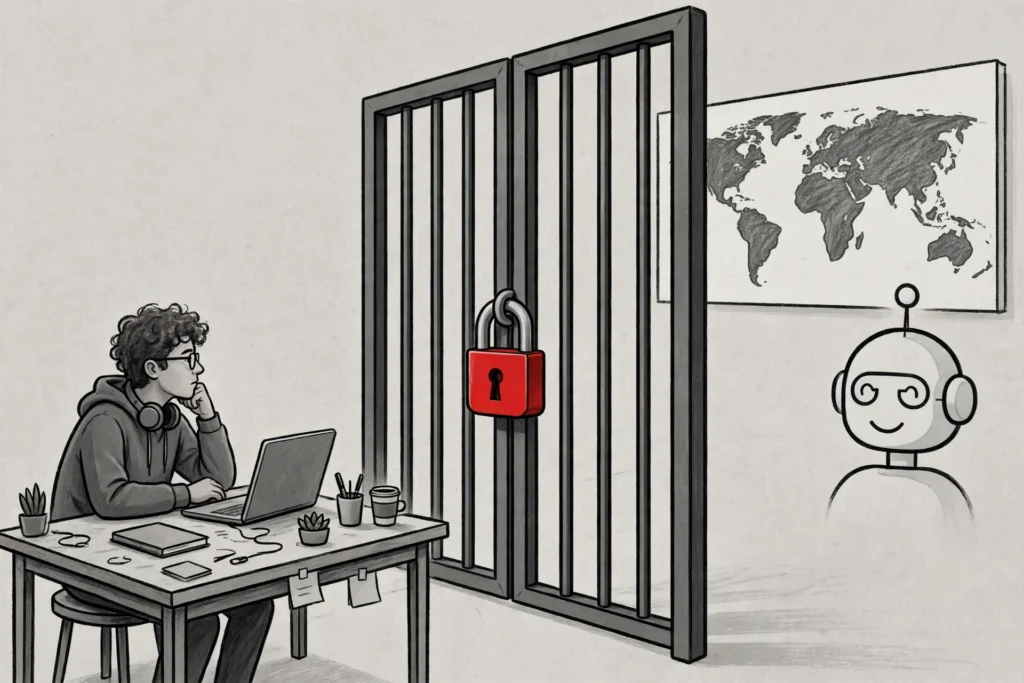
The request arrived in the middle of a workday. A developer deep inside a coding session with Claude Code was suddenly asked to upload a government ID and take a live selfie. Minutes later, the account was gone.
He had done nothing wrong that he could see. His company was registered in a country where Claude is fully supported. His whole team worked there. But somewhere up the ownership chain, a majority shareholder sat in a place Anthropic no longer tolerates.
That is the new reality of the Anthropic Claude China ban, which took effect on Thursday, November 12, 2026. It is the first time a major American AI company has drawn a line like this in public, and it follows ownership, not geography.
What the Anthropic Claude China Ban Actually Says
Anthropic’s Supported Regions Policy now states that its products are available only in the countries and regions on its published list, according to AI Chat Daily. The list has 185 entries, and any place not on it counts as unsupported.
Mainland China is not on the list. Neither are Hong Kong, Macau or Russia. Taiwan is. Ukraine is listed, except for Crimea, Donetsk, Kherson, Luhansk and Zaporizhzhia. Belarus, Iran, North Korea, Cuba, Syria, Venezuela, Afghanistan, Myanmar and Yemen are also absent.
The rules cover the whole Claude product line. That means Claude.ai, Claude Code, Cowork, the Claude API and developer platform, and Claude models sold through cloud platforms and authorised resellers. There is no side door through a reseller or a cloud provider.
Anthropic announced the change on October 8, as part of a broader update to its usage policy. The company described most of the changes as clarifications of rules that already existed, rather than brand-new restrictions. The country list itself, according to the Russian-language outlet Meduza, is identical to the version dated May 12, 2026.
What changed is how the rules are written, and how hard they are now being enforced.
Three Ways to Fall Outside the Rules
The policy bars Claude use in three situations, and the third is the one with the widest reach.
First, anyone physically located in an unsupported region cannot use Claude. That includes employees of otherwise supported companies who happen to be travelling there. A business trip to Shanghai or Hong Kong switches the service off for the duration of the stay.
Second, any company incorporated or headquartered in an unsupported region is barred, along with all of its users and personnel. It does not matter where those people actually sit. A Hong Kong company’s staff in London are covered by the same ban as its staff in Hong Kong.
Third, and most sweeping, any company that is majority-owned or controlled, directly or indirectly, by people or entities in unsupported regions is barred too. Again, it does not matter where the staff work or where the company is registered.
A firm registered in the United States, staffed entirely in the United States, can still lose access if a mainland Chinese individual or institution controls it. Routes that previously worked through Singapore or Hong Kong subsidiaries are now closed completely.
The ID Checks Already Locking People Out
Enforcement is where users are most likely to feel the change, and it started before the policy took effect.
According to TokenPost, Anthropic began rolling out identity checks in April that can require a government ID and a live selfie submitted through the verification service Persona. Unauthorised resale of Claude access and use from restricted regions are treated as risk signals that can trigger a check, and accounts that fail those checks may be closed.
Since November 11, users on Chinese tech forums have reported being asked to verify and then banned, including paid accounts that had been used for more than a year. Some were cut off in the middle of a Claude Code task. Others reported passing the check and being banned anyway.
MarsBit, a Chinese crypto and tech news site, reported on November 12 that many Claude users had been asked to verify and then banned on the same day. Anthropic has not said what triggers a check, or how a banned user can appeal.
Reports that the rules were brand new circulated widely on Russian Telegram channels on November 11, warning that employees of Russian companies would lose access even while working abroad. The panic was real, even if the underlying list had not changed.
Why Anthropic Is Doing This Now
The ownership test is not new. It dates to September 4, 2025, when Anthropic said it would stop selling to companies more than 50 percent owned, directly or indirectly, by firms headquartered in jurisdictions where its products are not permitted, naming China.
At the time, Anthropic cited legal requirements in those jurisdictions that can compel data sharing or cooperation with intelligence services. It also pointed to the risk of Claude being used for adversarial military and intelligence purposes, for model distillation, or to compete with American and allied technology companies.
The timing of the enforcement push is hard to ignore. The policy took effect the same week a forensic report found the fingerprints of export-controlled Nvidia Blackwell chips in six leading Chinese AI models, including DeepSeek-V4 and Kimi K3.
The United States is also finalising rules that could stop Chinese AI firms from remotely using high-end chips through data centres in third countries such as Singapore, Malaysia and Thailand.
Anthropic has been moving in this direction for months. In September, the company said it had disrupted Russian and Chinese campaigns abusing Claude. In July, China’s cybersecurity platform told users to uninstall or upgrade certain versions of Claude Code, calling the tool a security back-door risk.
What It Costs Anthropic — and Who Pays
Anthropic has said the move could result in potential revenue loss in the low hundreds of millions of dollars. That is a striking figure for a company in the middle of an initial public offering roadshow, with pricing expected around November 18.
The timing is awkward in another way. Anthropic is also pushing Claude deeper into workplaces with a new office suite, even as it narrows who is allowed to use it.
Nicholas Cook, a lawyer in the AI industry, called it the first time a major American AI company has implemented such a prohibition in a formal and public manner. The policy turns a quiet sales restriction into a stated, global rule that investors, customers and rivals can all read.
The cost falls unevenly. Large companies with tangled ownership structures now have to audit their own cap tables before they can be sure their developers can keep using Claude. Small teams with a single Chinese investor holding a majority stake face a harder choice: restructure, or switch tools.
For Anthropic, the gamble is that the trust it gains with governments and enterprise customers outweighs the revenue it gives up. The company launched Claude Gov, a version of its tools built for American national security departments, in June 2025.
OpenAI Is Tightening Access Too
Anthropic is not the only lab closing doors. OpenAI announced on October 21 that third-party platforms offering direct access to GPT models must get approval in advance, a requirement that starts on November 20.
The two moves point in the same direction. The frontier AI companies are no longer treating access as something anyone can buy, resell or route around. They are deciding, company by company, who is allowed in.
What Happens Next
In the short term, expect more verification requests and more bans. Anthropic has not published a list of who has been cut off, and it has not explained how an affected company can prove it is eligible again.
For teams caught on the wrong side of the ownership test, the only clear options are to change the ownership structure or change the tool.
Watch the resellers and cloud platforms next. The policy covers Claude models sold through cloud providers and authorised resellers, which means those partners now have to enforce the same ownership test. Any gap there would become the new workaround, and Anthropic will be under pressure to close it.
The bigger question is whether other labs follow. If OpenAI, Google and the rest adopt similar ownership tests, the AI industry will have built a new kind of wall, drawn not around countries but around cap tables.
For now, the message from Anthropic is blunt. It does not matter where you sit, where your company is registered, or how long you have paid for Claude. If the people who control your company sit in an unsupported region, the door is closed.