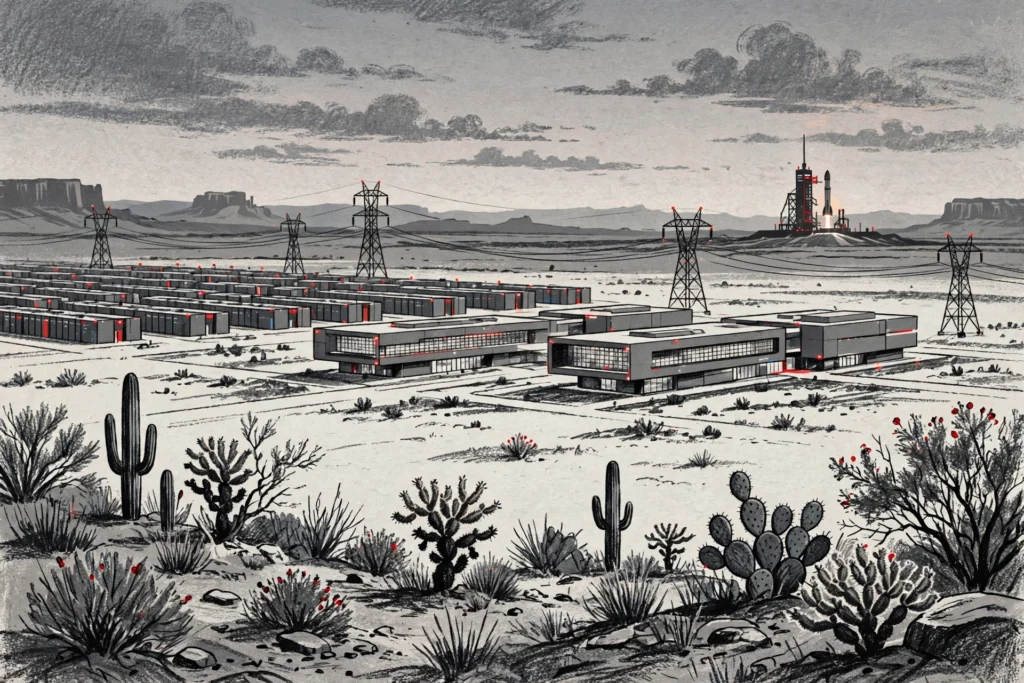
At dawn, the desert outside Willcox, Arizona, is mostly empty sky. A few ranchers, a highway, and a dry lakebed called the Willcox Playa stretch out toward the horizon. Nothing here looks like the centre of the artificial intelligence race.
That is about to change. SpaceX plans to spend roughly $50 billion building a supercomputing campus on 747 acres of this land, and another $24 billion at its Starbase site in Texas. Together, the two projects add up to more than $74 billion, one of the largest single bets any company has made on AI computing.
The announcement, made on November 12 under SpaceX’s “Building the Future” initiative, shows how far the rocket company has travelled from its origins. SpaceX is no longer just a launch provider. According to Reuters, its AI segment generated more than half of the company’s third-quarter revenue.
The SpaceX AI supercomputing campuses are the physical form of that shift. They are where the company’s AI ambitions stop being software and become concrete, steel, and power lines.
Two campuses, two very different bets
The Texas and Arizona projects are not twins. They share a price tag and a purpose, but almost nothing else.
In Texas, the campus sits at Starbase, SpaceX’s rocket site in the Rio Grande Valley near the Port of Brownsville. The facility is designed to generate its own electricity rather than draw from the Texas grid, and construction is already under way.
Separate reporting suggests the site has already created more than 3,000 construction jobs. It is expected to support over 500 permanent roles once it is running.
SpaceX says the Starbase facility will train frontier AI systems for medical research, emergency response, advanced manufacturing, and national security. It will also support the development and testing of future space-based computing, a hint that the company’s ambitions for AI extend beyond Earth.
Arizona is the bigger, earlier-stage gamble. The campus in Cochise County could draw up to 6 gigawatts of power at full build-out, delivered in four phases of about 1.5 gigawatts each.
Nine single-story compute buildings of about 493,000 square feet each are planned, along with electrical buildings, an operations and security building, and outdoor yards for dry coolers, transformers, and battery storage.
To put 6 gigawatts in perspective, it is close to ten times the capacity of the nearby Apache Generating Station. It is the kind of power draw that makes grid negotiations, not construction, the central challenge.
The Arizona site still needs permission
For all the scale of the announcement, neither campus is a done deal. The $74 billion figure is SpaceX’s own, and none of it is contracted capacity or revenue yet.
In Arizona, the project needs a special use permit from Cochise County, because data centres are not allowed there by right. The application was filed by Tombstone Resources LLC, a SpaceX affiliate, for land along US Highway 191 near the Willcox Playa.
The Cochise County Planning and Zoning Commission will hold a public hearing on the application, known as SU26-22, on December 9. A petition with about 2,400 signatures asks officials to deny the permit.
SpaceX has tried to sweeten the deal for locals. The Arizona site would use dry cooling, with no planned industrial groundwater use, a sensitive point in a desert county. The company also says the project could cut power bills for members of the local electric cooperatives by up to 20 percent.
The power deal still has to clear the state regulator, and negotiations with Sulphur Springs Valley Electric Cooperative and Arizona Electric Power Cooperative are ongoing. SpaceX estimates the Arizona campus would create about 5,500 construction jobs at peak and 1,000 permanent positions.
Texas moves faster, but faces its own vote
Texas is further along, but it is not free of politics either. On the same day, December 9, the Starbase City Commission is due to consider a property-tax abatement for the project.
SpaceX has already committed $220 million to water and wastewater infrastructure in the Brownsville area, a sign of how much groundwork a project of this size requires before a single server rack arrives.
The company has not disclosed which accelerator suppliers it will use, what network architecture the campuses will run, or any commissioning schedule for either site. That silence matters, because the hardware choices will determine whether these campuses run on chips from Nvidia, AMD, or someone else entirely.
Riley Trettel, who leads energy and supercomputer development at SpaceX, is overseeing the build-out, according to company materials.
Why SpaceX is spending like a chip giant
The timing of the announcement is no accident. SpaceX’s AI business has grown fast enough to change the shape of the whole company.
Filings with the US Securities and Exchange Commission show quarterly revenue nearly doubled, from $7.814 billion in the three months to June 30, 2026, to $14.575 billion in the quarter ended September 30. Reuters reported that the AI segment accounted for more than half of that third-quarter revenue.
That segment is built around SpaceXSI, the company’s AI division, which runs the Grok family of models and the Grok Bot workplace tools that SpaceX launched earlier this month. Training frontier models at that scale demands computing power on a level that only a handful of companies in the world can afford to build.
SpaceX confirmed only last week that it is behind the 6 gigawatt Arizona proposal, which had been filed quietly under an affiliate’s name. Thursday’s statement was the first time the company put a price on Arizona and a total on both projects.
What happens next
The next milestone is December 9, when both votes land on the same day. In Arizona, the county hearing will decide whether the permit moves forward. In Texas, the Starbase commission will weigh the tax abatement.
If the permits clear, SpaceX still has to answer the questions it has not yet addressed: where the chips come from, when the first phase switches on, and how a company best known for rockets will operate some of the largest data centres ever built.
The stakes reach beyond SpaceX. A $74 billion build-out would tighten an already fierce competition for power, land, and chips, and it would put SpaceX in direct rivalry with the hyperscalers that have dominated AI infrastructure for a decade. It also arrives as regulators and courts are paying closer attention to frontier AI development itself.
For now, the desert outside Willcox is still quiet. But if the votes go SpaceX’s way, it will not stay that way for long.