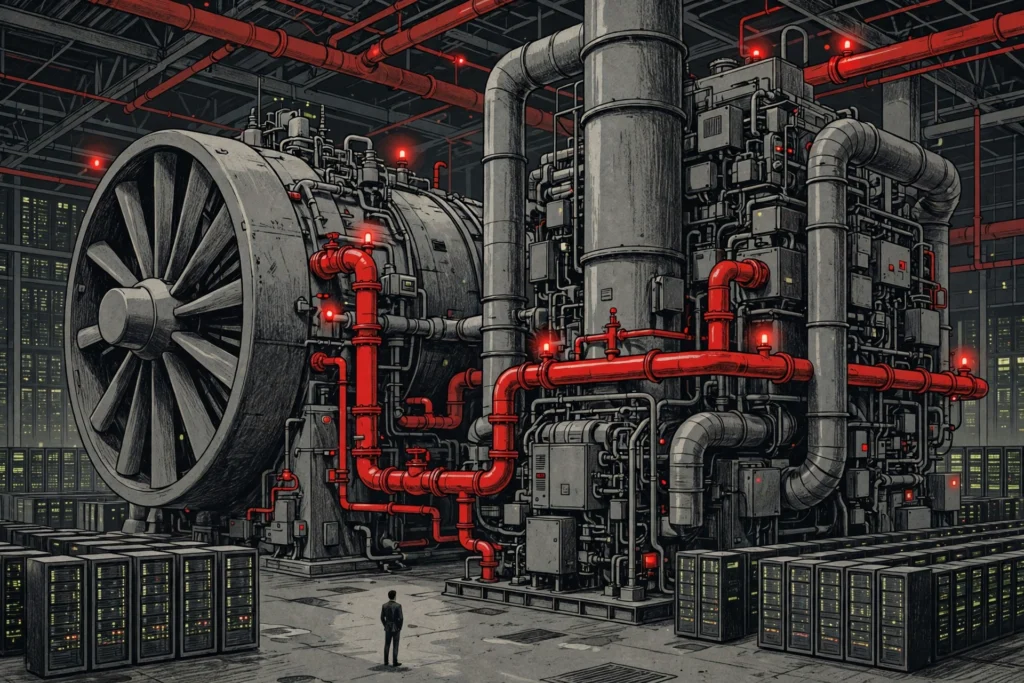
Picture a warehouse floor the size of several football fields, lined with steel turbines taller than a house. Each one can power a small city. SoftBank ordered them by the dozen, paid billions in advance, and waited for the AI boom to catch up.
It did not. On November 10, the Japanese group admitted that part of the bet had gone badly wrong — and the bill came to $3.7 billion.
The write-off pushed SoftBank to a net loss of about $7 billion for its fiscal second quarter, its first quarterly loss in almost two years, according to the Daily AI Brief. For a company that has staked its future on artificial intelligence, the timing could hardly have been worse.
SoftBank’s $9.5 Billion Shopping Spree for Power
The story starts with a subsidiary called Silver Bands 7, or SB7, backed by SoftBank and its second Vision Fund. Its job was simple in theory: secure the power equipment SoftBank’s American AI data centres would need before anyone else could buy it.
According to SoftBank’s own financial report, SB7 paid $9.48 billion through the end of September to reserve factory capacity and buy power-generation equipment. The company described the spending as “bridge investments in advance”, made in anticipation of shortages.
It was not a small precaution. The Wall Street Journal reported that SoftBank had reserved well over 13 gigawatts of gas turbines, largely with GE Vernova, between late 2025 and early 2026. That is more than six Hoover Dams’ worth of generating capacity.
The logic was easy to understand. In the AI race, the scarcest input is no longer just chips. It is electricity. Every new data centre needs gigawatts, and gas turbines have waiting lists measured in years. Buying early looked like the smart move.
Then the plan changed. SoftBank said SB7 revised its equipment procurement strategy “given the evolving requirements of its existing and planned projects”. In plain language, it had bought far more than it could use.
The $3.7 Billion Turbine Loss, Explained
The charge SoftBank recorded totals ¥597.2 billion, or about $3.73 billion. It has two parts, and both hurt.
The first is $2.85 billion in advance payments that will never come back. SB7 paid deposits to reserve turbines and factory slots, and when the orders were cut back, that money stayed with the suppliers. The second part is $0.88 billion for changing and settling contracts.
Not everything was lost. About $6.6 billion of the advances remains allocated to equipment for the PORTS-Pike power project in Ohio and other sites.
SoftBank also said it is entitled to rebates of up to $2.1 billion over ten years on future equipment purchases. It has not put those rebates on its books, because the amount cannot yet be determined.
Even so, the scale is striking: billions spent on equipment that will never be delivered.
Musk Called It a Default. SoftBank Disagrees.
Four days before SoftBank published its results, Elon Musk had already framed the story. On November 6, he wrote on X that “SoftBank is defaulting on their turbine orders.” The post travelled fast, and it set the tone for the coverage that followed.
SoftBank pushed back hard. Chief financial officer Yoshimitsu Goto told reporters the claim was “simply not correct at all”, adding: “There is no such default.” The company insisted it was revising its procurement plan, not breaking contracts.
The distinction matters. A default would suggest suppliers left unpaid and projects in chaos. A revision means a company changing its mind and paying the price for doing so.
GE Vernova, the turbine maker named in the Journal’s reporting, said SoftBank remains a valued customer and that the announcement had no financial impact on it. Musk, undeterred, returned to the subject after the Journal story circulated, reviving an old jab about SoftBank’s $12 billion WeWork investment.
The feud is entertaining, but it hides a more serious question. How did one of the world’s most aggressive AI investors end up holding billions of dollars of power equipment it does not need?
What Happens to the PORTS-Pike Campus in Ohio
The centrepiece of SoftBank’s American data-centre plan is PORTS-Pike, a technology campus in Pike County, Ohio, on the site of a former uranium enrichment plant. On August 17, SoftBank signed a 20-year agreement leasing the full 8 gigawatts of the site to OpenAI.
That project is not being cancelled. SoftBank said the $3.7 billion loss was unrelated to PORTS-Pike, and Goto said the company is not discussing downsizing the Ohio project.
A deal announced in March, tied to the Japan-US trade agreement, calls for the Japanese government to fund a $33 billion, 9.2-gigawatt gas plant beside the campus, with SoftBank as builder and operator.
Construction is scheduled to start early next year. SoftBank plans to fund such projects with project finance that does not reach back to the parent company — a structure designed to keep the risk off its own balance sheet.
The Ohio campus explains why SoftBank bought turbines so aggressively. An 8-gigawatt data centre needs an enormous amount of power, and the company wanted the equipment secured before construction began.
The mistake was buying for everything else as well.
SoftBank has not cancelled its Milam County site in Texas either. The remaining equipment, it said, “will be used for PORTS-Pike power generation project and others”. The question is how much of that $6.6 billion still on the books will actually find a home.
The Quarter Behind the Charge
The turbine loss landed in a difficult quarter. SoftBank lost ¥1,115.3 billion, about $7 billion, attributable to shareholders in the three months to September, against a ¥2.5 trillion profit a year earlier. It was the group’s first quarterly net loss in almost two years.
Net sales rose 13.3% to $26.4 billion, so the loss was not about a collapsing business. It was about paper values and one-off charges. The power-equipment write-off made up most of the ¥669.9 billion in other losses recorded in the quarter.
OpenAI, SoftBank’s biggest bet, did not help or hurt much. Its valuation was essentially flat in the quarter, which matters because SoftBank’s profit swings with the paper value of a handful of holdings. The group’s cumulative investment in OpenAI now stands at $64.6 billion, according to its results presentation.
That figure is worth pausing on. SoftBank has poured more into OpenAI than most countries spend on defence in a year.
The PORTS-Pike lease, the turbine orders and the $3.7 billion loss are all chapters of one story: a company betting its balance sheet on AI infrastructure paying off at a scale nobody has seen before.
Why Power Is Now the AI Race’s Bottleneck
SoftBank’s stumble is not an isolated accident. Across the industry, the fight for AI supremacy has quietly become a fight for electricity. Chips can be ordered, buildings can be raised, but a gigawatt of power takes years to arrange — and everyone wants it at once.
SpaceX announced plans on November 12 to spend more than $74 billion on two AI supercomputing campuses in Texas and Arizona, with the Arizona site alone drawing up to 6 gigawatts at full build. The projects face local votes on December 9, and neither is approved yet.
Meanwhile, the companies that actually run the data centres are booming. CoreWeave’s revenue jumped 168% in the third quarter as demand for AI computing overwhelmed supply, and its order backlog swelled to $132.5 billion.
The demand is real. The question is whether the power to serve it can be built fast enough.
That is what makes SoftBank’s loss so instructive. It bought early, paid in advance, and still got it wrong — not because demand disappeared, but because its own plans changed faster than the equipment could be delivered. In a market where a single campus can need a decade’s worth of turbines, flexibility is expensive.
OpenAI itself is not standing still. Its revenue passed $10 billion in the third quarter, even as its losses widened. The appetite for power is only growing.
SoftBank simply bought too much of it, too soon, for projects that no longer exist in their original form.
What Happens Next for SoftBank
The immediate fallout is financial. The $3.7 billion charge is booked, the $2.85 billion in advances is gone, and the $0.88 billion in contract settlements will be paid in cash from next quarter. The rebates of up to $2.1 billion are real but conditional, spread over a decade, and unbooked.
The bigger test comes early next year, when construction at PORTS-Pike is due to begin. If the Ohio campus proceeds on schedule, SoftBank can argue the turbine episode was a costly but survivable over-order.
If it slips, the questions will sharpen. Investors will want to know how a company that prides itself on seeing the future misjudged its own power needs by billions of dollars.
For now, the lesson is plain. In the AI era, the most expensive mistakes are not always about models or chips. Sometimes they are about the unglamorous machinery that keeps the lights on — ordered too early, in too great a quantity, for a plan that changed before the turbines ever arrived.