It is just after nine on a Friday morning in Sydney, and the first customers are already holding Apple’s newest idea for the home in their hands.
After years of rumours and a delay that pushed it from spring 2025 to this winter, the Apple HomeView is finally a real product you can walk out of a shop with.
Apple HomeView is the company’s first smart display, a 7-inch screen built around Siri AI that is meant to sit at the centre of the house. It costs $299, it goes on sale in eight countries today, and the first reviews are already in — praising the hardware, and asking pointed questions about the software.
Apple HomeView: what you actually get for $299
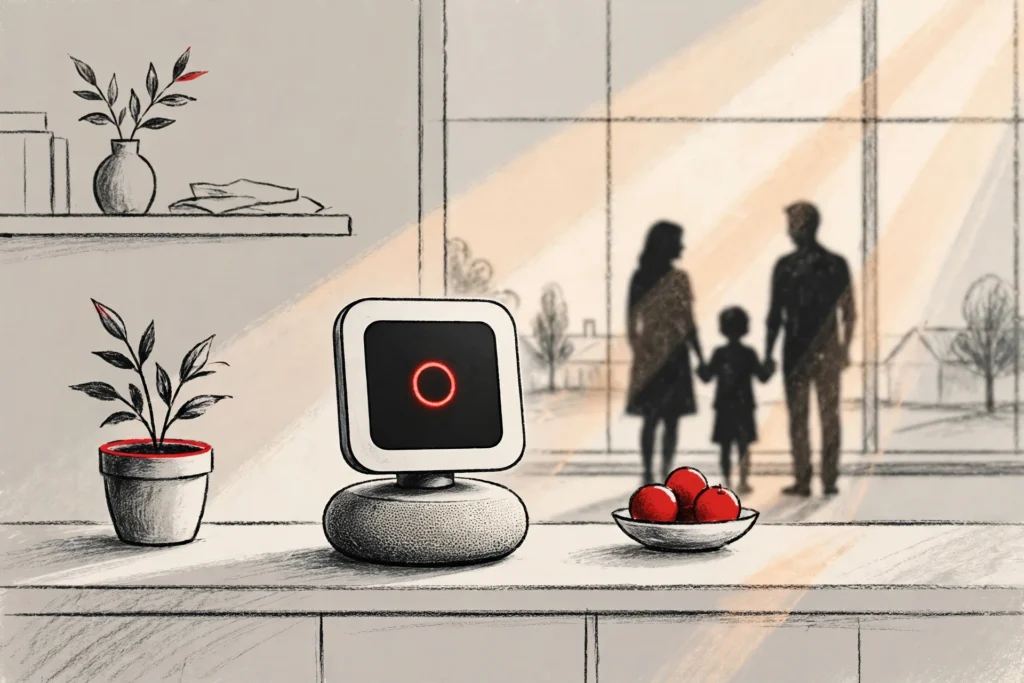
At its simplest, HomeView is a cross between a small iPad and a HomePod. The square 7-inch Liquid Retina display sits on an aluminium speaker base, joined by a stainless steel hinge that lets you tilt the screen to the angle you want.
The screen measures 1088 by 1088 pixels at 220 pixels per inch, with True Tone to match the light in the room. Inside is Apple’s A18 chip, the same silicon that powers the iPhone 16 range, and it runs the whole device on its own.
There are two versions, and both cost the same $299. The tabletop model comes with the speaker base in silver, starlight, rose pink or space gray. The wall-mounted version comes in space gray or silver, but you will need to buy the mounting hardware separately.
Reviewers who have lived with it for a week say the hardware is the easy part to love. The display is sharp, the speaker sounds far better than a device this size has any right to, and the whole thing looks unmistakably Apple on a kitchen counter.
Siri AI is the whole point of Apple HomeView
Apple did not build HomeView to sell you another screen. It built it to give Siri AI a permanent home. The new Siri, which debuted with iOS 27, is the voice that runs the device, and it is the reason this product exists at all.
Ask it to turn off the lights, read your messages, check your calendar or start a FaceTime call, and it answers in conversation rather than with a list of commands.
It pulls personal context from the iPhone or iPad it is paired with, so it can tell whose day it is describing when several people share a house.
That shared-home idea goes further than voice. HomeView recognises up to six people by face, and shows each of them their own calendar, reminders and messages when they step in front of it. It is the first Apple device designed from the start to be used by a whole household, not one person.
There are 18 built-in apps, including Home, Music, Safari, FaceTime, Calendar, Podcasts, Messages, Intercom, Weather, Find My, Reminders and Timers. What there is not, deliberately, is a conventional App Store — Apple has kept the software tightly focused on the home.
What the first Apple HomeView reviews say
The review embargo lifted on Thursday, a day before launch, and the verdicts landed in a remarkably similar place. The hardware earns praise almost everywhere, while the software draws the questions, according to MacRumors’ round-up of the first reviews.
The Verge gave HomeView 7 out of 10. Its senior smart home reviewer, Jennifer Pattison Tuohy, tested tabletop and wall-mounted units in the kitchen, entryway, bedroom and office, and called it a strong favourite for families — with one serious friction.
During testing, one family member was able to access another’s messages on the shared screen. For a device that lives in the kitchen and shows personal texts, calendars and reminders, that is the kind of flaw that matters more than any spec sheet.
TechRadar scored it 4 out of 5, and ZDNET went higher at 4.5 out of 5. Both praised the screen, the speaker quality and the smart home controls.
Both also noted the same limits: Siri AI can be slow, it is less capable than Alexa+ or Gemini in many tests, and the device leans heavily on a nearby iPhone.
CNET framed the same problem from a different angle. Smart homes are full of accessories from different manufacturers and ecosystems, and HomeView does not magically bring them all under one roof. It works best, every reviewer agrees, when the household is already deep inside Apple’s world.
The catch: Apple HomeView needs your iPhone nearby
HomeView is not a standalone device in the way an iPad is. Setting it up needs an iPhone running iOS 27.2 or later, or an iPad on iPadOS 27.2 or later, and many of its smartest tricks only work when that phone or tablet is at home on the same Wi-Fi network.
That is because the personal Siri AI features run through your own device. When your iPhone is on the home network, the display acts as an extension of it, pulling in your texts, calendars and reminders. Take the phone away, and much of the magic goes with it.
It is a trade-off Apple has made on purpose. Keeping personal data on your own hardware, processed through the A18’s Secure Enclave, is the privacy story Apple wants to tell. The cost is that HomeView is less independent than Amazon’s Echo Show or Google’s Nest Hub, and it costs more than both.
The wall-mounted version also needs roughly $100 of extra mounting hardware, on top of the $299 price.
Apple TV 4K launches today too
HomeView is not arriving alone. The fourth-generation Apple TV 4K reaches stores on the same day, also priced at $299, with Apple’s A19 chip that the company says is up to 50 percent faster on the CPU.
Apple is also opening pre-orders today for the first three accessories in its Apple Home Collection: two security cameras and a video doorbell, made with LG. More accessories from LG and Schneider Electric are scheduled for early 2027.
Put together, it is the biggest smart-home push Apple has ever made. The company announced HomeView and opened pre-orders on October 13, entering a category Amazon and Google have owned for nearly a decade, after a delay from a planned March 2025 debut because Siri AI was not ready.
HomeView goes on sale today in the United States, Australia, Canada, India, New Zealand, Singapore, South Africa and the United Kingdom. It is not available in the European Union, because Siri AI is not offered there yet, and Apple has withheld the launch indefinitely while regulatory reviews continue.
Should you buy an Apple HomeView?
The honest answer depends on the house you already live in. If your lights, locks, cameras and speakers already run through Apple Home, and everyone in the family carries an iPhone, HomeView slots into place in a way no rival can match.
The screen is lovely, the sound is strong, and Siri AI finally has a room of its own.
If your home is a mix of brands, or nobody in the house uses an iPhone, the case is weaker. At $299, HomeView costs more than the Echo Show and Nest Hub ranges, does less on its own, and asks you to wait until December for a software update that fixes some of its roughest edges.
Apple’s own history suggests the software will get better. The company has already said a December update will improve Siri on HomeView, including voice unlocking for compatible doors and garage doors once the device recognises who is asking. The hardware, reviewers agree, is already good enough.
For now, the first customers walking out of Apple Stores in Sydney are buying a promise as much as a product: that the screen in the kitchen becomes the centre of the home, and that Siri AI finally grows up enough to run it.
Whether that promise holds will be decided in the weeks after launch, one family kitchen at a time.
Apple Intelligence is still rolling out in stages around the world. If you want the wider picture, read our report on Apple Intelligence clearing its regulatory hurdle in China, and our look at Apple’s new $50 Intelligence Usage Packs.
For what Siri AI might do next, see our report on the iOS 27.3 beta, where Siri AI could soon read your sleep, workouts and medication logs.