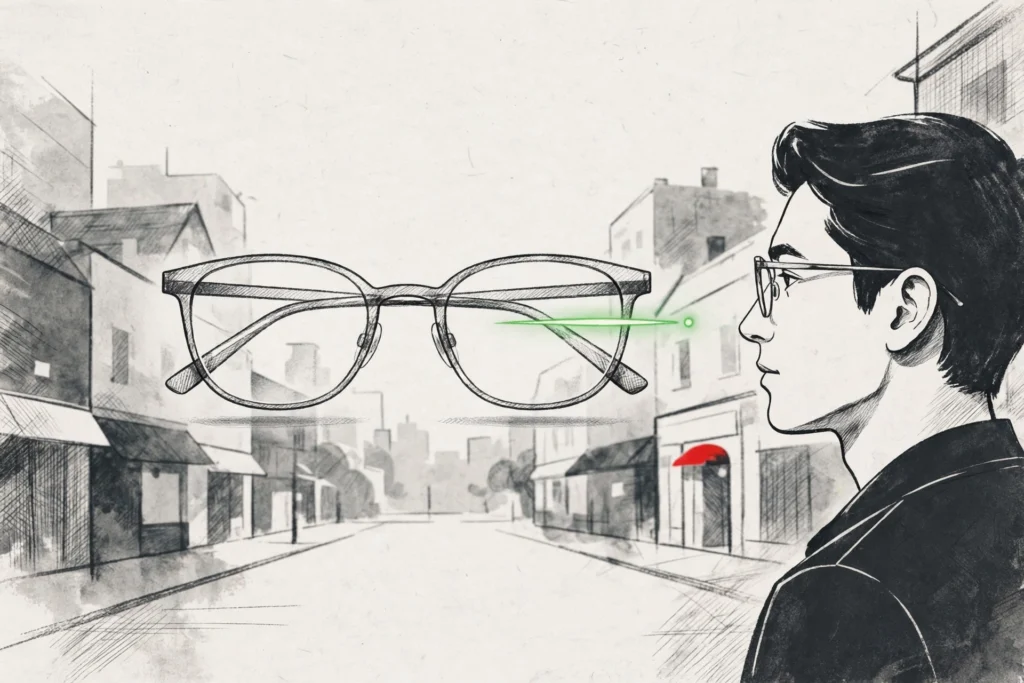
Picture this. You are walking through a busy street in New York, late for a meeting, when a poster catches your eye. Instead of pulling out your phone, you simply ask out loud. The answer comes back through your Samsung Intelligent Eyewear frames, quietly, in your ear, and you keep walking.
That is the promise of Samsung Intelligent Eyewear, the Gemini-powered smart glasses Google and Samsung have been building toward for more than a year. On Friday, the glasses finally got the one thing they were missing: a price tag.
Warby Parker frames start at $395. Gentle Monster frames start at $449 and run up to $489, depending on the frame. Pre-orders opened on November 12 in the United States, and general sales begin on December 10, just in time for the holiday season.
Until now, the glasses were a known quantity in every way except the one that matters most at the checkout. When pre-orders opened yesterday, Samsung and Google had confirmed the designs, the features and the December date, but not the price.
Friday’s launch announcement fills that gap. It also confirms the full shape of the range: 30 designs across two fashion brands, built on Google’s Android XR platform with Gemini at the centre.
Samsung Intelligent Eyewear Price: Two Brands, Two Starting Points
The headline number is $395. That is where the Warby Parker collection begins, and it is a deliberate piece of positioning.
Meta’s Ray-Ban Meta Gen 3, launched in September, costs $449. Google’s entry-level frames undercut Meta’s newest camera glasses by $54, according to Business Standard.
Gentle Monster sits higher. Its collection starts at $449, matching the Ray-Ban Meta Gen 3, and climbs to $489 for selected coloured frames. In South Korea, where Gentle Monster’s collection is also sold, prices run from 650,000 to 700,000 won including tax.
Warby Parker’s collection, by contrast, is available only in the United States. There is also one cost the launch does not settle: prescription lens add-ons are available, but neither brand has confirmed what they will add to the final total, so check the price at checkout.
Thirty Designs, Two Very Different Personalities
The range is split between two brands with very different ideas about what glasses should look like. Gentle Monster contributes six frame styles in 16 variations, with bold coloured frames and lenses that carry the Korean brand’s unmistakable fashion-forward character.
Warby Parker offers three designs, Alden, Reid and Wren, in 14 variations. They come in colours including Pine, Saddle and Jet Black, with optical and sunglass options in different widths.
That split is the point. Google and Samsung are selling the same technology inside two distinct fashion identities, one loud and one understated, and letting buyers choose the one that fits them.
Both collections go on sale on December 10. Gentle Monster’s first United States pre-order batch runs from November 12 to 15, and a public exhibition in New York runs from November 13 to 23.
What the Glasses Actually Do
Strip away the fashion, and the glasses are a way of carrying Google’s Gemini assistant on your face. Say “Hey Gemini” or tap the frame, and the assistant is listening.
Ask about the street art in front of you. Get a recommendation based on a book you are looking at. Check whether you are free after glancing at an event poster. The 12-megapixel ultra-wide camera feeds Gemini what you see, and the open-ear speakers deliver the answer without covering your ears.
Navigation works the same way. Google Maps turn-by-turn directions arrive through the speakers, so you can follow a route without staring at a screen. Google Translate handles real-time speech translation with automatic language detection across more than 70 languages.
Everyday tasks are covered too. Ask Gemini to add an item to a grocery list or set a reminder based on something you see. Hands-free calls, messaging and notifications work through the frames, and music plays through YouTube Music, Spotify or Apple Music.
It is the same assistant that lives in your phone, moved to a place where you never have to reach for it. The same idea drives Gemini Intelligence on Pixel phones, which brings the assistant deeper into the device you already carry.
Guided Vision and the Accessibility Angle
One feature deserves more attention than the launch headlines gave it. Guided Vision provides spoken descriptions of surroundings and text for people who are blind or have low vision.
Through a partnership with Aira, users can also connect the glasses’ camera feed to a trained human visual interpreter for live assistance. A device that can describe a street crossing, read a menu aloud or identify a bus number is not a novelty for the person who needs it.
A Camera, a Speaker and No Screen
There is one thing the glasses deliberately do not have: a display. Unlike the heads-up displays in some rival concepts, these frames show you nothing. Everything comes through sound.
Google has said a version with a display is coming later, but it has given no date. Buyers should assume the screenless experience is the product for now.
Inside the frames sits a Qualcomm Snapdragon AR1 Gen 1 chip, with 2GB of RAM and 64GB of storage. The glasses weigh around 41 grams, which puts them in the same territory as ordinary eyewear rather than a headset.
Battery life is rated at up to nine hours on a single charge, and the charging case can recharge the frames up to seven times, depending on usage. That weight matters more than the spec sheet suggests.
The first generation of smart glasses failed partly because they felt like hardware on your face. At 41 grams, with no display and no visible bulk, these are designed to disappear. Whether they succeed depends on how they feel after eight hours, not eight minutes in a shop.
Battery, Weight and the Phone in Your Pocket
The glasses are not standalone. They need a compatible smartphone and a Google account, and they only work with Google accounts in the United States and South Korea for now.
Supported phones include Google Pixel 7 series and newer, Samsung Galaxy S and Z series devices running One UI 9.0 or later, and iPhone 13 Pro and newer models. Users must be 18 or older to activate them.
That list is wider than it looks: most buyers in the launch markets will already own a phone that works. The catch is the account restriction. No India launch has been announced, and buyers elsewhere must wait until next year.
Privacy: The Question Every Smart Glasses Maker Must Answer
Smart glasses live or die on trust, and Google clearly knows it. When you capture a photo or video, an indicator light on the frames tells people nearby that recording is happening.
The glasses are designed to stop recording if that light is covered or disabled. That is a direct answer to the oldest complaint about camera glasses.
Google also says camera visuals processed by Gemini are not saved in Gemini History and are not used to train its AI models or target advertisements. Faces of bystanders are automatically blurred in camera visuals before Gemini processes them.
Users control which apps can access the camera and microphones, changing permissions at any time. There is also a physical switch that turns the frames off completely, so they can be worn as ordinary glasses.
The details still deserve a careful read. Google’s help page says activity is auto-deleted after 18 months while reviewed chats can be retained for up to three years, with no separate retention period stated for glasses conversations. Even so, the privacy package is more thorough than anything Meta offered at launch.
How They Stack Up Against Ray-Ban Meta — and What Happens Next
The comparison everyone will make is with Ray-Ban Meta. Meta’s glasses start at $349 for the audio-only model and $449 for the Gen 3 camera glasses, so Warby Parker’s $395 sits neatly between the two, while Gentle Monster’s $449 matches Meta’s flagship.
Google’s advantage is Gemini itself, a more capable assistant than Meta AI, plus translation and accessibility features Meta does not match. Meta’s advantage is scale: Ray-Ban Meta glasses have sold for years, and millions already own a pair.
Google is arriving late to a market Meta created, with a product that only works in two countries and needs a phone and a Google account. The race is still early, and the AROTI R1 shows how crowded it is getting, with lightweight AI glasses arriving from startups as well as giants.
What the Samsung launch proves is that the category has moved from experiment to product. Thirty designs, two fashion brands, a real price and a real date: this is no longer a demo.
The question now is whether people will pay $395 to put Gemini on their face, and whether Google can keep the privacy promises that make that purchase feel safe. For now, the glasses are a statement of intent as much as a product.
Google and Samsung have built the hardware, signed the fashion brands and set the price. On December 10, the market gets to answer. According to Business Standard, pre-orders are already open, and the first buyers will soon find out whether AI glasses are ready for everyday life.