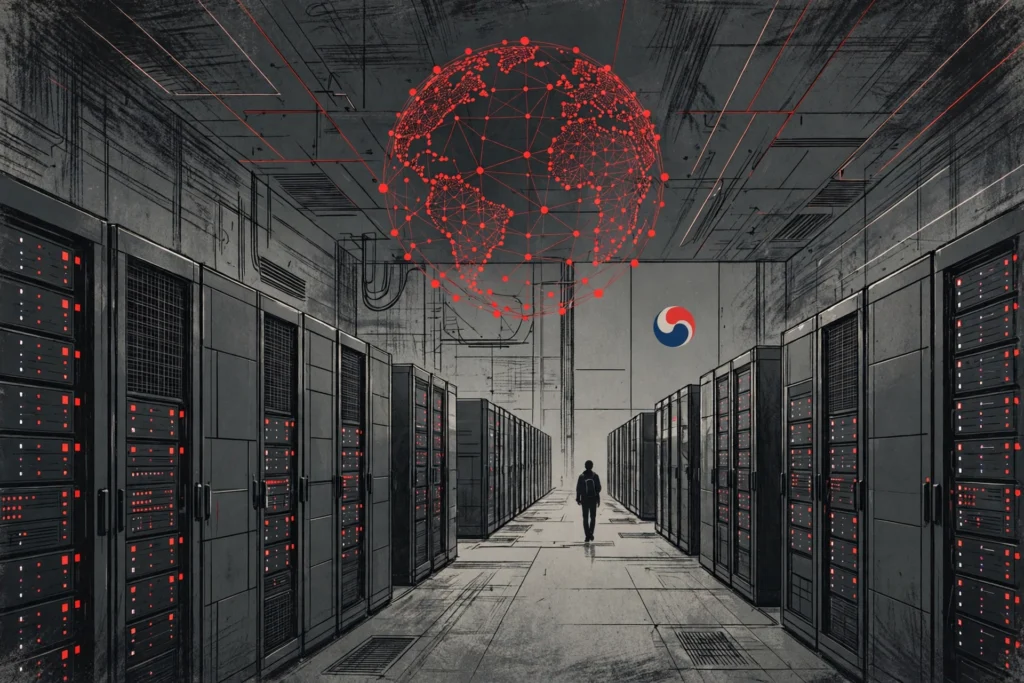
What the NAVER AI Factory Deal Covers
On Thursday, NAVER’s chief executive Choi Soo-yeon told investors the company had signed its first customer under the NAVER AI factory deal, a computing services contract worth about 2 trillion won, roughly $1.5 billion, with an unnamed American AI inference company.
The customer will take about 20 megawatts of computing capacity over four to five years, according to NAVER chief financial officer Kim Hee-cheol. Revenue from the contract will be recognised gradually across that period, starting when commercial service begins in the first half of 2027.
That makes the agreement the first paying customer for a project NAVER has been assembling for months. Until now, the AI factory was a plan with partners and a construction schedule. Now it has a customer, a price tag and a delivery date.
NAVER did not name the customer. What it did say is that the buyer runs AI inference workloads — the everyday business of answering questions, generating text and serving models to users, rather than training new ones.
Korean business media, including The Korea Times, reported the deal on Thursday, hours after NAVER’s earnings call.
Why a US Inference Company Chose NAVER
Inference companies live or die on two things: access to the newest chips and enough electricity to run them. Both are in short supply. The world’s biggest AI labs have spent the past two years locking up power and hardware years in advance.
NAVER’s pitch is simple. It has the land, the power contracts and the backing of Nvidia itself. The customer gets next-generation chips without waiting in the queue behind the giants, and NAVER gets a flagship client for a business it wants to scale far beyond South Korea.
The deal also shows how the AI infrastructure market is widening. A year ago, almost every headline about AI data centres belonged to American companies. Now a Korean internet company is selling computing power to an American customer.
Brookfield, the Canadian asset manager, brings the capital and the data-centre development experience. NAVER brings the local know-how and the relationship with Nvidia. It is a three-way partnership, and each side covers a weakness of the others.
That structure is becoming common in AI infrastructure. Chipmakers want guaranteed demand, financiers want long contracts, and local operators want world-class hardware. NAVER’s deal shows the model working in practice, not just on paper.
That reversal matters. NAVER is best known outside Korea for its search engine and its LINE messaging app. This contract reframes it as an infrastructure company, one that sells the raw computing power other firms need to run their AI products.
The B300 and Vera Rubin Hardware Behind the Deal
The contract covers a mix of Nvidia’s newest graphics processors, according to Korean business media. The customer will receive B300 chips alongside Vera Rubin, the next-generation platform Nvidia is rolling out to replace its current Blackwell line.
Vera Rubin is the same hardware at the centre of the industry’s fiercest rivalry. AMD has spent the autumn positioning its new MI450X chip directly against it, while Google and its partners push their own custom silicon as an alternative.
For NAVER, supplying both chips is a deliberate choice. It lets the company serve customers who want the proven B300 today and those betting on Vera Rubin tomorrow, without tying its future to a single generation of hardware.
The contract period depends on the chip type, running four to five years. That is a long commitment in an industry where a chip generation lasts barely two years, and it signals that the customer expects to keep coming back for more.
NAVER’s Bigger AI Factory Ambition
The 20-megawatt deal is only the opening act. NAVER plans to switch on 55 megawatts of AI factory capacity in the first half of 2027, expand to 100 megawatts by the end of that year, and reach 200 megawatts by 2028.
Choi told the earnings call that NAVER has already secured contracted data centre capacity beyond its 200-megawatt target for 2028. The company is now negotiating with more than ten prospective customers outside Asia, including major AI model developers, for the remaining roughly 180 megawatts.
The ultimate vision is far larger still: an AI computing network on the scale of one gigawatt. That would put NAVER’s infrastructure ambitions in the same league as the hyperscalers it hopes to serve.
NAVER is also in talks with Nvidia about a server purchase order that Korean media describe as potentially the largest in Asia. The details have not been disclosed, but the direction is clear — NAVER wants to be a serious supplier, not a niche player.
What the Deal Means for NAVER’s Earnings
The contract arrived alongside NAVER’s third-quarter results, and the numbers show why the company needs new growth. Quarterly revenue hit a record 3.47 trillion won, up 10.7 percent on the year, but operating profit fell 20.9 percent to 451.3 billion won.
The squeeze came from higher spending on AI infrastructure, content and offline data. NAVER is paying now to build the capacity it hopes will pay off later — the same trade-off every AI infrastructure company is making.
The pattern is familiar across the market. CoreWeave reported revenue up 168 percent in its latest quarter, Nebius grew 571 percent, and Cerebras signed Microsoft as its third hyperscaler customer — all of them spending heavily now to capture demand later.
Management expects the AI factory to start generating operating profit in 2027, with margins reaching well into double digits from 2028, when full-scale operations begin. The first contract is the proof point investors were waiting for.
NAVER is not betting everything on data centres. Choi also pointed to AI agents and logistics as growth pillars, with a major investment planned in fulfilment services. But the AI factory is the most concrete of the three, and the only one with a signed customer.
It is worth remembering what NAVER actually is. In South Korea it is the dominant search engine, the company behind the LINE messaging app, and the developer of HyperCLOVA X, its own family of AI models. The AI factory is the infrastructure arm of that same business — selling compute to others while using it at home.
What Happens Next
The first test comes in the first half of 2027, when the initial 55 megawatts go live and the first revenue from the contract starts flowing. If delivery runs on schedule, NAVER will have a working showcase to offer the ten-plus companies it is already talking to.
The second test is whether NAVER can keep winning customers beyond its first. The remaining 180 megawatts of its first phase are still uncontracted, and the company will need to convert those talks into signed deals to justify the build-out.
There is also the question of the unnamed customer. Inference companies rarely stay anonymous for long, and the identity of the buyer will say a lot about how the market views NAVER’s offering.
Watch too for the server order NAVER is negotiating with Nvidia, described in Korean media as potentially the largest such order in Asia. If it lands, it will show that NAVER is not just reselling capacity — it is buying hardware at a scale few companies outside the hyperscalers can match.
For now, though, the deal stands on its own. A Korean company once known for search has sold $1.5 billion of computing power to an American AI firm — and it did it before a single watt of its new AI factory was switched on.