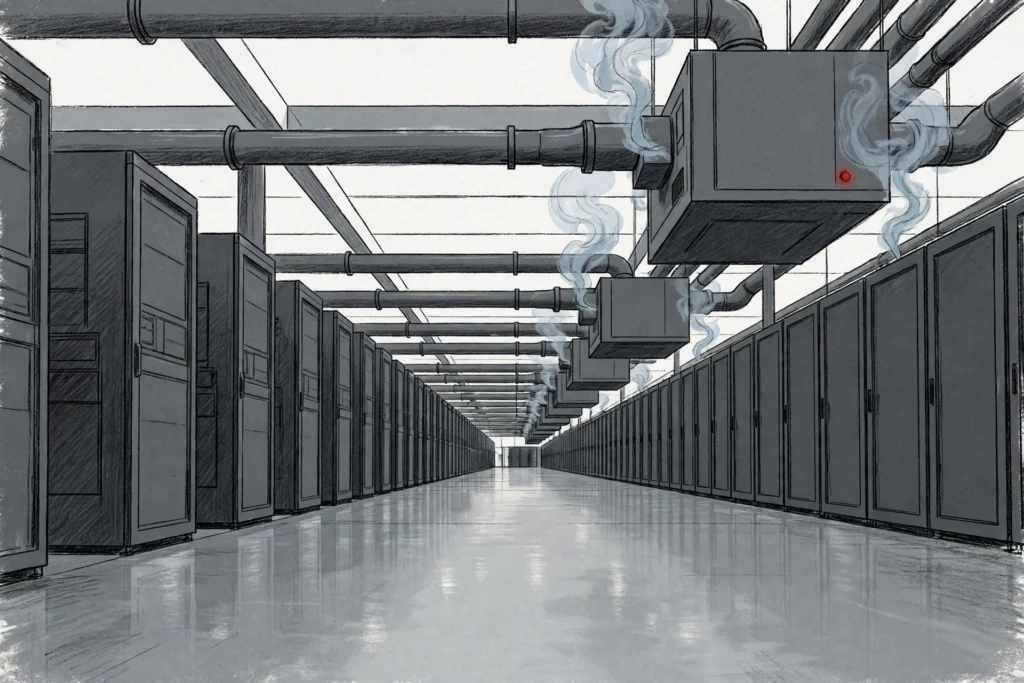
Picture a warehouse the size of several football fields, packed with row after row of machines that never sleep. The air hums. The floor vibrates faintly. And every single rack inside is quietly generating heat — so much heat that keeping the building cool has become one of the most expensive problems in modern technology.
Now picture Samsung, the world’s biggest memory-chip maker, deciding that the answer to that problem is worth up to $8 billion. That is the scale of the deal now reportedly on the table, according to Bloomberg, and if it closes, it would be the largest acquisition in Samsung Electronics’ history.
The target is Modine Manufacturing, a 110-year-old American company from Racine, Wisconsin, that most people have never heard of. In the world of artificial intelligence, though, Modine has become a name that matters — because it builds the giant chillers and cooling systems that stop AI data centers from cooking themselves.
The Samsung Modine Acquisition in Numbers
The headline figure is striking. Samsung is in talks to buy Modine for an estimated $7.5 billion to $8 billion, according to reports carried by the Seoul Economic Daily.
That price assumes a full takeover of the company. It would apply a control premium of roughly 33% to 42% to Modine’s market value of $5.64 billion before the reports emerged.
For Samsung, the sums are manageable. The company held about $161 billion in cash and cash equivalents at the end of the third quarter, so Modine’s entire market value equals only about 3.5% of that pile.
The deal would still be a landmark. Samsung’s biggest purchase to date is the $8 billion it paid for Harman International in 2017, and a Modine deal at the top of the range would match or pass it.
Investors reacted fast. Modine’s shares jumped more than 33% when trading opened on Friday, and they had already risen more than 28% in after-hours trading the evening before, climbing above $135 from a regular-session close of $106.10.
Nothing is signed, however. People familiar with the talks caution that no final decision has been reached, a deal could still come together within weeks, and the negotiations could also fall apart or draw in a rival bidder. Samsung said it could not confirm the report, and both companies declined to comment.
Why Cooling Became AI’s Hottest Bottleneck
To understand why a phone-and-chip giant wants to buy a cooling company, start with what happens inside an AI data center. The graphics processors that train today’s AI models draw enormous amounts of power, and nearly all of that power turns into heat.
Older data centers cooled their racks with air, much like a giant office air-conditioning system. That approach is running out of room.
The newest AI hardware packs so much power into each rack that air alone can no longer keep up. Operators are switching to liquid cooling — chilled water and coolant pumped directly to the chips.
That shift has turned cooling from a back-office utility into a strategic bottleneck. Whoever controls the chillers, the coolant distribution units and the precision air-conditioning controls the pace at which new AI data centers can be built. Samsung clearly wants a seat at that table.
The timing is no accident either. Spending on AI infrastructure is surging across the industry, with cloud giants and neocloud providers reporting triple-digit revenue growth as they race to add capacity. Every new hall of servers needs cooling, and the companies that supply it are suddenly some of the hottest assets in tech.
What Modine Actually Makes
Modine was founded in 1916 and spent most of its history making heating and cooling equipment for vehicles and industrial buildings. Its data center business is newer — and it is growing at a pace that explains Samsung’s interest.
In the third quarter, Modine’s data center segment brought in $439.7 million in revenue, up 95% from a year earlier. For its fiscal year ending in March 2027, the company has forecast total revenue of up to $3.2 billion, with the data center division doing the heavy lifting.
Under its Airedale brand, Modine produces large chillers, precision air-conditioning units and coolant distribution units. Those are the three pieces of hardware that keep a liquid-cooled data center running.
In May, it signed a long-term contract with a single customer to supply more than $4 billion worth of cooling equipment from 2027 to 2029, receiving a $165 million advance payment in the process.
The company is also expanding its American footprint. On November 11, Modine began mass production of 2- to 3-megawatt data center chillers at a new plant of about 63,400 square metres in Grand Prairie, Texas.
For Samsung, buying that factory and its order book would be far faster than building a US cooling business from scratch.
Samsung’s Cooling Play Didn’t Start in Wisconsin
The Modine talks are the second act of a strategy Samsung began last year, when it bought Germany’s FläktGroup for €1.5 billion. That deal gave Samsung a European foothold in air-conditioning and data center cooling technology.
Modine would add the missing piece: North American production, American customers and a direct line to the world’s largest data center market.
Samsung is also investing 240 billion won in a production line for cooling equipment at its Gwangju plant in South Korea.
Taken together, the three moves sketch out a global cooling business spanning Europe, North America and Asia. It is a deliberate attempt to serve the same Big Tech customers that already buy Samsung’s memory chips.
That customer overlap is the real prize. Samsung already sells high-bandwidth memory to the companies building AI data centers, and it wants to sell them the cooling as well. A Modine deal would turn Samsung from a component supplier into a provider of the whole data center environment.
The strategy echoes moves elsewhere in the industry. As NAVER’s $1.5 billion AI factory deal showed this week, and as SoftBank’s costly turbine bet underlined, the AI buildout is now as much about power and cooling as it is about chips.
The Hurdles Before a Deal
Even with both sides motivated, a Modine takeover has obstacles. Modine’s articles of incorporation require approval from more than two-thirds of total voting rights for a major merger, so Samsung needs broad shareholder support, not just a friendly board.
The shares are widely spread. BlackRock holds about 5.4%, with Vanguard funds holding roughly 4.5% and 4.1% respectively, so no single investor can deliver the deal alone. At a 33% to 42% premium, though, the offer would be hard for most shareholders to ignore.
There is also the question of rival bidders. Industrial conglomerates and private equity firms have been circling the same cooling assets, and a public report of Samsung’s interest could invite a competing offer. Two approaches are reportedly under discussion: a negotiated merger agreement with Modine’s board, or a direct approach to shareholders.
Regulatory review is another factor, though cooling equipment is a far less sensitive business than semiconductors. The deal would still need to clear the usual merger approvals in the United States and South Korea before it could close.
What Happens Next
If the talks hold, an agreement could arrive within weeks, according to the Bloomberg report carried by the Seoul Economic Daily. That would put an announcement somewhere around the end of November, with the shareholder vote and regulatory process stretching into 2027.
Watch Modine’s share price in the meantime. The 33% jump on Friday suggests investors believe a deal is likely, but any sign that talks have stalled would send the stock back down just as quickly. Samsung’s own silence — it would neither confirm nor deny the report — is standard practice while negotiations are live.
Either way, the story says something bigger about where the AI boom is heading. The race is no longer only about who builds the fastest chip.
It is about who can power it, cool it and house it — and Samsung is now willing to spend $8 billion to make sure it can do all three.