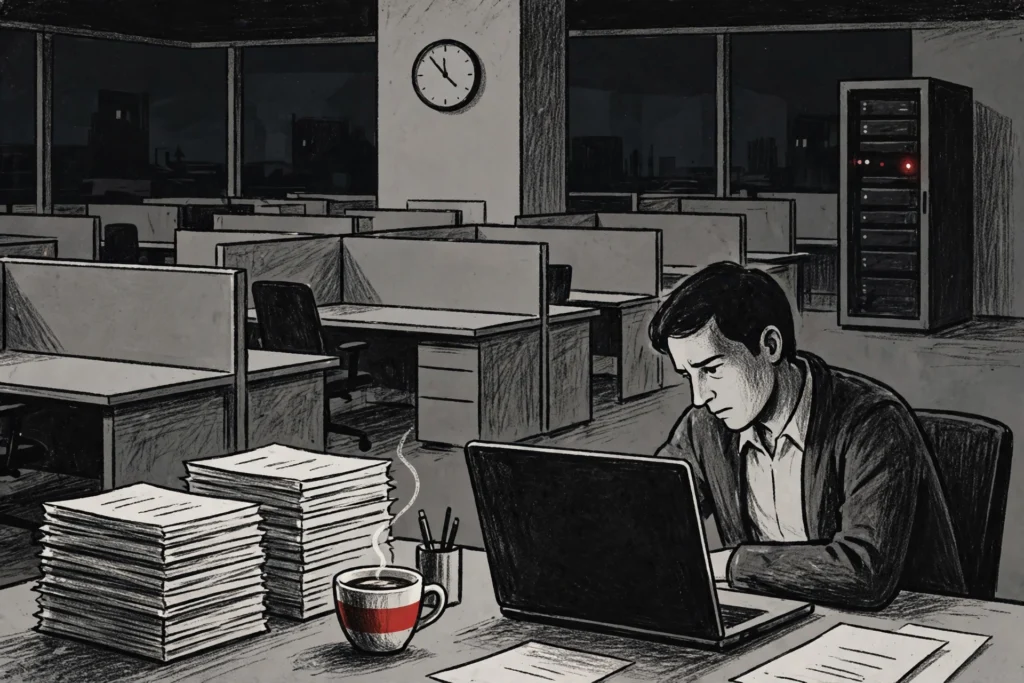
It was the end of a long week, and millions of workers were doing the most ordinary thing in the world: clocking out. They opened the app their employer uses for payroll, timekeeping and benefits — and found a message that stopped them cold. Workday was unavailable.
For the rest of Friday evening, the system that pays America simply was not there. No clocking in or out. No pay slips. No time-off requests. No benefits enrolment.
And the cause, when Workday finally explained it, was almost worse than a hack: nobody had attacked the company at all. Its own safety drill had broken the system it was supposed to protect.
What the Workday Outage Looked Like on Friday Night
The trouble began on Friday evening, November 13, 2026. Shortly after 5 p.m. Eastern time, outage tracker Downdetector logged nearly 3,000 reports from workers who could not reach the service, according to LiveNOW from FOX.
Employees who tried to sign in met a flat message: “Workday is currently unavailable.” Behind that message, scheduled jobs that feed other company systems were failing, and integrations that sync Workday data with payroll and benefits platforms had stopped working.
Workday is the cloud platform that runs payroll, timekeeping, benefits and human resources for more than 11,500 organisations worldwide. Its public client list includes Walmart, Target, Netflix, Chipotle, Southwest Airlines, the US Department of Energy and NASA’s Jet Propulsion Laboratory.
But the company has only ever said that “some” of its customers were affected — and it has not named them. Reports naming specific employers were based on an unnamed source, so they should be treated as unconfirmed.
The scale of the disruption is real either way: when the platform that handles pay goes dark, every affected employer feels it within hours.
A Disaster Recovery Test That Hit the Live System
The cause of the Workday outage was, by the company’s own account, self-inflicted. Workday was validating the weekly maintenance window for its disaster recovery tenants — a routine check of the backup systems that exist so a failure in one place cannot spread to another.
During that validation, something went badly wrong. In a notice posted on its customer status page and quoted by university IT departments, Workday said that services inside the disaster recovery site “unexpectedly connected to Production databases”.
The result was data left in what the company called “an inconsistent state”. In plain language, the backup environment had touched the live customer databases — the one thing a disaster recovery setup is designed never to do — and the records no longer matched up cleanly.
That mismatch could cause errors when people opened their accounts, or make scheduled jobs, integrations and tasks fail with missing transaction errors. Workday’s response was to put all of its WD1 production tenants into maintenance and promise updates every 30 minutes while engineers worked on a fix.
A backup copy exists so trouble in one place cannot reach the other. Here, the test reached the real thing — and the real thing paid the price.
What Workers Could Not Do During the Workday Outage
For the employees caught in the outage, the impact was immediate and practical. Staff could not clock in or out at the end of their shifts. They could not check their pay information or see upcoming pay details. They could not request time off, and they could not finish benefits enrolment.
The timing made it worse. The outage landed during open enrolment season, when many American workers choose their health benefits for the coming year. Emerson College in Boston told its community that Workday had taken the system offline at about 5:15 p.m. Eastern on Friday.
Emerson then extended its open enrolment deadline to Monday, November 16, because staff could not complete their choices.
Hiring-software firm Ashby also reported that Workday’s API for the WD5 data centre was refusing connections, so syncs failed for customers hosted there.
The Third Big Outage in 48 Hours
The Workday outage did not happen in isolation. It was the third major technology failure in barely two days, and the pattern is hard to ignore.
On Thursday, November 12, Microsoft’s email and chat services went down around the world. Outlook, Teams, Copilot and Exchange-dependent services were offline for more than 24 hours across 70 to 74 countries, hitting hospitals, police forces, courts, schools and businesses — a failure we covered in our report on the Microsoft 365 outage.
Then on Friday, November 13, the Federal Aviation Administration halted every departing flight in the United States for more than four hours after a telecom outage affected all 22 air-route traffic control centres, as we reported in our coverage of the FAA ground stop.
And on Friday evening, Workday joined them. Three systems, three different causes, one shared lesson: the infrastructure that modern life runs on is concentrated in a small number of platforms, and when one of them stumbles, the effects spread fast.
The Workday failure was different from the other two in one important way. It was not an outside event, and it was not a telecom problem. It was a routine internal test that went wrong — the digital equivalent of a fire drill that accidentally set off the sprinklers.
Workday Says It Was Not a Cyberattack
With breaches dominating the news this month, the first question many people asked was whether hackers were involved. Workday’s answer was clear: no. The company said the disruption was not a cybersecurity incident, and no source has reported any sign of an attack.
That matters, because the context invites suspicion. Just weeks earlier, a breach at AI vendor Fireworks AI exposed customer data and credentials, and the incident rippled through companies that depended on it — a chain of events we detailed in our report on the Fireworks AI breach.
The Workday outage, by contrast, was an internal error, not an intrusion.
The distinction matters for the workers affected, too. A hack raises questions about stolen data. A backup test gone wrong raises questions about process — about how a disaster recovery environment was ever able to connect to production databases at all.
Workday has not yet explained how that connection happened, or whether any records were lost rather than simply left mismatched. Those are the questions its customers will want answered before they trust the next maintenance window.
When Service Came Back
The outage dragged into Saturday. As of about 6:30 a.m. Eastern on Saturday, November 14, Workday had still not announced that service was restored, according to the International Business Times.
By Saturday morning, the company told customers that reindexing and releasing their environments was expected to finish for the majority of them by 11 a.m. Eastern. A Workday spokesperson later confirmed that service “was restored by 11 a.m. EST Saturday”, according to reports citing the company’s statement.
Florida Atlantic University’s IT team posted at 10:30 a.m. Saturday that Workday Production was available again. Workday’s own status page marked the outage resolved at 12:24 p.m. Eastern — but warned that updates between systems and within Workday could be delayed for a while.
In total, the disruption lasted roughly 18 hours from the first reports on Friday evening to full restoration on Saturday. For a platform that handles pay, that is a long time to be dark.
What Happens Next for Workday and Its Customers
Workday has not yet published a full root-cause report, and that document will be the real test of how seriously the company takes what happened. Customers will want to know how the disaster recovery site reached production databases, and what safeguards will prevent a repeat.
They will also want to know whether any customer data was lost or corrupted, rather than merely left inconsistent.
The incident also lands at an awkward moment for the whole software industry. Three major outages in 48 hours — Microsoft 365, the FAA’s air traffic systems and now Workday — have put the reliability of concentrated cloud infrastructure back in the spotlight.
Each failure had a different cause, but together they make the same argument: when millions of people depend on one platform, even a routine test can become a national story.
For the workers who could not clock out on Friday night, the lesson is simpler. The systems that handle their pay are powerful, centralised and mostly invisible — until the evening they stop working.
Workday’s backup test was supposed to prove the company could survive a failure. Instead, it created one. The next test will be whether the company learns from it.


