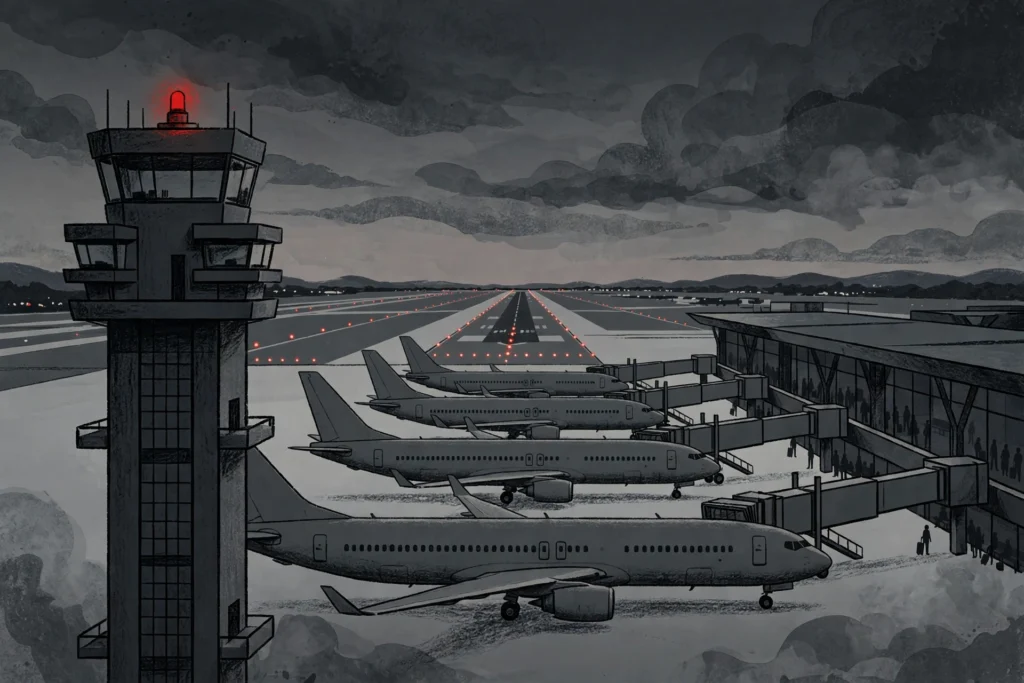
The departure board at LaGuardia did not flicker. It simply stopped making sense.
One minute, flights were boarding. The next, every gate in the terminal seemed to freeze at once. Pilots sat in cockpits with nowhere to go. Families dragged suitcases back from jet bridges. And across the whole of the United States, not a single commercial flight was allowed to take off.
It was Friday afternoon, November 13, and American aviation had just come to a standstill. The Federal Aviation Administration had issued a nationwide ground stop — the kind of order so rare that most travellers have never lived through one.
For four hours and twenty-one minutes, the busiest airspace in the world went quiet on the ground. And when the planes finally started moving again, the story was not really about the weather, or a computer glitch, or a cyberattack. It was about wires laid down in the 1980s.
The FAA Ground Stop in Numbers
The order went out at 3:54pm Eastern Time on Friday. Every departing flight in the United States was told to stay where it was.
At that moment, 4,042 aircraft were already in the air, heading for American airports, according to flight-tracking site Flightradar24. Those planes were allowed to land. Nothing new was allowed to leave.
The scale of the disruption grew fast. More than 10,000 flights were delayed on Friday, and more than 4,700 were cancelled, according to FlightRadar24 figures reported by Reuters.
About 1.5 million passengers were affected, according to the Associated Press. And the pain did not end when the order was lifted. More than 2,500 flights were cancelled on Saturday too, with hundreds more delayed, as airlines tried to put aircraft and crews back where they belonged.
The FAA lifted the ground stop at 8:15pm Eastern Time, just over four hours after it began. Transportation Secretary Sean Duffy announced the news at a White House briefing, telling stranded passengers that it was safe to fly. He warned that flights would not resume immediately, and airlines said the disruption could stretch on for days.
What Caused the FAA Ground Stop
The trouble began a little before the order itself. At around 3:36pm Eastern, air traffic control centres began reporting instability in their radar and radio communications.
Duffy said the problem came down to switches and routers on the FAA’s older network becoming overloaded with data and going down. It was not a total loss of communications or radar, he stressed. But the instability was serious enough that the FAA chose to stop departures rather than risk controllers working with unreliable tools.
The outage affected all 22 Air Route Traffic Control Centers — the regional centres that guide aircraft at high altitude as they travel between different parts of the country. Terminal Radar Approach Control facilities, which manage planes approaching and departing airports, were affected too.
The 1980s Copper Lines Behind the FAA Ground Stop
Duffy did not hide what he thought the real cause was. “We have old switches, old routers. We use 1980s little copper lines,” he said at the briefing.
Homeland Security Secretary Markwayne Mullin put it even more sharply. He said technology upgrades had “overwhelmed” the existing, antiquated system. In other words, the new equipment the FAA has been installing asks more of the old network than the old network can give.
Days earlier, the FAA had rolled out a new system called the Strategic Management of Airspace, Routes and Trajectories across the country. Officials have not blamed that rollout directly, but the timing has raised questions about whether the new system pushed the old network over the edge.
A telecommunications network overseen by L3Harris Technologies appeared to be among the systems affected, the Wall Street Journal reported. And Air Space Intelligence, the company behind the FAA’s AI-powered air traffic management system, said its technology was not responsible for the stop.
The administration said on Friday that 68 percent of the FAA’s legacy copper telecommunications network has now been replaced with high-speed fibre, according to Reuters. That leaves nearly a third of the old network still in place — and Friday showed what can happen when it fails.
It was a familiar pattern in a week already full of infrastructure failures. Just a day earlier, Microsoft’s cloud services went down for more than 24 hours, knocking out Outlook, Teams and Copilot for users in more than 70 countries.
Why the FAA Ground Stop Was Not a Cyberattack
Within minutes of the order, speculation began online. A nationwide halt of all flights invites alarming theories, and this one arrived in a year already full of major breaches and outages.
Officials moved quickly to shut that speculation down. Mullin told reporters there was no evidence that a threat to the United States had triggered the stop. “This isn’t another 9/11,” he said. “This is a telecommunication outage.”
The FBI does not believe a cyberattack or criminal activity caused the failure, Bloomberg reported, citing an official familiar with the matter. The problem, officials insisted, was old equipment failing under modern loads — not an attacker.
That distinction matters. A cyberattack would point to a security failure and a hunt for whoever was responsible. An equipment failure points to something slower: decades of underinvestment in the wiring that keeps planes apart in the sky.
The Longest Ground Stop in 25 Years
Friday’s halt was the longest nationwide ground stop since the September 11, 2001 attacks, according to Al Jazeera. It was also only the second nationwide ground stop of all departures since 9/11.
The most recent comparison came in January 2023, when a failure in the system that sends safety alerts to pilots paused departures for about 90 minutes. Friday’s stop lasted nearly three times as long.
About 3,000 flights landed safely after the order was issued, Mullin said. Every flight was accounted for, the FAA said in a statement, and international flights were handled on a case-by-case basis.
The human cost was visible at airports across the country. Travellers waited at Dallas Fort Worth, at Seattle-Tacoma, at LaGuardia in New York — sleeping on floors and queuing at rebooking desks.
For the airlines, the damage goes beyond one bad evening. When a network stops completely, planes and crews end up in the wrong cities, and untangling that takes days, not hours.
What Happens Next for Passengers
The immediate advice for travellers is simple: check before you go to the airport. Airlines were still cancelling hundreds of flights on Saturday, and schedules were expected to remain disrupted through the weekend.
The bigger question now belongs to Washington. The FAA has been promising to modernise its air traffic control infrastructure for years, and Friday’s failure will sharpen the pressure to finish the job. Replacing the remaining copper network with fibre is the obvious first step.
For now, the system is running again. Duffy insisted the problem is fixed and flying is safe. But the image from Friday will linger: the world’s most advanced aviation system, brought to a halt by switches and routers and copper lines from the 1980s.
And for the 1.5 million passengers who spent Friday night in an airport instead of at home, that is a hard lesson to forget. The next time a departure board freezes, they will know exactly what it can mean — and how fragile the systems behind a simple flight booking can be.
According to Al Jazeera, the FAA’s own statement described the outage as a temporary telecommunications problem, and officials confirmed that all flights were accounted for throughout the stop.