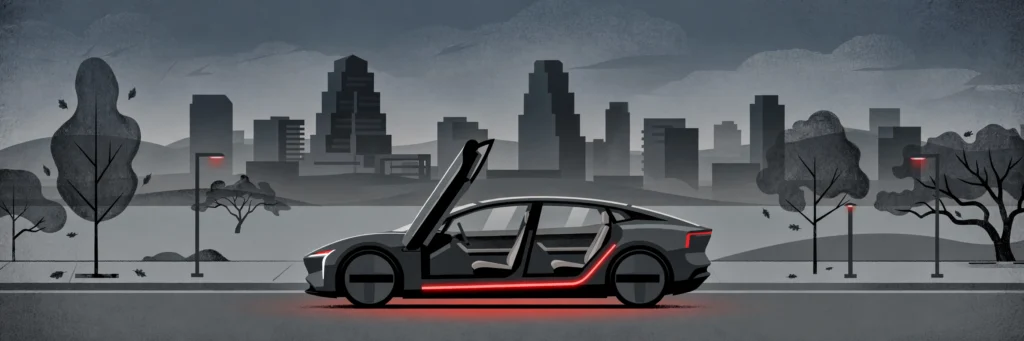
Picture the scene. You walk out to your driveway on a December morning in Austin, Texas, and there it is: your brand-new car, gleaming in the sun, with no steering wheel, no pedals and no place for you to sit behind the wheel. You cannot drive it. Nobody can. That is the point.
On Friday, November 13, Tesla turned that strange vision into something you can actually buy — if you are on the list. The company’s Robotaxi account announced on X that select customers are now being invited to purchase the Cybercab for personal use, at $29,990 before taxes.
It is the first time a driverless car has gone on sale to private buyers anywhere. But the sticker price is only the start of the story, because this car will not move an inch unless you keep paying Tesla every single month.
What Tesla announced on Friday
The invitation went out on Friday evening, US time, through Tesla’s official Robotaxi account on X. Elon Musk reposted it. Screenshots of the order page and the invitation email, shared by Tesla itself, show a two-seat car with butterfly doors, a 21-inch central touchscreen and 20.1 cubic feet of cargo space.
There is no public order page. You cannot walk up to tesla.com and place an order. Tesla has not said how it chooses who gets invited, how many invitations it has sent, or when — or whether — orders will open to the general public.
The order page shows an estimated delivery of December 2026 in Austin, Texas. A $1,000 deposit is due when you order, and it is non-refundable. Buyers must also agree to the Cybercab Order Agreement, the Terms of Use, the Autonomy Subscription Agreement and the Privacy Notice.
One of the first people to share an invitation was the president of the Tesla Austin Owners Club, who posted screenshots of an email confirming his order, according to Modern Robotics, drawing on Electrek’s reporting.
The real price of a $29,990 Tesla Cybercab
Elon Musk promised a Cybercab priced below $30,000 when the car was unveiled in 2024, and on the sticker Tesla has kept that promise. InsideEVs calls it the cheapest vehicle Tesla has ever sold — $7,000 less than a Model 3, according to reports.
Then comes the catch. The order page has a $299-a-month Autonomy Subscription pre-selected, and the fine print says the subscription and regular vehicle maintenance are required for the car to operate. Without an active subscription, the Cybercab simply will not go anywhere.
The first month is included. After that, the subscription is billed monthly until you cancel. At $299 a month, it adds $3,588 a year. Over five years, that is $17,940 in subscription fees, taking the real cost to roughly $47,900 — before taxes, insurance and charging.
Electrek, which saw the order page, makes a similar calculation and points out another detail: Tesla can change the monthly price. The company has announced no change, but nothing in the terms fixes $299 forever.
Tesla has not yet explained exactly what the subscription covers beyond the line on the order page. Buyers who put down a non-refundable deposit will want to read the Autonomy Subscription Agreement closely before they commit.
Where a Tesla Cybercab can actually drive
The invitation email carries an asterisk that does a lot of work: “Only available in supported service areas. Subscription required for operation.” In practice, that means the places where Tesla runs its Robotaxi service.
Electrek lists eight cities: Austin, Dallas, Houston, Fort Worth and San Antonio in Texas, plus Miami, Orlando and Tampa in Florida. A Cybercab owner outside those areas would not have a car that works.
Even inside those cities, the map and the road are not the same thing. Electrek cites an independent tracker, Koby Pierce, who tested thousands of addresses in the Robotaxi app and found that the areas where Tesla accepts pickups and drop-offs were only 59% to 78% of the advertised service areas in the six cities he checked.
In Austin, where the first cars are due, he put it at about 59%. These are the tracker’s findings, not Tesla’s, but they matter because the Cybercab is a one-trick vehicle. It has no manual controls, so the owner cannot take over and drive it out of the zone.
Tesla has also said most Cybercabs will stay in its own ride-hailing fleet. On the company’s third-quarter earnings call, executives said only some cars would go to customers by the end of the year. The invite-only sale fits that picture: a small, controlled first step rather than a mass launch.
The safety review hanging over the launch
There is one more thing hanging over the December deliveries: a safety review that is still open. According to Bloomberg, the US National Highway Traffic Safety Administration opened a probe looking at the process and technical data Tesla relied on when it self-certified the vehicles as compliant with all federal safety standards.
Electrek adds that the regulator has ordered Tesla to demonstrate under oath that a car with no brake pedal meets federal standards that call for one. Tesla replied on October 30 and asked for its answer to be kept confidential. Electrek says NHTSA has not ruled.
So Tesla is, in effect, taking customer deposits while that review is open. If the regulator disagrees with Tesla’s reading of the rules, the cars could face restrictions — although that is a possibility, not a prediction.
It is worth remembering that Tesla has missed autonomy targets before. The Cybercab itself was unveiled in October 2024 at the company’s “We, Robot” event, and the Robotaxi service only began carrying paying passengers in Austin in June 2025. December’s deliveries would be the next milestone — if they happen on schedule.
Why this Tesla Cybercab launch matters beyond Tesla
Driverless cars have so far been something you hail, not something you own. Waymo and others run fleets and keep the vehicles. Tesla is now offering to sell one to an individual who would, in effect, rent the driving software every month.
The subscription model puts the value in the software and keeps Tesla in control. The owner holds the metal, while Tesla decides where the car goes and what it costs to keep it moving. That is a very different deal from buying a car outright.
AI is already moving into the cars people drive today — Google’s Gemini has just arrived on Apple CarPlay — but the Cybercab takes the idea much further. And companies are already drawing lines around what AI agents may do on their own: United Airlines banned AI agents from booking flights this month.
It also raises a question nobody has answered yet: can a private owner earn money from the car? Reports of the terms are still emerging, and it is not yet confirmed whether a personal Cybercab can be added to Tesla’s ride-hailing network. The Autonomy Subscription Agreement limits the car to personal, non-commercial use, according to reports.
The rest of the industry will be watching Austin in December. If the first handovers go smoothly, other carmakers will have to answer the same question Tesla just answered: what is a car worth when the driving is sold separately?
What happens next for the Tesla Cybercab
For now, the unanswered questions pile up. How many invitations has Tesla sent, and how many cars can it build and deliver in December? Will the $299 price stay the same, and what exactly happens to a car whose subscription lapses? Will the service areas grow, and what can a buyer outside Austin do with the car?
Then there is the regulator. How NHTSA responds to Tesla’s sworn answers could shape not just the Cybercab, but every driverless car that follows it. A ruling against Tesla’s self-certification would echo far beyond one model.
It has been a busy week for Elon Musk’s companies: SpaceX’s Starship Flight 15 put 26 Starlink V3 satellites in orbit on November 13, the same day the Cybercab invitations went out.
The first deliveries, if they happen on schedule, will be the real test. A price on a page is a promise. A driverless car actually parked in a driveway in Austin is evidence. December is only weeks away.