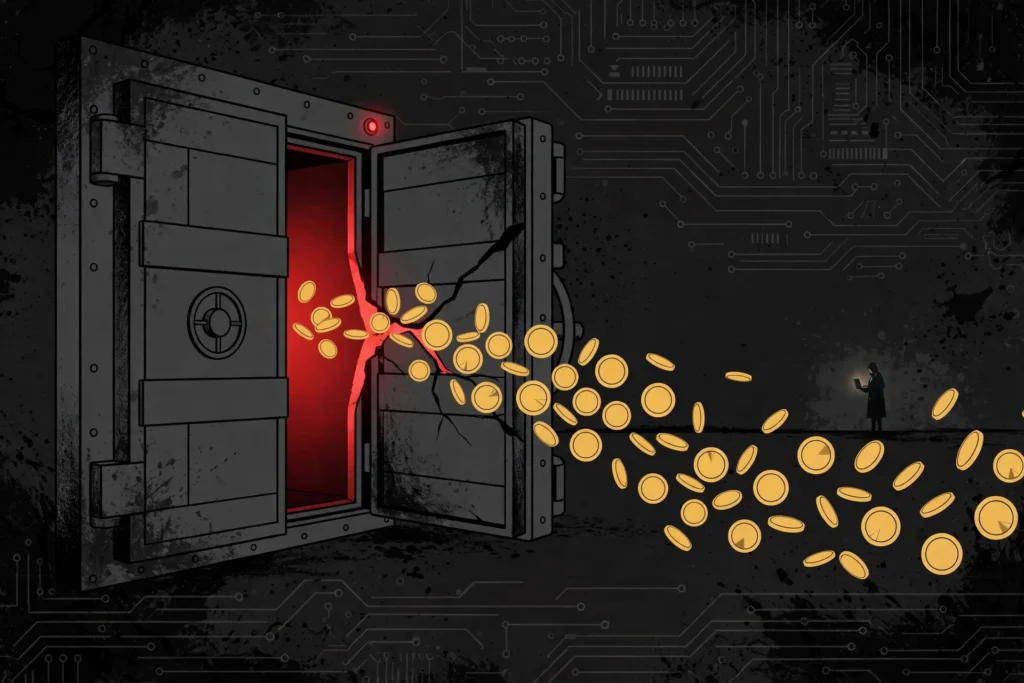
Picture the world’s biggest cryptocurrency exchange as a vault the size of a city block. Now picture someone walking out of it with $6.3 billion — not in one smash-and-grab night, but slowly, quietly, over four months.
That is the story of the Binance $6.3 billion hack, and this week the exchange finally began to put the pieces back together.
Binance said on Saturday that it aims to reopen withdrawals for all remaining networks and assets by the end of next week. The announcement, posted on X, marks the clearest sign yet that operations are returning to normal after the largest cryptocurrency theft ever recorded.
Withdrawals have already come back for 87 networks this week. The rest will follow in phases, the company said, as its teams work through the remaining systems one by one.
How the Binance Hack Unfolded Over Four Months
The theft did not happen in a single night. According to Reuters, Binance detailed a multi-stage hacking campaign in its initial report on the incident — one that began in June and ended with the money gone on October 29.
It started with something almost embarrassingly ordinary. In June, a Binance team member downloaded a tampered software installer while setting up an AI coding tool. Reporting by BleepingComputer describes it as a hacked version of Homebrew or another popular package.
The download itself was not the theft. It was the open door. The installer exposed details about the employee’s role and colleagues, giving the attackers a map of who to target next.
Three months later, in September, the attackers made their second move. A second engineer was approached on a legitimate job platform by someone posing as a “project director.” The fake recruiter ran the engineer through a series of interviews.
The interviews ended with a coding assignment. The assignment was malicious software, and downloading it handed the attackers a second foothold inside Binance.
A Fake Job Interview and a Tampered Download
By October 20, the intruders were deep inside. Using the compromised computer — and, remarkably, one of Binance’s own internal AI tools — they took over the systems of two more engineers who worked on the company’s wallets.
Nine days later, the trap closed. On October 29, the attackers used stolen credentials and a malicious script to reach Binance’s wallet-signing systems. Cryptocurrency flowed out of multiple hot wallets across several blockchains.
The total came to roughly $6.3 billion. Experts describe it as the largest cryptocurrency theft ever, dwarfing the previous record — the roughly $1.5 billion taken from rival exchange Bybit in February 2025, which was also blamed on North Korea.
Binance did not tell the public straight away. It disclosed the incident on November 3, by which point it said it had already covered 95% of the stolen tokens and begun restoring services in phases.
North Korea’s Shadow Over the Binance Hack
Who was behind it? The FBI and Binance have both said North Korea was responsible for the Binance hack. Pyongyang has denied any involvement.
Blockchain investigation firms have attributed the attack to a North Korean group known as “TraderTraitor.” The group specialises in exactly this kind of slow, patient social engineering — fake recruiters, poisoned software, and months of quiet preparation before a single coin moves.
The pattern fits a long history. North Korean hacking groups have been linked to a string of major crypto thefts over the past decade, with stolen funds widely believed to help finance the country’s weapons programmes.
For Binance, the attribution adds a geopolitical edge to an already enormous security failure. This was not a smash-and-grab by opportunists. It was a state-linked operation that spent four months working its way through one of the best-resourced companies in crypto.
Withdrawals Return, Network by Network
For ordinary Binance users, the question that matters most is simple: when can I get my money out? The exchange’s answer, delivered on Saturday, is that almost everything should be working again by the end of next week.
“This week, we reopened withdrawals for 87 networks. We will aim to reopen withdrawals for all remaining networks and assets by the end of next week,” the company said in its post on X.
The phased return is deliberate. After an attack of this scale, every network and asset has to be checked before it is switched back on. A rushed reopening would risk a second incident — or a flood of withdrawals the exchange’s rebuilt systems are not ready to handle.
Binance has vowed to repay customers in full. Reporting so far says the attackers hit the company’s internal systems through hacked employee computers, and none of the coverage reviewed reports individual customer accounts being compromised.
That distinction matters. If customer accounts were never breached, the losses sit with Binance itself — and the company says it has the reserves to absorb them.
A Finance Chief Departs as the Fallout Continues
The hack has already cost Binance one senior executive. Finance chief Kaiser Ng left the company just over a week after the heist, to pursue a new venture after more than five years at Binance.
He was replaced by Justin Yek, a longtime finance executive who was most recently vice-president of finance at Airwallex. The change came at the worst possible moment — just as the exchange was trying to reassure customers, regulators and partners that it was still standing.
The departure also raises an uncomfortable question. A $6.3 billion loss, even one the company says it can cover, will invite scrutiny from regulators around the world. Binance has spent years rebuilding its relationship with authorities after a string of enforcement actions.
Now it must explain how attackers spent four months inside its systems, used its own AI tools against it, and walked away with more money than most countries hold in foreign reserves.
What the Binance Hack Means for Crypto Security
The Binance hack is a warning that applies far beyond one exchange. The attackers did not break through a firewall with a brilliant exploit. They used the oldest tricks in the book: a poisoned download and a fake job interview.
That should worry every company in tech, not just crypto. If the world’s biggest exchange — with all its security budgets and engineers — can be undone by a tampered installer and a coding assignment, then the human layer is still the weakest link.
The incident also echoes a wider wave of AI-era breaches. In recent weeks, Fireworks AI disclosed a breach that exposed customer data, a Grok Build leak left 35,000 apps exposed, and Railway reported stolen AI keys that racked up $740,000 in charges.
The Binance case is the largest of them all — and the most patient.
There is also an irony that will not be lost on security teams. One of the footholds in the attack came through an AI coding tool — the same kind of tool that companies everywhere are now rushing to adopt.
The technology that promises to make developers faster also gives attackers a new place to hide.
What Happens Next for Binance
The immediate test is the withdrawal deadline. If Binance hits its target and all networks are open by the end of next week, it will have restored normal service less than a month after the theft.
That would be a remarkable recovery — but it would not be the end of the story. Regulators will want answers about how the breach happened and what has changed.
Customers will want proof that their funds are safe. And the stolen billions are still out there, moving through wallets the authorities are trying to trace.
Binance has promised a fuller account of the incident. For now, the message to its users is simple: your withdrawals are coming back, and the company says you will be made whole.
Whether that promise holds — and whether the exchange can convince the world it has closed the doors the hackers walked through — is the real test of the weeks ahead.
Source: Reuters