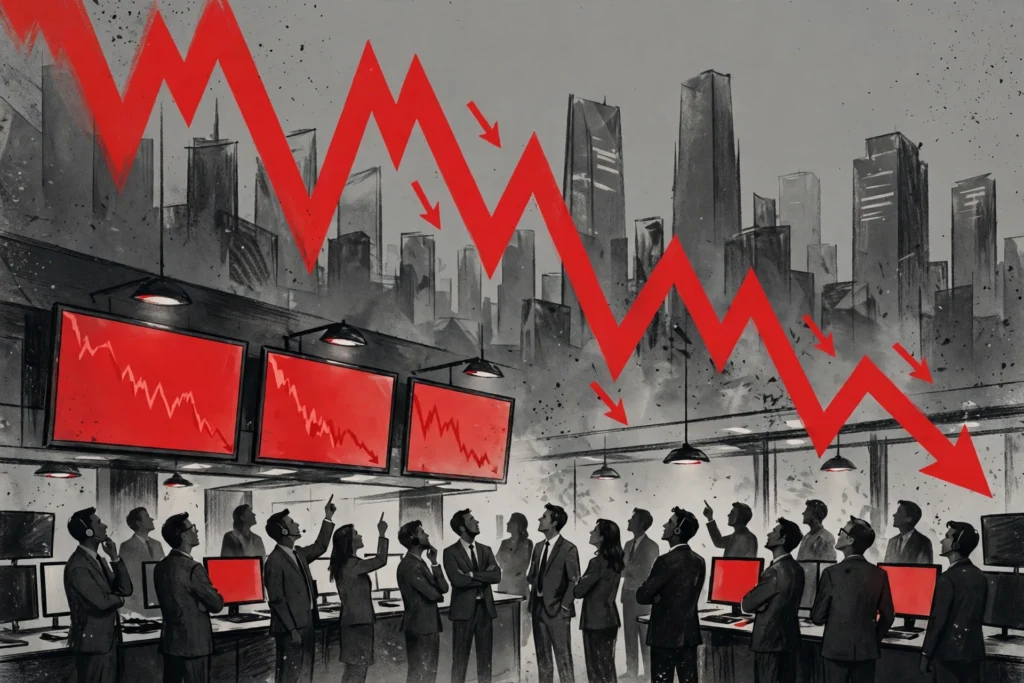
Friday morning in Tokyo began like any other trading day. Then the screens turned red, and they stayed red. By the time the dust settled, SoftBank Group had lost more than a sixth of its value in a single session, and the shockwave was rolling across every major market in Asia.
The trigger was not bad news from SoftBank itself. It was the opposite: a triumph, thousands of miles away in New York, by a company SoftBank does not even own.
On Thursday, Anthropic — the maker of the Claude chatbot — made its debut on the Nasdaq in the largest stock-market listing in history. Its shares opened at $111.50, a full 34 percent above the $83 IPO price, and closed the day at $97.17, still 17 percent higher.
At one point during the session, the company was briefly worth $2 trillion.
Investors in Tokyo watched that celebration and drew a very different conclusion. If Anthropic, now publicly priced, was the yardstick for what a frontier AI company is worth, then the valuations attached to SoftBank’s own AI bets suddenly looked far too generous.
The selling started fast, and it did not stop.
Why SoftBank Shares Crashed 16% in a Single Session
SoftBank shares fell 16.16 percent on Friday, according to CNBC, leading a broad sell-off in Asian technology stocks.
At their lowest point, the shares touched ¥2,950.5, down 16.58 percent on the day, before recovering slightly to trade around ¥3,065 in early trading.
The scale of the drop was extraordinary for a company of SoftBank’s size. Traders were not just selling a stock. They were repricing an entire investment thesis.
At the heart of that thesis sits OpenAI. SoftBank has poured $64.6 billion into the ChatGPT maker, building a stake of roughly 13 percent in the world’s most valuable private AI company.
Because OpenAI itself is not listed, SoftBank’s shares have become the closest thing to a public proxy for it — a way for traders to buy, or sell, a view on OpenAI’s worth without ever touching the private company.
Anthropic’s debut gave the market its first hard public price for a rival frontier lab. The comparison was not flattering for SoftBank.
Anthropic raised $81.3 billion in its offering, the biggest IPO ever, topping the $75 billion raised by SpaceX in June.
Yet even that triumph came with a warning: Anthropic’s shares gave back almost half their opening gains by the close, and the Nasdaq fell more than 2 percent overnight.
Anthropic’s Debut Becomes the Trigger
The irony is hard to miss. Anthropic’s listing was supposed to be a validation of the AI boom. It was the first standalone frontier AI lab to go public, and demand for the shares was so strong that the company raised its offering to 980 million shares, priced above its original $70 to $78 range.
But a public price cuts both ways. For months, investors had taken SoftBank’s $64.6 billion OpenAI commitment at face value, treating it as a ticket to the most exciting company in technology. Anthropic’s debut forced them to ask a harder question: what if the whole sector is priced for perfection, and perfection is not arriving?
The answer arrived in Tokyo within hours. Money flowed out of SoftBank and, just as quickly, out of the chipmakers and suppliers that feed the AI build-out. The sell-off was not a verdict on one company. It was a verdict on the price of the AI trade itself.
The $64.6 Billion OpenAI Question
SoftBank’s exposure to OpenAI goes far beyond a single investment. The Japanese group has committed tens of billions to the ChatGPT maker, and its funding schedule includes a further $22.5 billion payment due to OpenAI in December. That deadline now hangs over the stock at the worst possible moment.
To keep funding its AI ambitions, SoftBank has already been reshaping its portfolio. It sold a $5.8 billion stake in Nvidia, redirecting the proceeds into foundation models, the chip designer Ampere Computing, and robotics.
The company also owns around 90 percent of Arm, the British chip designer, and that stake is used as collateral for much of its borrowing.
That structure creates a feedback loop: when chip shares fall, the collateral shrinks, borrowing tightens, and funding the next round of data-centre and energy projects gets harder.
The strain has already reached the bond market, where the cost of insuring SoftBank’s debt against default has climbed to a four-year high. Even before Friday, SoftBank’s shares had fallen roughly 40 percent from their October peak.
Asian Chip Stocks Join the Rout
SoftBank was the biggest faller, but it was far from alone. The Nikkei 225 dropped 4.16 percent, and at its worst point during the session it was down as much as 4.8 percent.
South Korea’s Kospi fell 3.66 percent, and the selling spread across the region’s most important chip names.
In Japan, Tokyo Electron dropped 7.19 percent, Lasertec lost 6.75 percent, and Renesas slid 6.71 percent. Kioxia and Ibiden fell by more than 10 percent in early trading. In South Korea, SK Hynix and Samsung Electronics both took a hit, and Taiwan’s TSMC also declined as investors reassessed the AI hardware trade.
It was not the first warning sign. SoftBank had already booked a $3.7 billion loss on power-generation equipment for US AI data centres in its fiscal second quarter, after reserving factory capacity and buying gas turbines for projects that ran into trouble.
That loss, reported earlier in November, was the first quarterly net loss in almost two years.
A Sell-Off Months in the Making
Friday’s crash did not come out of nowhere. The AI trade has been under pressure for weeks, and the cracks have been visible in several places at once.
Anthropic’s own debut, for all its records, ended the day well below its opening price. The Nasdaq has fallen 11 percent over the 50 days leading up to the listing.
Nvidia, the company whose chips power the entire AI build-out, has lost nearly a third of its value over the same period, and its boardroom turmoil has only added to the uncertainty.
Meanwhile, AMD’s shares fell 9 percent this week after a report linked its firmware to a blacklisted Chinese firm, and the companies at the centre of the boom keep spending at a pace that would have been unthinkable two years ago.
Anthropic’s own filings show around $900 billion in future purchase commitments for computing power and data-centre capacity. OpenAI’s spending plans are larger still. The question investors are now asking, out loud, is whether any of it earns a return.
SoftBank sits at the centre of that question. Its net asset value has fallen from ¥72.3 trillion at the end of June to ¥44.7 trillion in early November on a pro forma basis, according to its own second-quarter presentation.
Most of that decline came from Arm, whose value dropped sharply as chip stocks corrected.
What Happens Next for SoftBank and the AI Trade
Anthropic’s offering closes on Friday, and its shares will now trade freely, giving the market a daily public verdict on a frontier AI lab for the first time. That verdict will matter far beyond Anthropic itself. Every other private AI valuation — including OpenAI’s — will be measured against it.
For SoftBank, the immediate test is the $22.5 billion payment due to OpenAI in December.
The company has options, including selling assets and raising debt, but each of them gets harder if its shares keep falling and its borrowing costs keep rising. How Masayoshi Son funds that payment will be one of the most closely watched events of the year.
For now, investors in Tokyo have delivered their verdict. SoftBank’s shares crashed 16 percent in a day, and the message was unmistakable: in the AI boom, even a record-breaking IPO can be bad news.
Source: NewsBytes, reporting CNBC’s coverage of the sell-off.


