The Letter Every Woman Over 50 Knows
Every three years, a letter arrives in the post. It invites you to a breast screening appointment, at a clinic or a mobile van parked in a supermarket car park. You go, you wait, and then you wait some more for the result.
For Shirley, a 70-year-old from Cambridgeshire, that routine appointment in October 2025 changed everything. A mammogram picked up an early-stage breast cancer she could neither see nor feel. Treatment started quickly, and she is here to tell the story.
On Monday, Shirley stood beside the Health Secretary at Addenbrooke’s Hospital in Cambridge as the National Health Service launched the biggest test of its kind anywhere in the world.
Nearly 700,000 women will take part in the EDITH AI breast screening trial, a three-year study asking a simple question: can artificial intelligence help find cancers like Shirley’s even earlier?
What the EDITH AI Breast Screening Trial Will Test
EDITH stands for Early Detection using Information Technology in Health. The trial is funded with £10 million from the National Institute for Health and Care Research, and it is led by the University of Warwick, the University of Cambridge and Cambridge University Hospitals NHS Foundation Trust, working closely with NHS England.
The study will run at 30 breast screening centres across England, Scotland, Wales and Northern Ireland. Recruitment has already begun at Cambridge University Hospitals, the first site to open its doors. More centres will join over the coming months.
Women invited for routine screening will be told about the trial in their invitation letter. They do not have to do anything extra. Their appointment will proceed exactly as normal, and they can opt out at any point if they would rather their images were not read with AI help.
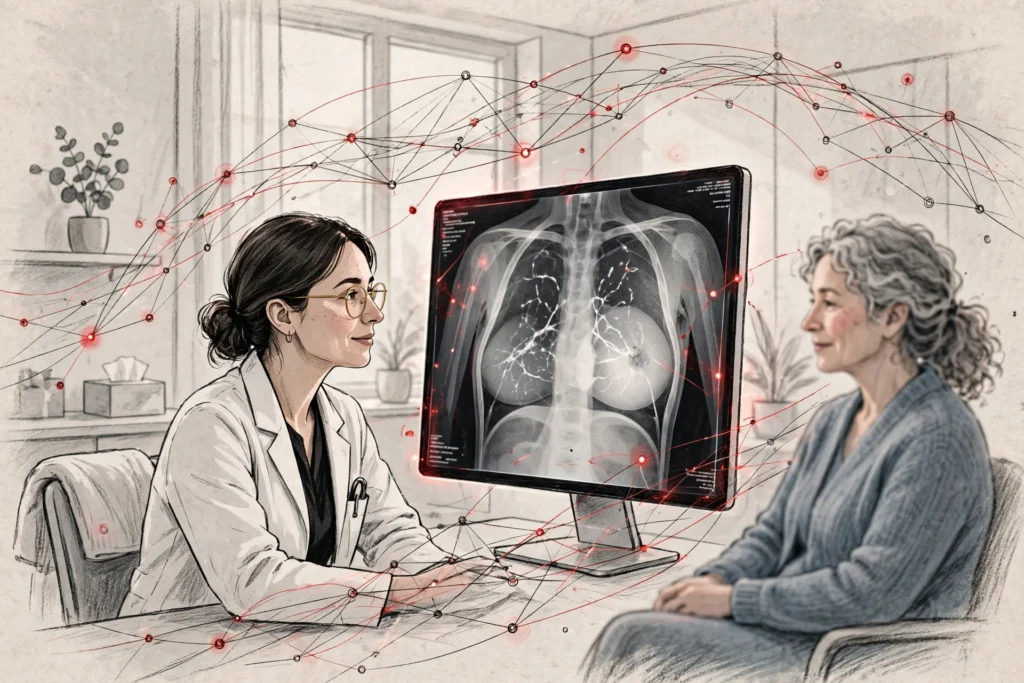
Behind the scenes, though, the way their mammograms are checked will change. Today, every mammogram in the NHS screening programme is read by two specialists. The EDITH AI breast screening trial will test whether one specialist, working with an AI tool, can do the job just as safely.
How AI Will Read Mammograms in the NHS Trial
Women taking part will be randomly placed into one of three groups. The first group will receive the standard screening used today, with two human experts reading each set of images. The other two groups will receive AI-assisted screening, with the AI used in two different ways.
The AI tool studies the mammogram images and flags areas that may need a closer look. It is looking for cancers too small to see or feel, the kind that even a trained eye can miss on a busy day.
The human specialist still makes the call. Every mammogram in the trial will be reviewed by at least one human radiologist, whatever group a woman is in.
The images are read in a secure online cloud environment run by a company called CIMAR (UK) Ltd. The company holds the information for a maximum of 30 days before it is permanently deleted. Study data will be kept for 20 years after the trial ends, so researchers can follow up on the results.
“We want to test whether NHS experts working with AI are better than without,” researchers at the University of Warwick explained. “We will look at the results from the three groups to see how well human experts combined with AI assistance works compared to the human readers alone, and the costs and benefits of this.”
Why the NHS Needs AI in Breast Screening
Breast cancer is the most common cancer in women. Around 55,000 women are diagnosed with it every year in the UK. Women aged 50 to 71 are invited for screening every three years, which adds up to roughly 2.1 million screenings a year. The NHS estimates that the programme prevents around 1,300 deaths annually.
That scale is exactly the problem. Two specialists must read every one of those millions of images, and there are not enough radiologists to go around. Screening units feel the strain every day, and the backlog of images waiting to be read grows while women wait for results.
Earlier research gives the trial reason for hope. A study published in The Lancet in January found that AI can improve breast cancer detection through more effective screening while reducing radiologists’ workloads. It analysed nearly 106,000 mammograms from Sweden’s national screening programme, carried out between April 2021 and early December 2022.
AI models are also growing more capable by the month, with new systems handling complex image and data work that once needed a human specialist. Medical AI is moving fast beyond the lab, with new specialist models appearing almost weekly.
The question EDITH must answer is whether that capability holds up at national scale, inside a real health service, with real patients.
What Safeguards Protect Women in the Trial
Health Secretary Yvette Cooper, who visited the trial team at Addenbrooke’s Hospital on Monday, called EDITH “the biggest AI breast cancer trial in the world” and pointed to the technology’s “huge potential”. She also pledged “proper safeguards” to make sure the tool is safe and effective before it is used more widely.
“If successful, this technology could help women get a breast cancer diagnosis and start treatment much more quickly, giving them the best possible chance of recovery,” Cooper said.
The safeguards are built into the trial’s design. No woman’s care changes because she takes part. The AI never works alone, and a human expert always reviews the images. Anyone who does not want AI involved in reading her mammogram can say so when she books, or at the appointment itself.
Data handling has drawn close attention too, as it should. Health data is among the most sensitive information there is, and the trial’s 30-day deletion rule for the cloud system is part of the answer.
The debate over how AI systems handle personal data is running across the whole tech industry, and a medical trial on this scale will be watched closely on that front.
The Royal College of Radiologists welcomed the trial but sounded a note of caution, describing it as having “real potential but not a quick fix”. The college’s message is that AI can ease the pressure on radiology teams, but it cannot replace the specialists the service still needs to train and hire.
What Happens Next for EDITH
The trial will run for three years, with results published in a scientific journal and presented at professional conferences. If the evidence shows that AI-assisted reading finds more cancers earlier, or finds the same number with fewer specialists, the NHS could change how screening works across the country.
That change would not arrive overnight. Any new way of reading mammograms would need to clear regulatory checks, win the confidence of clinicians, and be rolled out site by site. The EDITH trial is the evidence-gathering step that has to come first.
For now, the message to women invited for screening is unchanged: go to your appointment. The trial only affects how images are reviewed afterwards, not the appointment itself. And for the women who take part, their screening may help decide how the next generation of patients is looked after.
Professor Fiona Gilbert of the University of Cambridge and Professor Sian Taylor-Phillips of the University of Warwick are leading the study as co-chief investigators.
Their teams will spend the next three years watching the numbers closely: how many cancers the AI-assisted groups find, how quickly they are found, and whether one specialist plus a machine can match two specialists working alone.
Shirley’s cancer was caught because she turned up for a routine appointment. The EDITH AI breast screening trial is betting that the next Shirley will be caught sooner still, with a little help from a machine that never gets tired, never rushes, and never stops looking.
According to Channel News Asia, recruitment is already under way at the first site, with hundreds of women invited to take part at the outset.


