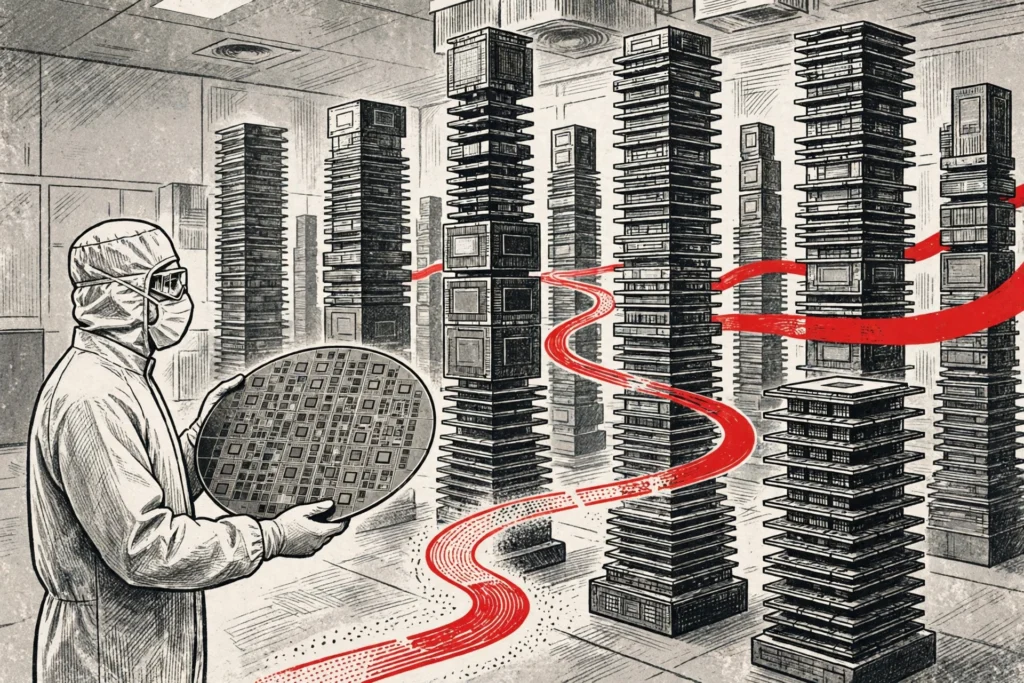
Picture a factory floor in South Korea, rows of machines humming under white light, turning out the tiny chips at the centre of the Samsung memory shortage.
Now picture a queue of the world’s biggest technology companies stretching out of the door, each one being told the same thing: there is nothing left to buy until 2029. That is the shortage in a single image.
According to a new report from South Korea’s Economy Tribune, most of Samsung Electronics’ memory production capacity for 2027 through 2029 is already secured under contracts.
Customers are not just buying what exists today. Some are pushing for long-term supply agreements that run all the way to 2031, according to WCCFTech, which first carried the report in English.
The numbers behind the story are stark. Industry sources cited by the Economy Tribune estimate that leading memory makers can currently meet only about 60 to 70 percent of customer demand. The shortfall is expected to get worse in 2027, not better.
What the Samsung Memory Shortage Actually Means
Samsung is the world’s largest memory maker, and its order book has become a barometer for the whole industry. When the company says its shelves are empty for three years, it is not describing a single product line.
It is describing high-bandwidth memory for AI accelerators, conventional DRAM for computers and servers, and enterprise storage products, all at once.
The company confirmed during its third-quarter 2026 earnings announcement on October 29 that it had already signed long-term supply agreements with 10 major customers.
Another 10 were in negotiations, several of them close to completion. Samsung’s stated plan is to place roughly 60 to 70 percent of its medium-to-long-term memory capacity under multi-year contracts by 2030.
That strategy gives Samsung predictable revenue for years. It also means the open market — the spot supply that smaller buyers, PC makers and phone brands rely on — keeps shrinking. When the biggest customers lock in their share first, everyone else fights over what is left.
Why AI Ate the Memory Market
The root cause is not a mystery. Training and running modern AI models needs staggering amounts of memory, and the data centre build-out shows no sign of slowing.
Every new AI accelerator that rolls off a production line needs high-bandwidth memory stacked beside it, and every rack of servers needs DRAM and storage to go with it.
High-bandwidth memory, or HBM, sits at the centre of the squeeze. Samsung had already confirmed that its entire 2027 HBM supply was sold out before this latest report. Now industry sources say conventional DRAM wafer capacity for the same year is effectively exhausted too.
The two shortages feed each other. Making advanced HBM consumes substantial DRAM wafer resources, so every wafer devoted to HBM is a wafer that cannot become the ordinary memory in a laptop or a phone. As manufacturers prioritise the high-margin products that AI accelerators need, conventional memory gets whatever capacity remains.
The result is a market turned upside down. For years, memory was a commodity business famous for boom-and-bust cycles and falling prices. Today, the buyers are the ones begging for supply, and the sellers hold the leverage.
The 2027 Crunch: HBM Sold Out, DRAM Next
The year 2027 is shaping up to be the tightest point. Industry data cited in the reports suggests annual DRAM bit supply growth will reach no more than 20 to 25 percent, far below what demand is doing.
With manufacturers able to fulfil only 60 to 70 percent of orders, the gap is expected to widen before it narrows.
The shortage is also spreading. What began as an HBM problem for AI hardware has moved into general-purpose DRAM and enterprise NAND flash. That matters because those are the components inside almost everything: the laptop on your desk, the phone in your pocket, the servers behind every website you visit.
It is not only Samsung feeling the pressure. The same reports describe a market-wide squeeze, with rival memory makers facing the same flood of orders. But Samsung’s scale makes its order book the clearest signal of where the industry is heading.
The pattern will look familiar to anyone who followed the chip business in recent years. When AI server prices jumped 45 percent after contracts were signed, it was the same dynamic: demand for AI infrastructure outrunning the factories built to serve it.
What It Means for PCs, Phones and Gamers
For ordinary buyers, the consequences arrive quietly, through prices rather than headlines. Memory is one of the largest costs inside a computer, and when DRAM gets expensive, the whole machine gets expensive. Budget laptops get thinner memory configurations. Phone makers face the same arithmetic on every handset they ship.
Gamers have reason to pay attention too. Graphics cards and gaming PCs depend on the same memory supply chain, and the reports warn that upward pressure on memory costs will be transmitted down the supply chain. A shortage that starts in a data centre can end up in the price of a graphics card.
PC manufacturers are already adapting. Some are signing their own long-term deals to guarantee supply, accepting higher prices in exchange for certainty. Others are redesigning products to use less memory, or shifting launch schedules to match when components become available.
None of this means shelves will suddenly be empty. It means the era of cheap, plentiful memory is over for now, and the cost of the memory inside your next device is likely to be higher than the last one.
Long-Term Deals Stretch to 2031
The most striking detail in the Economy Tribune report is how far ahead customers are planning. Some are seeking agreements that extend into 2031, potentially involving advance payments and contractual pricing mechanisms designed to protect both sides against sudden market swings.
Five-year supply deals are almost unheard of in a business that used to run on quarterly orders. They show how seriously the biggest technology companies now take memory security. For them, a guaranteed supply of HBM and DRAM is as strategic as the chips themselves.
Samsung is not the only company reshaping its business around AI demand. TSMC recently committed $1 billion to stakes in Anthropic and OpenAI, betting that the AI boom will keep chip demand high for years. Across the industry, the logic is the same: secure the supply chain first, worry about the price later.
Even Google’s new TPU chips, built to challenge Nvidia in AI training, depend on the same memory ecosystem. Every accelerator, whatever logo it carries, needs memory beside it.
What Happens Next
Samsung has warned that new factories will not fix the problem quickly. Bringing a new fab online takes years, not months, and the company says no noticeable improvement in DRAM availability should be expected in the near future, especially while AI infrastructure investment continues at its current pace.
That leaves the market in a holding pattern. Customers with long-term agreements are protected. Everyone else will compete for a shrinking pool of open supply, and prices will do the rationing. Expect memory prices to keep climbing through 2027, and expect the cost to show up in the devices you buy.
There is a longer-term question too. If memory stays scarce and expensive, it changes what gets built. Cheaper devices get squeezed first, and the gap between premium products and everything else grows wider.
The AI boom was supposed to make computing cheaper for everyone. Right now, it is making the memory inside that computing more expensive instead.
For Samsung, the next three years look secure: full order books, rising prices, and customers lining up years in advance. For the rest of the industry, the message from Seoul is blunt. The memory is spoken for. If you want some, you should have signed years ago.
Source: WCCFTech


