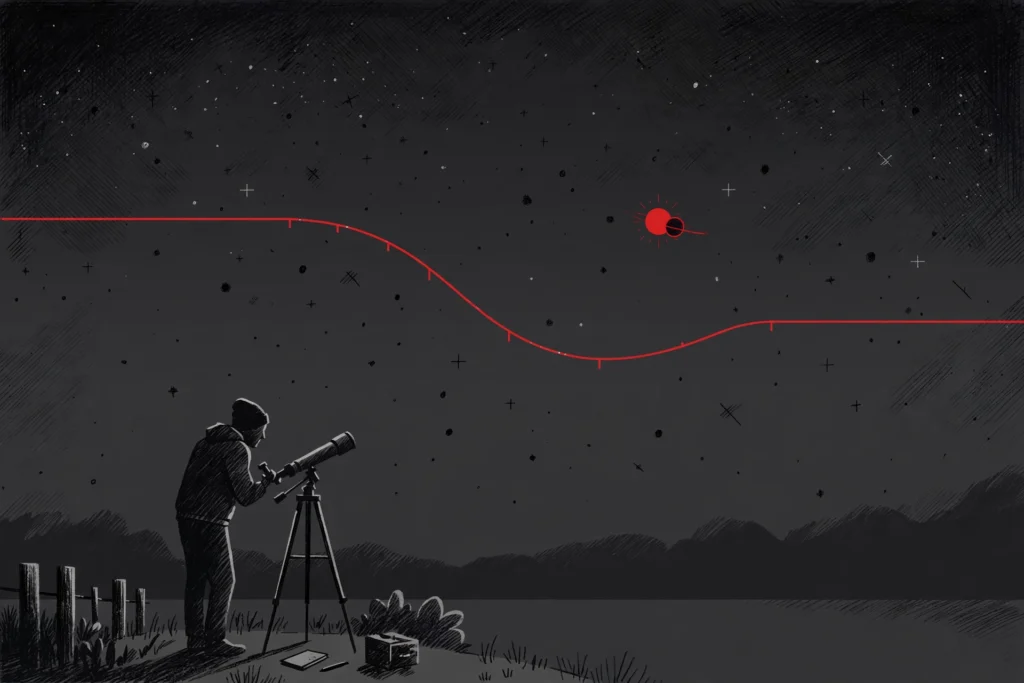
On a clear night, Kevin Bond does what he has done for years. He points his camera at the sky and waits. The stars above him are the same ones anyone can see from a dark backyard. Bond is not a professional astronomer. He is an engineer at OpenAI who fell in love with the night sky through photography.
Thousands of kilometres away, Ethan Byrd was asking a similar question. Byrd runs an email infrastructure startup called Primitive, and he has loved astronomy for as long as he can remember. He owned no telescope powerful enough to hunt for planets. He did not need one.
Both men turned to public data from NASA telescopes and to OpenAI’s AI tools. According to OpenAI, both of them found something worth a second look: signals that could point to planets nobody has confirmed, orbiting stars far beyond our solar system.
Two Searches, One Shared Idea
OpenAI described the two searches in a post published on November 24, 2026. The two men worked independently. They did not know each other. They used different tools, different data, and different methods.
What they shared was an idea that would have sounded strange a decade ago. The hardest part of finding a planet is no longer collecting the data. The data already exists, free, in public archives. The hard part is searching through it, and AI can help with that.
Bond used Codex, OpenAI’s coding agent, to build his search. Byrd used Astra, OpenAI’s newest flagship model, to design and run his. Between them, they scanned observations of millions of stars and came back with dozens of candidates.
How Do You Spot a Planet You Cannot See?
No telescope can photograph planets like these directly. They are too small and too dim, drowned out by the glare of their stars. So astronomers look for a shadow instead.
When a planet passes in front of its star, as seen from Earth, it blocks a tiny fraction of the starlight. On a graph of the star’s brightness over time, known as a light curve, that crossing shows up as a small dip. Astronomers call it a transit.
One dip proves nothing. But if the same dip returns at regular intervals, it tells astronomers when to watch again. A planet on a 13-day orbit will dim its star every 13 days, like clockwork. That repeating pattern is the fingerprint of a possible world.
Finding that pattern across thousands of stars is partly a coding problem. Astronomers have published methods for picking out faint, recurring dips from years of measurements. Bond used Codex to compare them, combine them into one program, and test each change, with one agent scanning light curves and a second checking the flags.
Bond’s Search: 100,000 Stars and Two Standout Signals
Bond ran his program on public data from NASA’s Kepler Space Telescope, a planet-hunting mission that operated from 2009 to 2018. His search covered observations of about 100,000 stars and flagged more than 200 signals.
Ten of them came from planets astronomers had already confirmed, which gave Bond confidence his program was finding the right kind of pattern. Then two stars stood out from the rest.
The first is KIC 5689121, a relatively cool star about half the size of our sun, in the constellation Lyra. Bond’s search found a dip in its brightness every 13.8 days. If a planet is causing it, the amount of light blocked suggests a world about 2.4 times the diameter of Earth.
The second is KIC 6691030, a faint star in the northern sky. There, the dip repeats every 4.8 days, a rhythm consistent with a planet smaller than Neptune. Neither signal is a confirmed planet yet. Both are leads, and leads are exactly what this kind of search is for.
Bond took his two best candidates to an astronomer at the SETI Institute, who ran an independent search and found the same two signals in the Kepler data.
Byrd’s Search: 49 Candidates Across 19 Million Stars
Ethan Byrd’s search was bigger and broader. He tried several AI models before choosing Astra to analyse telescope data covering about 19 million stars. His data came from NASA’s Transiting Exoplanet Survey Satellite, known as TESS, which launched in 2018, plus other public archives.
Byrd asked Astra to review the published detection methods, build the search software, and run the first checks on promising signals. He designed two searches: one looked broadly for exoplanet candidates, and the other focused on stars’ habitable zones, where a planet with a suitable atmosphere could hold liquid water.
The first pass through the data turned up 49 candidates. Byrd sent one of his strongest findings to researchers working on the TESS mission, where it is now awaiting further analysis. Two more candidates are waiting to be submitted. His search is still running.
Neither researcher has confirmed a new exoplanet. These are candidates, not discoveries, but they have already reached the professionals who can test them.
Why This Search Matters Beyond Two Amateurs
Astronomers have confirmed more than 6,400 planets beyond our solar system since the first ones were announced in 1992. A worldwide community of amateurs has long been part of that hunt, combing public data and sharing what they find.
AI has helped for years too. In 2017, researchers trained a neural network on 15,000 Kepler signals astronomers had already examined. Pointed at weaker signals, it led them to an eighth planet orbiting a star called Kepler-90.
What changed with Bond and Byrd is who gets to run the search. Neither man needed a university lab, a research grant, or years of specialised training. They needed public data, a question, and an AI tool that could help them design and run a proper search.
That is the same shift already visible elsewhere in science. Earlier this year, OpenAI’s GPT-6 protein design work showed AI creating molecules that bind drug targets in the lab, while Google DeepMind’s AlphaGenome 2 began reading DNA cell by cell. The tools are moving out of the lab, into the hands of anyone with a good question.
For astronomy, the timing is generous. Kepler’s archive still holds stars that traditional searches never examined closely. The Kepler Bonus Catalog alone covers a vast collection of stars beyond the mission’s original targets, and Bond’s pipeline has already surfaced candidates in data older methods may have missed.
What It Takes to Confirm a Planet
A dip in starlight is a clue, not a verdict. Astronomers must consider everything else that could explain it. Two stars passing in front of one another can produce a similar dip.
Confirmation is slow because astronomers can also collect more observations, sometimes using a completely different method.
One of those methods is radial velocity. An orbiting planet’s gravity tugs on its star, making the star move slightly toward us and away from us. That motion shows up as tiny shifts in the colour of the star’s light. If the wobble matches the dips, the case for a planet grows much stronger.
For Bond’s two signals, confirming what caused them could take months or years, according to OpenAI. That is normal in this field.
The same caution applies to every AI result. Google’s Humanity’s First Exam recently showed that even top AI models fail easy questions, a reminder that an AI’s output is a starting point for checking, not a finished answer. Bond and Byrd treated it exactly that way, handing their candidates to astronomers for independent assessment.
What Happens Next for the Two Searches
Both searches are still open. Byrd’s search continues to run, and Bond’s two signals are in the hands of professional astronomers. The TESS team is reviewing Byrd’s strongest candidate.
If a planet is passing in front of the star in Lyra every 13.8 days, astronomers can watch for the next crossing. Further observations can confirm whether the dip repeats as expected. The same is true for the faint star in the northern sky and its 4.8-day rhythm.
OpenAI says it wants more people to have that opportunity. Readers who want to try it themselves do not need a telescope either. NASA’s Exoplanet Watch lets anyone request data and learn to plot a light curve, and its broader citizen science programs offer other ways to take part.
Bond and Byrd are part of a long tradition of people following their curiosity and sharing what they find. This time, an AI assistant did the heavy lifting. The sky is still full of signals nobody has checked yet, and the next one might belong to whoever looks next.
For the full account of both searches, see Interesting Engineering’s report on the amateur astronomers’ planet hunt.


