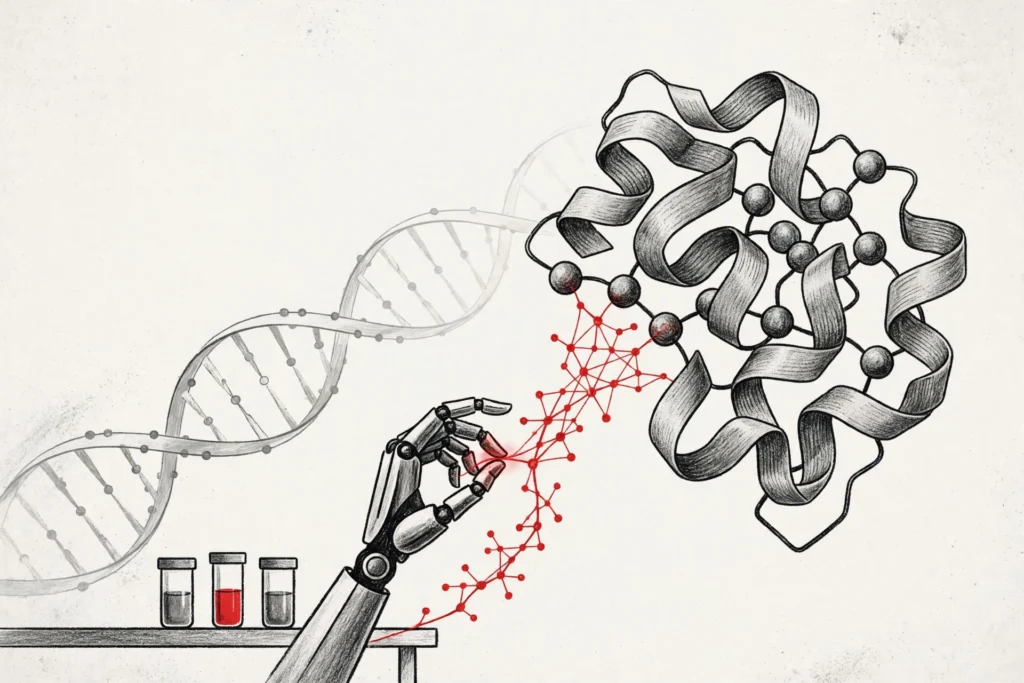
Somewhere in a laboratory this month, a rack of tiny vials held proteins that had never existed before — the first fruits of GPT-6 protein design.
No biologist sketched them at a whiteboard. No evolution shaped them over millions of years. They were designed by a chatbot — a general-purpose AI model that has never held a pipette or run a gel. And when the tests came back, some of them worked.
That is the claim at the heart of OpenAI’s latest research, published on November 24. Its GPT-6 family, the company says, can design new protein structures and the amino-acid sequences behind them using reasoning and general-purpose code.
In laboratory tests run with research partner Onava, proteins based on GPT-6.2 designs showed evidence of binding to five different drug targets. It is the first wet-lab evidence OpenAI has published for a general model doing protein design.
GPT-6 Protein Design: What OpenAI Actually Tested
Protein design is, at its core, a translation problem. A scientist starts with a job — grip this spot on a cancer protein, block that signal — and must turn it into a three-dimensional shape.
Then that shape must become a chain of amino acids that folds into it. Until now, that work has belonged to specialist AI tools built for biology, such as AlphaFold and RFdiffusion.
OpenAI’s preprint, titled “GPT-6 as a Universal Foundation Model for Protein Biology: Beyond Specialized Models,” asks a different question: can one general model do the job?
The researchers gave GPT-6.2 instructions in plain language — where a protein should attach, what overall shape it should have, how many coils or strands it should contain. The model then reasoned about the problem and wrote Python code to explore candidate designs.
OpenAI says its written reasoning drew on maths, physics, chemistry and biology to work out how two proteins fit together. On computational tests across 14 protein-design tasks, the company’s latest internal model matched or beat specialist systems on many of them.
It scored 43.7% on a motif-scaffolding benchmark, against a 27.8% specialist baseline. On docking tests it reported 93% on PoseBusters, against 50% for the specialist DiffDock-L. But computer scores are cheap — the interesting results came back from the lab.
35 of 322: The Lab Results in Numbers
The first experiment asked GPT-6.2 to design minibinders — small proteins engineered to grip a chosen spot on a larger target. The model was given the structures of five target proteins, with the attachment sites marked.
Onava then made 322 of those designs into real proteins and tested whether they stuck. Thirty-five did: a hit rate of 10.9%, with at least one binder for every target.
The breakdown tells its own story. Eighteen binders hit IL-17A, a target involved in inflammation. Eight bound VEGF-A, a protein that drives blood-vessel growth and is targeted in cancer and eye disease.
Five bound PD-L1, the checkpoint protein targeted by cancer immunotherapies such as pembrolizumab, sold as Keytruda. Three bound IL-7Rα, and one bound TrkA, a nerve-growth receptor.
That spread matters. A single lucky hit could be a fluke; binders across all five targets suggest the model is doing something real. These are not drugs, though — just starting points that scientists can develop or use to study a disease.
The Redesign Tests: When GPT-6 Rewrites Existing Proteins
Designing from scratch is the hardest test, so OpenAI also asked GPT-6.2 to rewrite proteins that already work — given a confirmed minibinder’s structure, but not its original sequence, it had to propose a new one.
In initial lab screens, binding survived in 75 of 88 designs for MDM2, or 85%. It survived in 26 of 42 for VEGF-A, or 62%, and in 8 of 59 for PD-1, or 14%.
The model was also given three minibinder shapes it had generated earlier and never published, and asked to write sequences for them. Of 107 proteins made from those sequences, 14 — or 13.1% — showed binding.
OpenAI points to that result as evidence the capability goes beyond memorisation: the model worked with shapes it had invented, not ones it had seen in training data.
The antibody experiments went further still. GPT-6.2 redesigned the binding loops of six small antibodies targeting IL-4Rα, a receptor involved in allergic disease. Of 182 designs tested, 128 — or 70% — showed signs of binding.
In a separate test, the model changed roughly half the amino acids in three binding loops of five therapeutic antibodies. Of 272 fragments tested, 179 — or 66% — still bound their original targets, PD-1 or PD-L1.
The Honest Caveats: What GPT-6 Cannot Do Yet
None of this means a chatbot can design a medicine on its own. OpenAI states the limits plainly, and they are substantial. The pipeline that produced the lab results was hybrid.
A specialist model called SolubleMPNN supplied the amino-acid sequences for GPT-6.2’s shapes. Other specialist models — Boltz-2, OpenDDE and ESMFold2 — filtered the candidates before anything reached the bench.
The honest reading is that GPT-6.2’s shapes can become real binding proteins, not that the model did the whole job alone. Predicting a complete protein structure from its amino-acid sequence also remains a clear weakness.
OpenAI’s latest model recorded a TM-score of 0.38 on that task, against 0.93 for ESMFold2. Its backbone shapes scored slightly below RFdiffusion, whose original study reported higher hit rates.
OpenAI notes that hit rates swing heavily with how strictly designs are filtered before testing, and that binding in an assay is not biological function. The preprint publishes no affinity constants, no potency data, and no toxicity data.
Nothing in it shows how these proteins behave in a living organism. Joy Jiao, OpenAI’s life-sciences research lead, called the work a proof of principle and noted that specialist tools were still needed for key steps.
The preprint has not been peer-reviewed, and the strongest performance claims come from OpenAI’s own evaluations. Independent replication is still pending.
Why GPT-6 Protein Design Matters for Drug Discovery
Even with those limits, the result is significant. Protein design has been a stronghold of specialist models: narrow tools, trained on biology, doing one job well. GPT-6 is a generalist — it was not built for proteins.
If a generalist can now contribute real designs to a biology workflow, the boundary between “AI that talks” and “AI that does science” starts to dissolve. That matters for drug discovery, where time is the scarcest resource.
Designing a binder for a new target is one of the slowest early steps in developing a medicine. A model that can propose plausible starting points in hours rather than months could compress the front end of that pipeline.
It also matters for access. A single general model that handles many stages of a workflow is easier to deploy than a chain of specialist tools, each with its own setup and expertise.
GPT-6 joins a crowded frontier — Google’s Gemini 4 Carbon has also pushed into new territory this year — but this is the first time a general model has lab-verified protein designs to show for it.
Google DeepMind’s AlphaGenome 2, announced earlier this month, is the opposite approach: a specialist built to read DNA cell by cell. GPT-6 comes at biology from the other direction — a general mind pointed at the genome.
There is also a safety dimension. Designing proteins that bind human targets is dual-use, and OpenAI says the work sits under its biosafety governance, with a Rosalind risk-card addendum and SynthID Bio watermarking.
What Happens Next
The next step is peer review and replication. Other labs must repeat the experiments, test more targets, and publish affinity and safety data before anyone can judge how useful GPT-6’s designs really are.
For now, the scoreboard is modest: 35 proteins out of 322 stuck to their targets. None is a drug, and none may ever become one. But they were designed by a model built to write essays and answer questions — and that, more than the hit rate, is the news.
The general-purpose AI era has reached the wet lab. OpenAI, which reported roughly $10 billion in quarterly revenue in its last results, is betting this capability justifies the enormous sums flowing into frontier models.
Whether GPT-6’s protein designs hold up under independent scrutiny will decide if that bet pays off in the lab as well as on the balance sheet — and whether the next generation of medicines begins life as a conversation with a chatbot.


