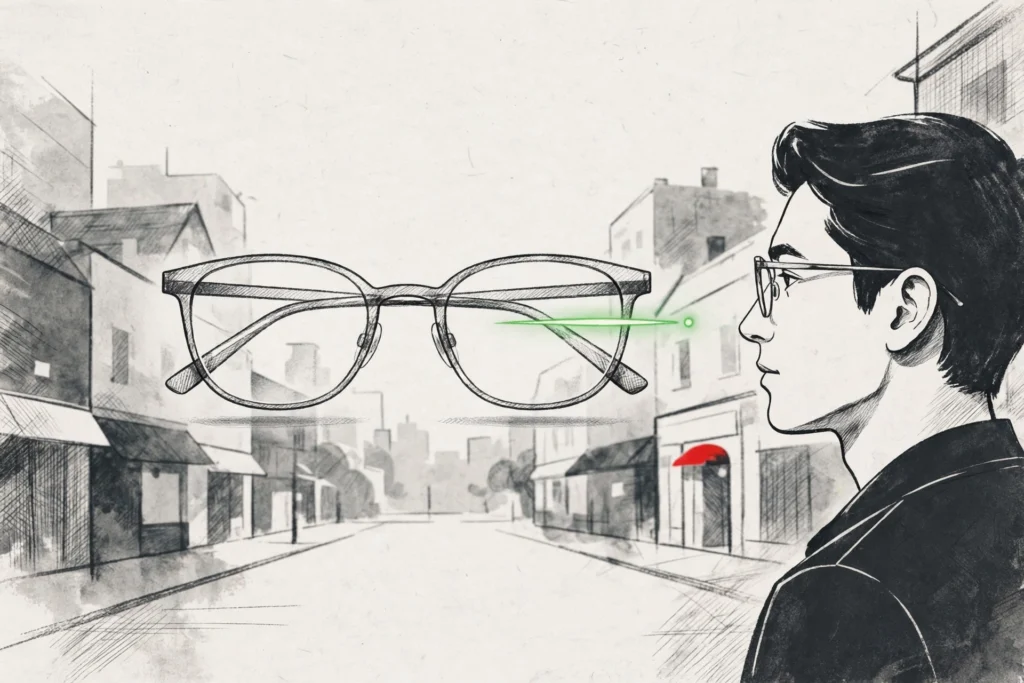
Picture the scene. You are halfway through a meeting when someone says the one thing that changes the whole plan. Nobody writes it down. By the time you reach your desk, the exact words are gone, and all that is left is a vague feeling that something important just slipped past.
Nothing thinks it has an answer for that moment. The London phone maker has now put a date on its first AI device: December 8. The announcement came on Friday in a short post on X, carrying a poster, a tagline, and almost nothing else.
“Be present. It’s noted. 8 December.” That was the whole message. No name. No price. No specifications. Just a promise that the device is coming, and that it is built to remember what you do not.
The Nothing AI device has been one of the worst-kept secrets in consumer tech this month. Company chief Carl Pei first confirmed in early November that a dedicated AI product would ship in December.
Then a leak this week showed what looks like a small metal gadget with a physical button labelled “Talk”. Now the date is official, and the countdown has begun.
The Teaser: “Be Present. It’s Noted.”
Nothing’s new poster does not show the whole device. It offers a close-up instead: a circular metallic component with a layered, glossy design, ringed by textured dark and silver finishes. It looks expensive. It looks deliberately mysterious. And it reveals nothing about the shape of the thing itself.
According to Gadgets 360, the company has still not revealed the official name of the device or any details about its features. The launch, the site notes, could mark Nothing’s entry into a brand-new category of AI-powered hardware. You can read their report on the announcement here.
What We Know About the Nothing AI Device So Far
Strip away the mystery and the confirmed facts are few, but they paint a fairly clear picture. The device has no screen. It is a piece of standalone hardware, not an app. It has a physical button for capturing audio, and it is designed to work alongside the phones and earbuds Nothing already sells.
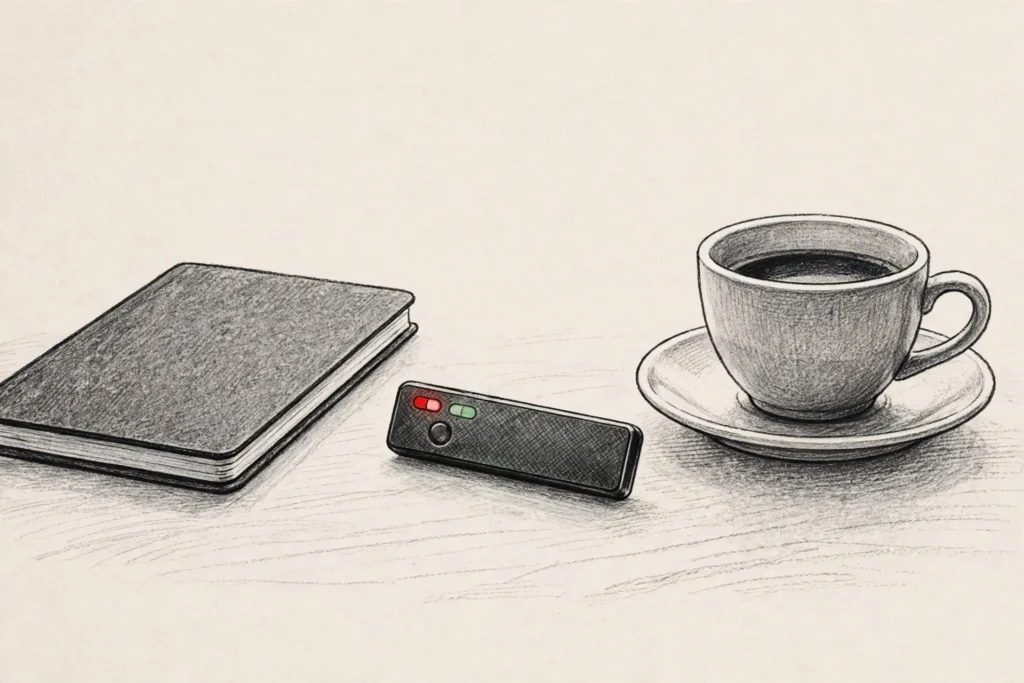
The leaked image, first shared by tipster Yogesh Brar, showed a slim rectangular body that fits in the palm of a hand. It had a dedicated “Talk” button, a small circular control, and the red and green indicator lights.
The pairing is a familiar one in recording gear: one colour says it is listening, the other says it is not.
What the device does with the audio is still guesswork, but the clues all point in one direction. Reports suggest it will record conversations, turn speech into text with AI, and hand back usable notes. Live translation and smart note-taking are also expected, which would make it a pocket companion for meetings, lectures and interviews.
Pei has said the product is a productivity tool first and foremost. It is not trying to be a phone replacement, and it is not trying to be a general-purpose AI companion. It is built for one job: capturing the information that usually disappears the moment a conversation ends.
A Screenless Tool, Not Another Phone
Pei laid out the thinking in an essay published on X in early November, titled “Toolmakers”. Today’s AI tools, he argued, miss most of the context of people’s lives. Chatbots only know what you type into them. They never hear the meeting, the phone call, or the idea you muttered on a walk.
“It’s a tool, but one built with the personality and care that have come to define a Nothing product,” Pei wrote. “It has no new screen, and it couldn’t have been an app.”
A phone, he argues, cannot always be there for us, and the more context you feed an AI, the more useful it becomes.
Why Nothing Is Betting on a Button
Nothing is a small company taking a large swing. Founded in 2020 by former OnePlus co-founder Carl Pei, the London brand has spent six years building a reputation for distinctive design and transparent hardware. It crossed one billion dollars in total sales early in 2025, after growing revenue by 150 percent in 2024.
The money behind the bet is real. Nothing raised 200 million dollars in a Series C round in September 2025, led by Tiger Global. The round valued the company at 1.3 billion dollars and took its total funding past 450 million dollars.
The company has said it plans to launch twice as many smartphones in 2027, and to build an operating system that is, in Pei’s words, hyper-personalised for each person.
The AI device is the first step beyond phones, earbuds and smartwatches. If it works, it gives Nothing a product in a category it can own, rather than one where it fights Apple and Samsung head-on.
If it fails, the company still has its phone business. It is a calculated risk, and the funding round was raised to pay for exactly this kind of move.
The AI Hardware Race Is Getting Crowded
Nothing is not entering an empty room. The race to build AI hardware that lives beyond the phone has already produced spectacular failures and serious contenders, and the lessons of both are written all over this launch.
The cautionary tale is the Humane Ai Pin, a screenless wearable that promised to replace the smartphone and collapsed under bad reviews, overheating batteries and a price nobody would pay. The Rabbit R1, another AI gadget, fared little better. Both tried to do too much, too soon, with too little to show for it.
The success story so far belongs to smart glasses. Meta’s Ray-Ban glasses have found real buyers, and Samsung’s own AI glasses, the Samsung Intelligent Eyewear, opened pre-orders this month with Google’s Gemini built in.
Apple, meanwhile, is reportedly working on its own smart glasses for a 2027 reveal, also without a traditional AR display.
Nothing’s answer is to go smaller and simpler. No glasses, no camera pointed at the world, no attempt to replace the phone. Just a button, a microphone, and an AI that turns talk into notes. It is a narrower bet than the Ai Pin ever made, and that narrowness might be the point.
The leaked design, which we covered in detail when it first surfaced, already shows how different this approach is. You can see the full breakdown of the leaked Nothing AI device here, including the Talk button and the red and green indicator lights.
What Happens on December 8
December 8 is when the guessing stops. Nothing is expected to reveal the device’s name, its price, its battery life, and the markets where it will sell first. The company has also kept quiet about which AI models power the transcription, and whether the device works on its own or needs a Nothing phone nearby.
Shipping is expected to start in December, which means the device should reach buyers before the year ends.
The questions that matter most are the ones Nothing has not answered yet. How long does the battery last when it is listening all day? Does it store recordings on the device, or send them to the cloud?
And what happens when the person on the other side of the conversation has not agreed to be recorded? The red and green LEDs may signal when recording is happening, but a light is not consent.
What Nothing Still Has to Prove
For all the hype, almost nothing about this device is confirmed beyond the date, the lack of a screen, and the existence of a button. The name is unknown. The price is unknown. The battery life is unknown. Even the exact shape is unknown, since the poster shows a detail rather than the whole product.
That is either brilliant marketing or a warning sign, and December 8 will tell us which. If the device is genuinely useful, the mystery will look like confidence. If it is a solution looking for a problem, the mystery will look like a company hiding a thin product behind a thick curtain of teasers.
What is certain is that Nothing has picked the right moment. AI hardware is the most argued-over category in consumer tech right now, and every major company is placing its bet.
Samsung has its glasses. Apple has its roadmap. Meta has its Ray-Bans. Nothing, a company a fraction of their size, is betting that the winning device is the smallest and simplest one in the room.
On December 8, we find out whether a button and a promise are enough.