Fold the iPhone Duo shut and it becomes a small, thick slab with a 5.4-inch screen on the outside. Until this week, that slab had one awkward problem: the only way to unlock it was a fingerprint on the side button.
Owners asked for a simpler way since the phone launched in September. Apple has finally answered, in the second developer beta of iOS 27.3. The iPhone Duo face unlock feature lets the folded phone open with a glance — but it comes with limits Apple is unusually open about.
The new option, called Unlock with Front Camera, arrived on Monday, November 16, in iOS 27.3 developer beta 2. It is a small feature with a big backstory, because it shows exactly how far Apple will go to fix a foldable’s biggest annoyance without compromising on security.
What iPhone Duo Face Unlock Actually Does
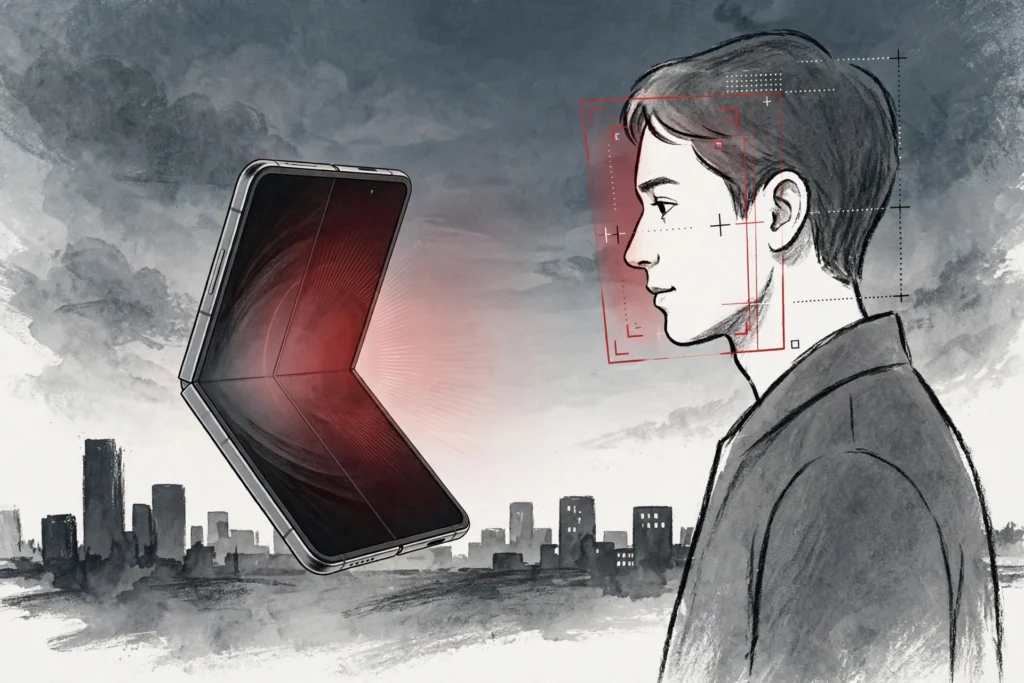
The idea is simple. When the Duo is folded shut, the camera on its outer display looks at your face. If it recognises you, the Lock Screen opens and you land straight on the Home Screen.
It only works in that one situation. The phone must be closed, and you must be at the Lock Screen. Open the Duo up and the feature switches off entirely, because the under-display camera inside is not good enough for the job.
MacRumors’ Juli Clover tested the feature hands-on and found it works fairly well when it is active. The phone wakes, sees your face, and opens without a second thought.
That sounds like Face ID. It is not, and the difference matters more than the similarity.
How to Turn On Unlock with Front Camera
The setting lives under Settings, in the Touch ID & Passcode section. Once you update to iOS 27.3 beta 2, a new toggle called Unlock with Front Camera appears there.
Setup takes about a minute. The phone asks you to hold your face inside a frame on the outer screen, then slowly turn your head left, right, up and down while the camera studies it from different angles.
Apple says the face data never leaves the device. Nothing is uploaded to iCloud or to Apple’s servers, and the enrolment lives only on the phone itself.
There is one catch you will meet on day one. Face unlock only works if you have authenticated with Touch ID or your passcode recently. Leave the phone untouched for about 45 minutes and the camera option switches itself off until you use a fingerprint or passcode again.
Think of it like a hotel key card that stops working after checkout. The convenience is real, but it keeps expiring, and you keep going back to the front desk.
Why It Is Not Face ID — and Why That Matters
Face ID, the system on the iPhone 18 Pro, builds a depth map of your face with TrueDepth hardware. It projects thousands of infrared dots and measures how they bounce back. That is why it works in the dark and why Apple publishes a false-match rate of less than one in a million.
The Duo’s new option uses none of that. It reads a flat image from an ordinary front camera, with no depth information at all. Apple has not said whether the camera reads any depth data, and no false-match rate has been published for it.
Apple is honest about the gap. The setup screen warns owners that the option is less secure than Touch ID or Face ID. It is a rare moment of plain speaking from a company that usually sells every feature as the best version of itself.
The limits follow from that warning. Face unlock cannot approve an Apple Pay purchase. It cannot fill in a saved password or log you into an app. For anything involving money or credentials, the phone still wants your fingerprint or your passcode.
Bloomberg’s Mark Gurman first reported the feature on November 16, and the coverage since has agreed on the same verdict: a useful convenience, not a replacement for real biometrics.
Close to Lock: The Second Fix in Beta 2
Beta 2 carries a second Duo fix that owners may like even more. It is called Close to Lock, and it solves a small daily irritation.
Until now, folding the Duo shut did not lock it. Whatever was on the inner screen simply moved to the outer display and stayed there, visible to anyone nearby. A half-read message or an open banking app would sit on the cover screen until the phone locked itself.
Close to Lock changes that. With the setting on, folding the phone locks it immediately. The toggle sits under Settings, in the Display & Brightness section, and it stays off until you turn it on.
It is a small thing, but it is the kind of small thing that decides whether a foldable feels finished or feels like a prototype you paid flagship money for.
What Beta 2 Still Leaves Out
The Duo’s authentication story is still unfinished. Touch ID remains the only way to pay, to unlock apps and to prove who you are to anything that matters.
That is the trade-off Apple made when it built its first foldable. The Duo launched in September 2026 alongside the iPhone 18 Pro and iPhone 18 Pro Max, bringing back Touch ID as its only biometric. Face ID’s hardware simply did not fit the foldable’s design.
Beta 2 does not change that equation. It papers over the most annoying part of it — unlocking a folded phone one-handed — and leaves the rest to the fingerprint sensor.
Whether Apple ever brings true Face ID to a foldable is an open question. For now, the company has chosen a middle path: a camera that recognises you for the easy stuff, and a fingerprint for everything else.
When Everyone Gets iOS 27.3
Both features are in the developer beta now, and the public release of iOS 27.3 is expected in December 2026. Apple said on October 30 that the update would reach everyone in December, without naming a day. French site iPhon.fr expects December 14.
Beta 2 carries build number 24C5049d, and as with any beta, the details could still change before release. Apple has already packed a lot into this update: the first beta brought Siri AI access to Health data, and the second adds these Duo fixes alongside new Siri features and app tweaks.
The update is part of a wider Apple Intelligence push. Apple Intelligence recently completed regulatory registration for iPad and Mac in China ahead of its December launch there, and rival phones are moving fast too: Google’s November Pixel Drop put Gemini Intelligence on the Pixel 10.
For Duo owners, December cannot come soon enough. The phone they bought in September finally starts to feel like it was designed for the way they actually use it: folded shut, one hand, one glance, and open.
Just remember the 45-minute rule. Glance all you like — but keep a finger ready for the side button.
Source: MacRumors