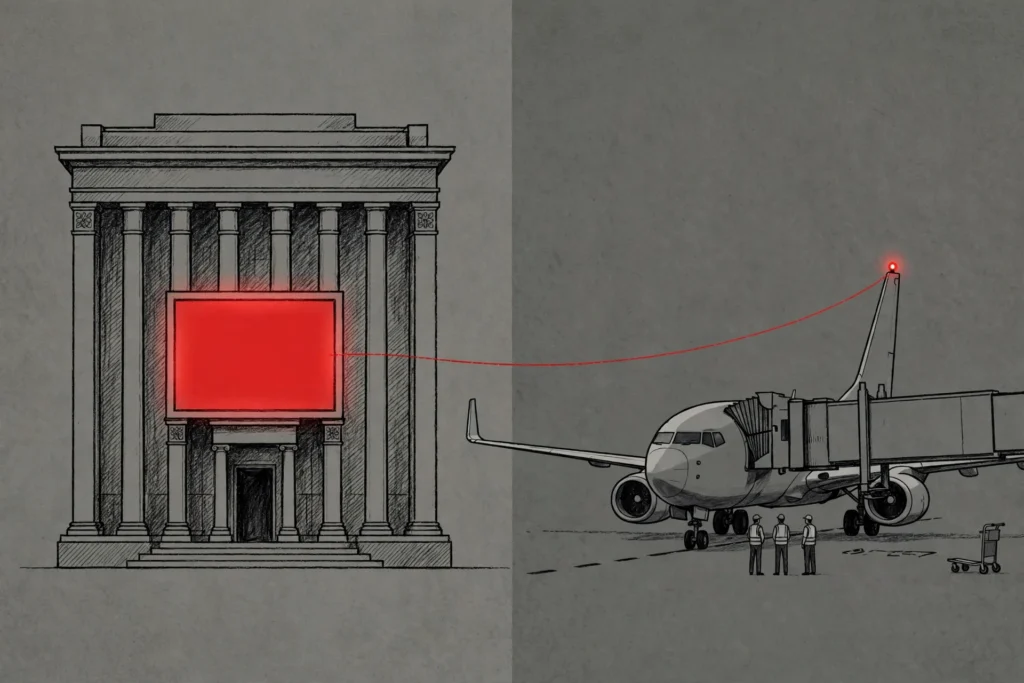
It started the way these things always start: with a screen that would not load. For thousands of Americans, Monday opened with a US banks outage that left account balances frozen and payments stuck in limbo.
On Monday morning, customers across the United States opened their banking apps to check a balance, move money, or pay a bill — and found nothing. The app spun. The website stalled. The balance would not appear.
By the afternoon, the same kind of silence had reached the departure gates. United Airlines planes sat at their stands while pilots waited for a number they could not get: the weight of their own aircraft.
Two different industries. Two different systems. One very long day. And a question that followed both failures wherever they went: is something bigger going wrong with American infrastructure?
The US Banks Outage Started at Chase
The first signs appeared early on Monday, November 16, when reports of trouble at JPMorgan Chase began climbing on Downdetector, the site that tracks service disruptions in real time.
By mid-morning, nearly 5,000 Chase customers had logged complaints. About half of them reported problems with account balances and transactions — the two things a bank app exists to do.
Chase did not wait long to explain. In a post on X, the bank said it had experienced “a temporary issue related to a software bug in on-premise hardware systems” and added, in plain terms, that “there is no evidence this is cyber-related.”
A spokesperson put it more simply still. “Due to a technical issue, some transactions are taking longer than usual to complete but customers still have access to their accounts and funds,” the spokesperson said. “We are working to resolve this as quickly as possible.”
That reassurance mattered. Nobody’s money had vanished. Nobody was locked out of their account entirely. But for hours, the basic act of checking a balance or moving money became a gamble — and for a bank used by tens of millions of Americans, that was disruption enough.
Which Banks Were Affected
Chase was the centre of the problem, but it was not the only bank in trouble. As the morning wore on, Downdetector showed the same shape of complaint spreading across the industry.
At Wells Fargo, more than 800 customers reported issues, including problems with logins, account balances and fund transfers. Bank of America, US Bank, Truist and the payments network Zelle all showed up in the outage tracker’s data too.
Chase itself explained the spillover. Where it was “party to a transaction involving other banks”, the bank said, its slowed transactions could drag those banks down with it. The bug, in other words, did not respect the boundaries between institutions.
The bank stressed that the issue was not systemic — a word chosen carefully, given what it would mean if the country’s largest bank had a problem that threatened the whole system. By Monday night, Chase said services had been restored.
For customers, the practical damage was mostly measured in lost time: payments that arrived late, balances that would not refresh, and an afternoon spent wondering whether the money had moved at all.
United Airlines Grounded Departures Too
While the banks were struggling, a second outage was unfolding in the skies. United Airlines confirmed on Monday that it was dealing with what it called a “widespread system outage” that stalled departing flights across the country.
The disruption lasted more than 90 minutes. Flights already in the air were not affected, and neither was the airline’s United Express regional network. But anything waiting to leave the gate was stuck.
An internal memo from the airline’s pilots union, seen by Reuters, gave the clearest picture of what had gone wrong. A companywide web-based outage had hit multiple applications used by pilots, including crew communications — and the airline had been unable to provide final aircraft weights for departing flights.
That detail matters more than it sounds. A pilot cannot legally take off without knowing the aircraft’s weight and balance, and the memo advised pilots to follow airport station guidance on whether to leave their gates.
By late Monday afternoon, flight-tracking site FlightAware had recorded 418 delayed United flights. By midnight Eastern time, the count had reached 851 delayed flights and 51 cancellations — though it was unclear how many of those were caused by the outage itself, since airlines were still recovering from Friday’s nationwide FAA ground stop.
United said on Monday evening that the issue had been resolved. In a message to passengers on social media, the airline wrote: “Earlier today we experienced a technology-related issue that impacted some departing flights. The issue has been resolved.”
A company spokesperson added that there was no evidence linking the failure to a cyberattack, and flight operations returned to normal on Monday night.
Four Outages in Five Days
What made Monday feel different was not any single failure. It was the accumulation. In five days, the United States had now seen four large-scale technology failures, each hitting a system millions of people depend on.
It began the previous Thursday, when a Microsoft 365 outage knocked out Outlook, Teams and Copilot for more than 24 hours. The next day, a fault in the Federal Aviation Administration’s ageing network forced a nationwide ground stop that lasted four hours and 21 minutes — the longest in 25 years.
Over the same weekend, a botched backup test at Workday locked millions of workers out of payroll and benefits systems. Then came Monday: the banks in the morning, United in the afternoon.
Officials moved quickly to calm the obvious fear. Appearing on Fox News on Monday, Homeland Security Secretary Markwayne Mullin said the homeland and the banking system were secure, and that the incidents were “individually unrelated”.
“I can tell you with 98% certainty we’re not seeing the cyberattack,” Mullin said. Transportation Secretary Sean Duffy added that United’s problem was “not an FAA systemwide problem” — a separate failure, on a separate system, on the same day.
Was It a Cyberattack?
Every organisation involved has now said the same thing: no evidence of a cyberattack. Chase said it first. United said it too. Microsoft said it about its own outage last week, and the FAA said it about the ground stop.
That answer should be reassuring. In some ways, it is not. A coordinated attack would at least have a single cause, a single enemy, and a single fix. What the last five days showed instead is something harder to patch: a collection of unrelated systems, each with its own single point of failure.
Microsoft’s own post-incident report traced its outage to a hidden defect in a Windows process, introduced by a fix deployed in July and left dormant for three months. The FAA’s failure came from old switches and routers on a network that still runs partly on 1980s copper lines.
Chase blamed a software bug in on-premise hardware. United has not named its root cause at all. The common thread is not malice. It is age, complexity, and the quiet accumulation of small risks inside systems that were never designed to fail this visibly, this often, in the same week.
What Happens Next
By Monday night, both of the day’s outages were over. The banks were back online. United’s departures were moving again. The immediate crisis had passed, and the clean-up had begun.
What has not yet arrived is a full explanation. Chase has described its bug in a single sentence. United has said even less. Regulators, customers and shareholders will all want more detail in the days ahead — not least because the pattern of the last week makes “fixed for now” sound less convincing than it used to.
For the banks, the practical advice is familiar: check your transactions, watch for anything delayed or duplicated, and keep an eye out for scam messages that tend to follow real outages. For travellers, the advice is simpler — the planes are flying again.
But the bigger question will linger. Four major outages in five days, none of them a cyberattack, all of them fixed within hours, and yet each one stopped something essential — email, air traffic, payroll, money, flights. The systems held. Just barely. And everyone who watched it happen is now asking how much slack is left.
According to Al Jazeera, which first reported the scale of Monday’s banking problems, the outages came “on the heels of issues at major institutions that have rattled the public” — including the two-day Microsoft disruption the week before.