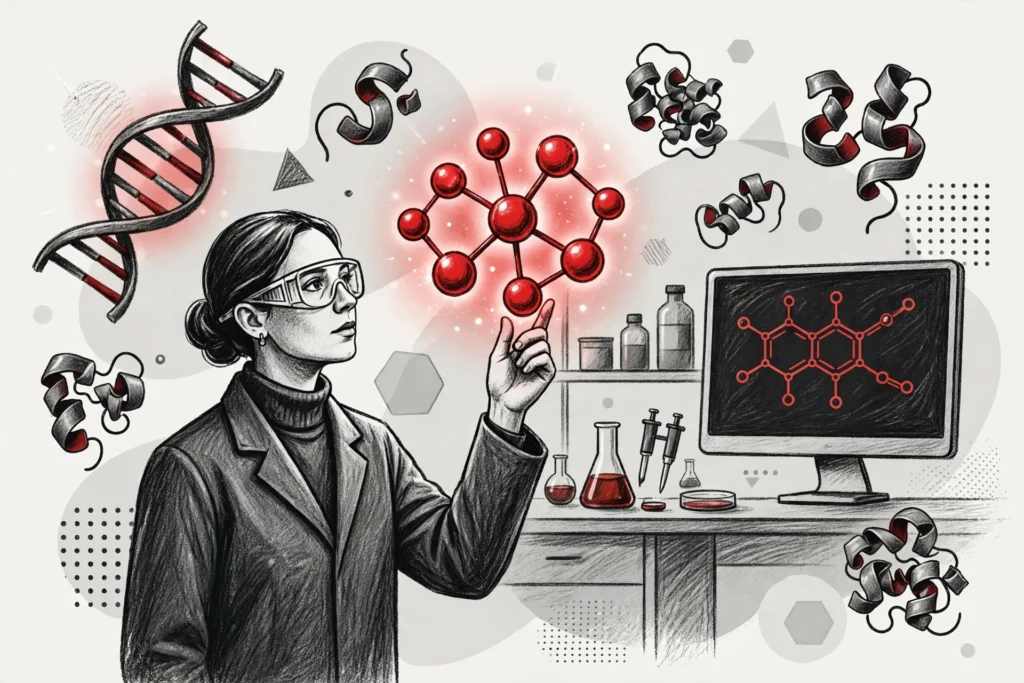
Picture a patient in a hospital bed, waiting for a medicine that does not exist yet. Somewhere in a London laboratory, a computer is sketching the molecule that might one day save her. That is the promise Isomorphic Labs has sold since 2021 — and on Tuesday, investors handed it $5 billion to prove it.
The Alphabet-backed drug discovery firm announced a Series C funding round of $5 billion, co-led by Greenoaks and Sequoia Capital, according to Reuters. It is one of the largest private financings ever raised by an artificial intelligence company, and it arrives at a moment when the whole field is about to be judged.
Isomorphic Labs was spun out of Google DeepMind in 2021 to turn the Nobel Prize-winning AlphaFold system into a working drug company. Five years on, it has raised billions and signed three of the world’s biggest drug makers as partners — and still has not given a single AI-designed drug to a human patient.
That is about to change, if the company’s own timetable holds. The money, founder and chief executive Demis Hassabis said, will push its first therapeutic programmes towards clinical trials. The clock, however, is ticking loudly.
What the $5 Billion Buys
The Series C round was co-led by Greenoaks and Sequoia Capital, with Andreessen Horowitz and other new investors joining in. Alphabet made what the company called a significant investment, and existing backers including Thrive Capital, MGX and GV also took part.
Isomorphic declined to share its valuation, but Bloomberg reported in October that funding talks valued it at at least $40 billion — among the most valuable private biotech companies on the planet, for a firm with no drug in human trials.
The round comes about six months after Isomorphic raised $2.1 billion in a Series B led by Thrive Capital in May 2026, following a $600 million round in March 2025, also led by Thrive. In less than two years, outside investors have poured close to $8 billion into the company.
“This round enables us to accelerate our progress: building foundational biology models, deepening our systemic disease understanding, and driving our first therapeutic programs towards clinical trials to deliver tangible impact for patients,” Hassabis said in the announcement.
A Drug Company Built on AlphaFold
To understand why investors keep writing such large cheques, it helps to go back to 2020. That year, DeepMind’s AlphaFold 2 solved a problem biologists had wrestled with for half a century: predicting the three-dimensional shape of a protein from its amino-acid sequence, to near-experimental accuracy.
Proteins are the machines of the body, and their shape decides what they do. Most drugs work by fitting into a protein like a key into a lock. If you can predict the lock’s shape, you can design the key on a computer instead of hunting for it in a laboratory.
Hassabis, who shared the 2024 Nobel Prize in Chemistry for AlphaFold, founded Isomorphic Labs in 2021 to turn that insight into medicines. AlphaFold 3 followed in May 2024, published in Nature with Google DeepMind, extending the system to predicting how proteins interact with other molecules — including the small molecules that become drugs.
Isomorphic calls itself a vertically integrated drug company. It builds its own AI models, generates its own laboratory data, runs its own medicinal chemistry, and plans to take its own candidates into trials rather than licensing its technology to others.
The same DeepMind stable also produced Gemini 4 Carbon, Google’s strongest AI model yet.
IsoDDE: The Engine Behind the Pitch
At the heart of the company’s pitch sits a system called IsoDDE — the Isomorphic Drug Design Engine. Isomorphic described it in a technical report published in February 2026, presenting it as the step beyond AlphaFold: not just predicting structures, but designing new drugs from scratch.
The engine designs candidate molecules, predicts their properties, and refines them before scientists decide which ones are worth making and testing. According to the company’s own report, IsoDDE more than doubles AlphaFold 3’s accuracy on the hardest protein-ligand cases in a benchmark built to test unfamiliar binding pockets and molecules.
Those numbers come from the company’s own evaluations rather than independent peer review — IsoDDE has not been published in a journal. That distinction matters, because the whole investment case rests on the claim that the engine’s designs will work in real bodies, not just in benchmarks.
Isomorphic said on Tuesday that it has seen positive pre-clinical results in its internal oncology and immunology programmes and with partners, “setting the stage for clinical entry”. It has not named its drug candidates or published preclinical data, so outsiders cannot yet judge how close those programmes are.
The Clock Is Ticking on Clinical Trials
The $5 billion round lands against a deadline Isomorphic set for itself. In 2025, Hassabis said the company would have AI-designed drugs in clinical trials by the end of that year. At the World Economic Forum in Davos in January 2026, he moved the target to the end of 2026.
As of November 16, no patient had been dosed with any drug designed by Isomorphic, and no first-in-human trial had been publicly announced. President Max Jaderberg told a Bloomberg Tech London audience on November 2 that AI will eventually design every medicine a human takes — while describing the programmes as still in preclinical development.
That leaves roughly six weeks for the company to hit a target it has already missed once. Its stated goal is to file its first Investigational New Drug application and begin first-in-human Phase I safety testing by the end of 2026.
Why Investors Keep Paying Up
Part of the answer lies in the partners. In January 2024, Isomorphic signed collaborations with Eli Lilly and Novartis worth nearly $3 billion including milestones. Lilly agreed to $45 million upfront and up to $1.7 billion in milestones; Novartis agreed to $37.5 million upfront and up to $1.2 billion, plus royalties in both cases.
Novartis expanded the collaboration in February 2025, adding up to three more programmes to the original three. In January 2026, Johnson & Johnson joined with a multi-target research collaboration, with financial terms undisclosed. Under that deal, Isomorphic does the computational design while Johnson & Johnson runs the assays and takes programmes forward.
Drug discovery startups are raising record sums in 2026. According to deal aggregation platform Dealroom, the sector will raise $23.2 billion this year — a record. Investors are betting that AI can cut the decade-long, billion-dollar cost of bringing a drug to market, and Isomorphic is the purest version of that bet.
The Race Is No Longer Theoretical
Isomorphic is not the only company chasing this prize, and the competition has started producing results. Insilico Medicine’s rentosertib — a small-molecule drug designed by its Pharma.AI platform for idiopathic pulmonary fibrosis — entered Phase III trials in July 2026, making it the first AI-designed drug to reach Phase III in any indication.
That milestone sets the benchmark Isomorphic must now meet. Being the best-funded AI drug company is a different achievement from being the first to prove an AI-designed medicine works in patients, and the gap between the two is where the scepticism lives.
There is also a simpler explanation for the money. Clinical trials are ruinously expensive, and the $5 billion buys Isomorphic the freedom to run several programmes at once, absorb failures, and keep building its models without returning to investors every year. In biotech, cash is time.
What Happens Next
The immediate test is the end-of-year deadline. If Isomorphic files its first Investigational New Drug application and doses its first patient before 2027, the $5 billion round will look like a company stepping onto the starting line with its war chest full.
If the deadline slips a second time, the questions will get harder. Investors who paid a premium valuation for a preclinical company will want to know when the science turns into medicine — and the company’s own history will make the answer harder to take on trust.
Either way, the Series C changes the stakes. With close to $8 billion raised in under two years and three of the world’s largest drug makers as partners, Isomorphic Labs is no longer a research project with a famous founder. It is a drug company now — funded like one, judged like one.
The patient in the hospital bed is still waiting. The $5 billion is a bet that the molecule sketched on a computer in London will one day reach her — and that when it does, it will work.
Source: Reuters