The call that stopped the trucks
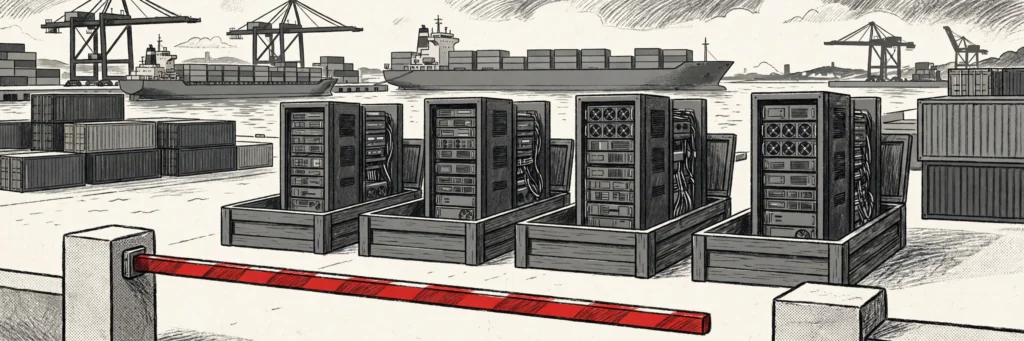
Somewhere in a warehouse outside Kuala Lumpur, a row of server racks was ready to go. The crates were packed, the paperwork was signed, and the buyer had already paid. Then the phone rang. The servers were not leaving the building.
That scene, repeated across four countries this week, is the sharp end of a decision by Nvidia, the world’s most valuable chipmaker. According to the Financial Times, Nvidia has told its manufacturing partners to halt shipments of AI servers to Malaysia, Singapore, Thailand and Indonesia.
The partners in question are the companies that turn Nvidia’s chips into finished machines: Dell and Supermicro. Both have now told buyers in the four countries that their orders cannot be shipped, the newspaper reported on Thursday, November 26, citing three people familiar with the matter.
Nvidia, Dell and Supermicro did not immediately respond to requests for comment. And nobody involved would say how long the freeze will last. That uncertainty is the story now, because the halt sits at the centre of the biggest question in the AI industry: who gets to use the world’s most powerful chips, and who decides?
Nvidia halts AI server shipments: what actually happened
The Financial Times report is short on detail but clear on the shape of it. Nvidia instructed its server-building partners to stop deliveries to the four Southeast Asian countries. Dell and Supermicro then passed the message on to their customers.
These are not small orders. The servers in question are the machines that power AI data centres: racks filled with Nvidia’s graphics processors, the hardware that trains large language models and runs them at scale. A single shipment can be worth tens of millions of dollars.
It is unclear whether the halt is temporary, the report added. Nvidia and its partners are still working out how to comply with new United States export controls, and the freeze may simply be a pause while the lawyers and compliance teams catch up. Or it may be the start of something longer.
Either way, the timing is striking. The halt comes days after Washington tightened the rules, and it lands on a company whose shares have already been under pressure. AI-linked stocks fell for a second straight day on November 25 as investors weighed the cost of the AI buildout against uncertain returns, according to Reuters.
The new US rule behind the Nvidia server halt
The halt follows a rule from the US Commerce Department’s Bureau of Industry and Security, known as BIS. The bureau announced the new controls on November 16, and they took effect on November 19.
Under the rule, a licence is now required to export advanced semiconductors to Indonesia, Malaysia, Singapore, Thailand or Brazil. BIS identified those countries as presenting a higher-than-normal risk of diversion, meaning chips shipped there could end up somewhere Washington does not want them to go.
That is not a blanket ban. Shipments destined for companies headquartered in the United States, or whose ultimate parent is American, are excluded from the licence requirement, provided reporting obligations are met. Legitimate local business, in other words, can continue — but only with paperwork that proves who the real end user is.
The rule also closes a loophole that had become central to the global chip trade. For years, Chinese companies that could not buy Nvidia’s most advanced chips directly have simply rented computing power from data centres abroad. The four Southeast Asian countries became popular destinations for exactly that kind of arrangement.
Now the new controls reach that workaround too. Data centres anywhere in the world that supply large volumes of computing power to companies headquartered in China or other restricted jurisdictions need a licence. Cloud providers have 90 days from the rule’s effective date — until around February 17 — to obtain one, and to obtain it they must show their end users include no parties subject to US export restrictions.
Why Southeast Asia became the detour
To understand why four countries on the other side of the world matter so much to Washington, follow the money. Nvidia booked $104 billion of revenue through its Singapore subsidiary in 2025, according to company accounts cited by the Financial Times. Some of that is revenue from Taiwan and China routed through Singapore, so not all of it is exposed to the new rules. But the number shows how central the region has become to the chip trade.
Singapore in particular has been at the heart of the diversion question. Earlier this year, US authorities investigated whether Nvidia chips had reached China through intermediaries in the region, and the trail led to Megaspeed, a Singapore-based company suspected of funnelling GPUs to China. The affair cast a long shadow: Nvidia’s chief executive Jensen Huang briefly stepped down on November 11 following revelations about his personal conduct, and was reinstated days later.
The new BIS rule is Washington’s answer to that pattern. Rather than chasing individual shipments after the fact, it puts the burden on exporters and data centres to prove, in advance, where the computing power is really going.
That is a harder test than it sounds. A data centre in Malaysia might serve dozens of customers, some of them subsidiaries of companies headquartered elsewhere. Tracing the ultimate owner of every workload is exactly the kind of due diligence the rule now demands.
What the Nvidia halt means for the AI buildout
For Nvidia, the halt is a commercial headache at a delicate moment. The company dominates the market for AI chips, and Southeast Asia has been one of its fastest-growing regions. Every shipment that sits in a warehouse is revenue deferred, and every delayed data centre is a customer that might look elsewhere.
For the four countries, the impact is more immediate. Malaysia and Singapore have both courted the data centre industry aggressively, offering land, power and tax incentives to attract the facilities that power the AI boom. Thailand and Indonesia have followed the same playbook. A freeze on the hardware those facilities need threatens the investment case at its foundation.
The money behind the buildout is already stalling. Bloomberg reported this week that lenders have paused loans tied to data centre projects in the region, including a $6.6 billion upsized loan for Bain’s Bridge Data Centres in Malaysia. Banks that were happy to fund the AI boom are now asking harder questions about who the customers will be.
And the disruption is spreading beyond the four countries. Data centre operators that had planned to sell GPU computing power to Chinese companies are now rethinking those plans, with some moving to sell their newest Nvidia chips instead of holding them for rental.
What happens next for Nvidia and Southeast Asia
The first question is whether the halt is temporary. If Nvidia and its partners can satisfy themselves that their shipments comply with the new rules — licensed where needed, documented where exempt — deliveries could resume within weeks. The Financial Times report suggests that is the hope, but nobody involved has said so on the record.
The second question is the licence queue. Cloud providers serving restricted customers have until mid-February to obtain licences, and the process will test how quickly BIS can process applications. A slow queue would freeze not just hardware shipments but the cloud services that run on hardware already installed.
The third question is the wider one. The United States has been tightening chip controls for years, and each round has pushed the industry to find new routes. The new rule is the most direct attempt yet to close the remote-access route, and its success or failure will shape how the next round of controls is written.
For now, the servers sit where they are. In warehouses across Southeast Asia, crates of the most sought-after hardware on earth are waiting for a piece of paper — a licence, a report, a signature — that says they are allowed to move. The AI boom has always run on chips. This week, for the first time in four countries, it ran into the paperwork instead.


