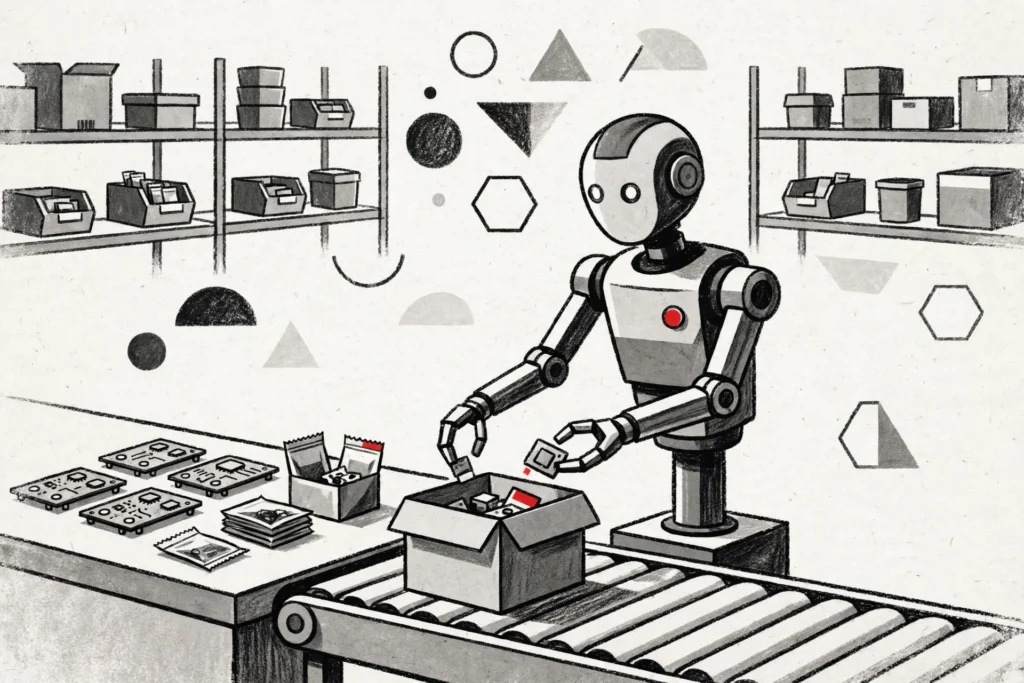
The clock on the packing station never stops. Every twenty seconds, another motherboard needs its box filled: fifteen small accessories, many of them sealed in thin, slippery plastic bags, each one in exactly the right place. It is the kind of job factories have trusted to human hands for decades.
On November 13, 2026, ASUS put a robot on that station. The machine is called ASUS Gallop, the company’s first humanoid robot, and it is already learning the job on a real production line inside one of the ASUS group’s own electronics factories.
Co-CEO S.Y. Hsu introduced Gallop on CNBC’s Squawk Box Asia, and the company expanded on the reveal the same day in a blog post by Dr. Albert Chang, a corporate vice president who co-leads the Physical AI Solutions Business Group and runs ASUS’s motherboard business.
ASUS Gallop’s First Job: Packing Motherboards
Gallop is a two-armed humanoid mounted on a fixed base. It does not walk yet, and it does not need to. Its workstation is a motherboard accessory packing station, where each board leaves the line with fifteen small parts tucked into its box.
The parts are deliberately awkward. Cables, screws, brackets and small components arrive sealed in clear plastic bags that catch the light and slide against each other. A human worker picks them up by feel as much as by sight.
That is the point. ASUS chose one of the least glamorous jobs in its factories on purpose. If a robot can handle fiddly, slippery parts at production speed, it can handle far more than a staged demonstration ever proves.
The programme is young. Work on Gallop began in early 2026 inside the Humanoid Robotics business unit, part of the Physical AI Solutions Business Group that ASUS built to push beyond its familiar territory of PCs, motherboards and servers.
The 20-Second Test for ASUS Gallop
ASUS has set Gallop a single, unforgiving target: 99.5 percent success within twenty seconds per board. That is the same standard the company holds a human worker to, and it is a demanding one.
Twenty seconds sounds generous until you count what has to happen inside them. Fifteen parts must be found, picked up, checked and placed, with no mistakes and no damage, again and again, shift after shift.
It is important to be clear about what that number is. The 99.5 percent figure is a target, not a result. ASUS has not published a measured success rate for Gallop, and it has not said how many boards the robot has actually packed.
A target is a design goal, and the company is honest about that. What it has shown is a working development platform on a live line, not a finished product with a scorecard attached.
One Computer Runs the Whole Robot
Gallop’s entire software stack runs on a single NVIDIA Jetson AGX Thor computer inside the robot. That detail matters more than it sounds, because it means the machine carries its own brain with it.
Jetson Thor is NVIDIA’s robotics computer, built for exactly this kind of work: running vision, planning and control together, fast enough for a robot that must react to the real world in real time.
ASUS says the system uses standard robotics software on top of that hardware. The company designs the robot’s body itself, and it is building its own touch-sensing hand in house.
That hand is central to the job. Packing small parts in plastic bags is a tactile task, and a robot that cannot feel what it is holding will drop things, crush things or stall.
How ASUS Gallop Learns a New Job
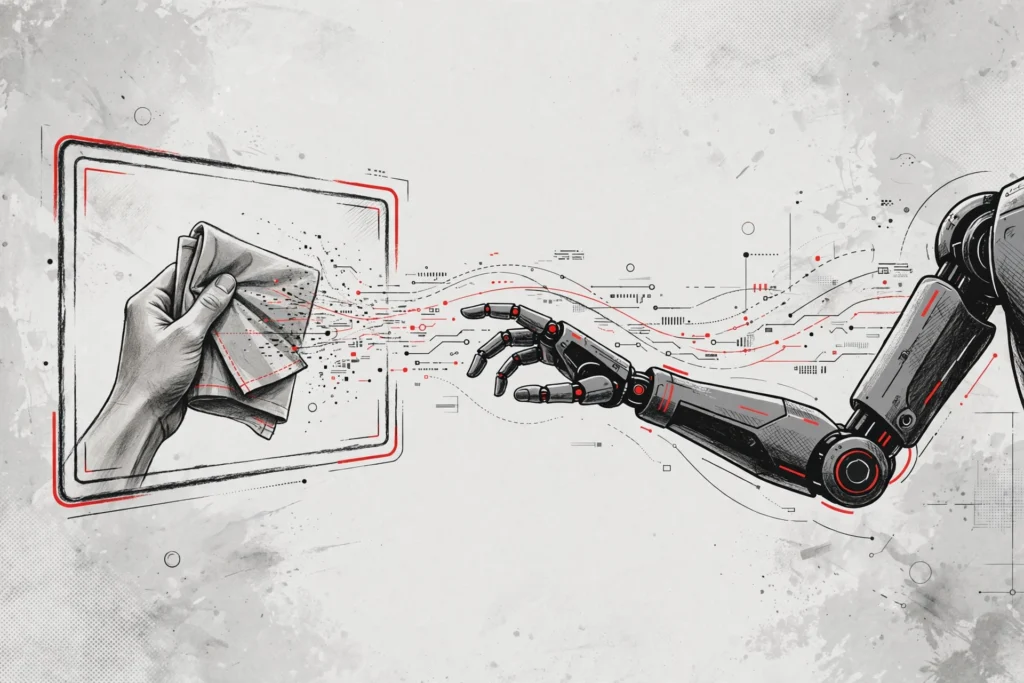
Gallop does not arrive knowing how to pack a box. A person shows it the task, the robot learns from the demonstration, and ASUS tests what it learned on the line. The loop then repeats.
This demonstration, learning and testing cycle is now working end to end, according to the company. It is the same approach other robot makers use, but ASUS gets to run it inside its own factories.
That is a real advantage. Most humanoid robots are still demonstrated in laboratories or at trade shows, where the floor is flat, the lighting is perfect and nothing unexpected happens.
Gallop works where the work actually happens. A factory floor is noisy, crowded and unforgiving, and a robot that survives there has proved something a stage demo never can.
What ASUS Hasn’t Said Yet
For all the detail in the announcement, the gaps are just as striking. ASUS has published no height, no weight, no payload and no battery life for Gallop. There is no price, and no production volume.
The company has also not said how many Gallop units exist, or how many hours the robot has actually spent on the packing line. A photograph of a robot at a workstation is not the same as a full shift of work.
That caution is probably wise. Humanoid robots have a long history of impressive videos and quiet failures, and ASUS is presenting Gallop as a development platform rather than a product you can buy.
The honest framing is part of the story. ASUS is not claiming the robot is ready. It is claiming the robot is working, and inviting the industry to watch what happens next.
When Will Gallop Leave the Factory?
The roadmap ASUS has published is measured in years, not months. Customer pilots are planned for 2027, and the company will show Gallop to customers at Computex 2027 in Taipei.
Over the coming year, ASUS plans to fit its own dexterous hand to the robot and put it on wheels. The current machine is bolted to a fixed base, so mobility is the next big step.
Market availability is targeted for the second half of 2028. That is a long way off in an industry that moves fast, but it is also a realistic schedule for a machine that must be safe around people.
Until then, Gallop stays where it is: on the line, packing boxes, with engineers watching every cycle and feeding what they learn back into the next version.
Why a PC Maker Is Building Humanoids
ASUS is best known for motherboards, laptops and graphics cards. But the company is also a major server maker, and its servers power the data centres where today’s AI models are trained and run.
Humanoid robots are the physical end of that same AI story. The models that understand language and images are now being taught to move bodies, grip objects and work alongside people.
Google’s Gemini Robotics 2.5 is already working on Mercedes-Benz production lines, and NVIDIA’s GR00T 2 robot model learns by watching humans. Runway’s Praxis-1 takes a different path, offering an open robot brain anyone can download.
Gallop sits between those approaches. It is a closed, company-built machine, but it is being developed in the open, on a real factory floor, against a human standard of performance.
That puts ASUS in a race that now includes carmakers, chip companies, AI labs and startups. Each is betting that the factory, the warehouse and eventually the home will be the next place robots earn their keep.
For ASUS, the factory is also home turf. Nobody knows the packing station better than the company that built the motherboards inside the boxes, and Gallop is learning its trade from the people who do the job today.
Whether it reaches 99.5 percent in twenty seconds is still an open question. But the robot is on the line, the clock is running, and the rest of the industry is watching. According to ASUS, that is exactly where a humanoid robot should prove itself.