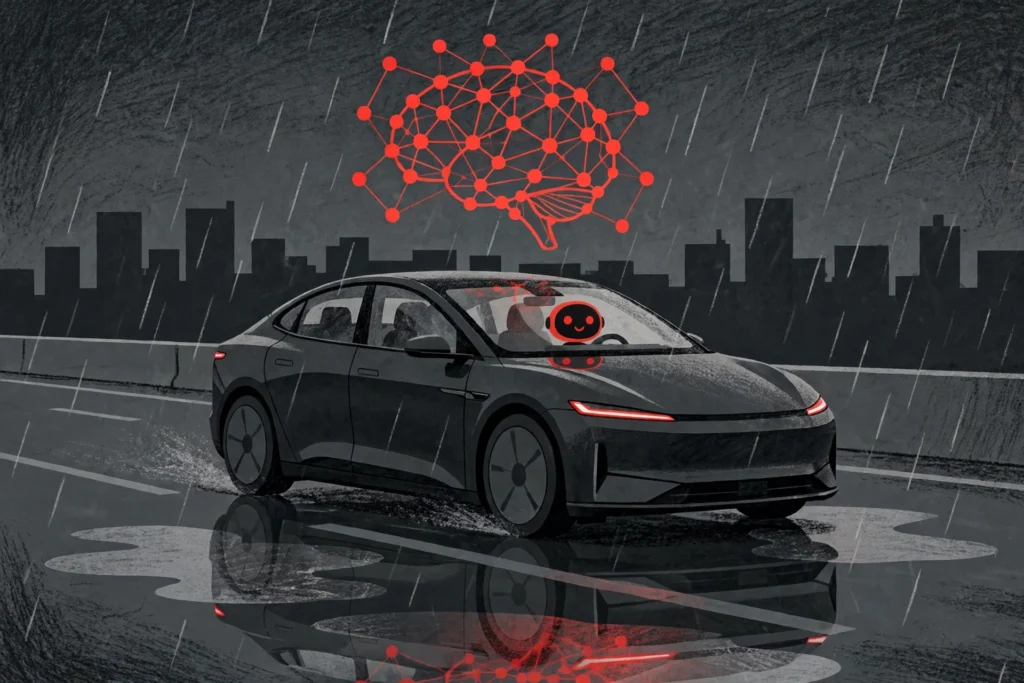
NIO WorldModel 3.0: Faster Reactions, Fewer Interventions
It was raining in Guangzhou, and the evening traffic was doing what traffic always does at rush hour. Cars stopped, started, and changed their minds. Scooters slipped through gaps that were barely there.
Inside one of those cars, the driver did not touch the wheel. The car read the wet asphalt, the brake lights ahead, and the scooter two lanes over, and it made its own decisions. That car was running software that did not exist a week ago.
On November 25, 2026, NIO marked its 12th anniversary with a technology event in Guangzhou called NIO IN. The company unveiled two systems at once: NIO WorldModel 3.0, the AI that drives the car, and NOMI Intelligence 4.0, the AI that runs the cabin.
According to NIO, both are ready to reach owners, starting in December. The headline number is the one drivers will feel first. NIO says WorldModel 3.0 needs 40% fewer driver interventions than the previous generation. In plain terms, the car asks for help less often.
The company also says drivers feel around 60% more reassured while it works. Those are NIO’s own figures, not independent tests — but they point in a clear direction: the car handles more of the messy moments on its own.
How NWM 3.0 Sees the Road Differently
The biggest change sits inside how the model thinks about the road. NIO WorldModel 3.0 introduces what the company calls 4D spatiotemporal compression, built on tubelet-based encoding. The name is dense, but the idea is simple: the car watches space and time together, instead of treating each camera frame as a separate snapshot.
That matters because driving is never a still photograph. A pedestrian stepping off a kerb, a lorry drifting across a lane marking, a puddle hiding a pothole — all of these are movements, not objects. By compressing four dimensions of data at once, the model catches small changes while using far less computing power.
NIO says the new approach cuts the onboard computing resources needed for attention by 36 times. A car cannot carry a data centre in its boot, so a cheaper brain leaves room for more of it — or the same brain in a cheaper car.
The second change is speed of reaction. Through joint optimisation of algorithms, chips, and chassis control, NIO says it cut chassis control latency by 78% and overall vehicle control latency by 54%. When the model decides to steer or brake, the car now acts on that decision much sooner.
Half a second sounds small until you remember what a car covers in half a second at motorway speed. In driving, latency is not a benchmark number. It is the distance between deciding and doing.
Two Loops, a Reward Model, and Faster Training
Training a driving model is the other half of the story, and NIO changed that too. WorldModel 3.0 uses a reinforcement learning framework with two closed loops. One loop works in observation space, reconstructing sensor data to make closed-loop testing more reliable.
The other works in latent space, updating the model’s internal picture of the world faster and with fewer resources. The result, according to NIO, is training efficiency five times higher than the previous generation.
The model also gains a reward model, a way to judge its own driving decisions against real-world conditions instead of fixed test scores.
NIO says the data volume behind WorldModel 3.0 is seven times larger than for version 2.5. More miles, more weather, more edge cases — the strange situations that separate a demo from a dependable system.
NOMI Intelligence 4.0: From Voice Commands to an AI Agent
The second announcement lives inside the cabin, and it may matter more to everyday owners. NOMI, NIO’s in-car assistant, has been around for 12 years. Version 4.0 rebuilds it from the ground up.
Old in-car assistants wait for a command and run a fixed routine. Tell it to set the temperature, and it sets the temperature. Tell it something more complicated, and it usually gives up or asks you to repeat yourself. NOMI 4.0 is designed to work differently.
According to NIO, the new system combines the company’s foundation models with the industry’s first vehicle-native AI agent framework, plus the car’s infrastructure and a vehicle-wide safety framework. That lets NOMI sense what is happening inside and outside the car, and call on tools across its systems.
Instead of following a script, it plans. A driver who says they are running late for a meeting is not just asking for directions. NOMI is meant to work out the goal — get there on time — and then act on it: route, messages, climate, and charging, all coordinated.
Ted Li, NIO’s Senior Vice President of Product Experience, unveiled two foundations under the new architecture: a proprietary foundation model matrix, trained with in-vehicle reinforcement learning, and the agent framework itself, which NIO claims is the first built natively into a vehicle.
NIO describes this as a new era of emotional intelligence. The phrase sounds grand, but the idea underneath is grounded. A car that knows you are tired, cold, or in a hurry can respond to the person, not just the command.
Whether owners experience it that way will depend on how well the system reads real people in real cars.
When Do Owners Actually Get It?
Both systems roll out in phases, and the timing depends on regulators as much as on NIO. WorldModel 3.0 will be submitted for regulatory filing in China in December. It will reach all users of the Banyan, Cedar, Cedar S, and Coconut+ smart systems once clearance comes through.
NOMI Intelligence 4.0 follows a slower path. Cedar 2.0.0, the first software release to carry it, will be filed in early December, with the rollout starting after clearance. Cars running Cedar S and Banyan should receive the update in the second quarter of 2027, after system adaptation.
The technology will later extend to the Coconut and Coconut+ systems in ONVO models. That staggered schedule is normal for software-defined cars in China, where driver-assistance updates need regulatory sign-off before they reach owners.
It also means the two systems will not arrive together for most drivers. The driving brain comes first; the cabin assistant follows months later. NIO did not announce pricing for either update.
NIO’s Bigger Bet: Becoming an AI-Native Carmaker
The two product launches sat inside a larger argument from NIO’s founder, chairman, and CEO, William Li. The car industry, he said, is the largest sector where AI can be applied.
Li put a number on that claim. The global automotive industry — components, manufacturing, sales, service, energy, and finance — is worth roughly 7 to 9 trillion dollars. If AI can generate 15% more value across it, that unlocks more than 1.2 trillion dollars.
Smart electric vehicles, he said, are the most valuable form of physical AI.
NIO says it has been rebuilding itself around that idea since 2023, running operations through 12 categories of Cell Business Units and a six-layer AI-native operating architecture.
The scale is already large: more than 7,500 AI agents deployed inside the company, with over 2.9 million executions to date. NIO Power uses AI agents to manage its battery and swapping network, aiming to run more than 350 billion yuan in battery assets by 2030.
The message is that NIO no longer sees itself only as a carmaker that uses AI. It wants to be an AI-native organisation that happens to build cars, with the same agent technology running the factory, the charging network, and the cabin.
What It Means for Drivers — and for Rivals
For NIO owners, the promise is straightforward: a car that intervenes less, reacts faster, and understands what you want without exact commands. If the numbers hold up, daily driving in a NIO should feel calmer within months.
For the rest of the industry, the announcement is a marker. NIO is betting that the next competition in cars is not range or horsepower, but the intelligence inside the vehicle.
A world model that predicts the road, and an agent that runs the cabin, are two halves of the same idea: the car as a thinking machine.
That idea is spreading fast. Humanoid robots are learning to work in factories, AI agents are booking travel and writing code, and now cars are being rebuilt around the same technology.
The open questions are the ones no launch event can answer. Do the intervention and latency figures survive contact with real roads, real weather, and real drivers? Does NOMI 4.0 feel like a helpful companion, or like a system that guesses wrong at the worst moment?
NIO has given itself a December deadline for the first answers. The cars, and their owners, will deliver the rest. Watch December first: that is when NIO files both systems for clearance in China, and when Cedar 2.0.0 goes in for filing too.


