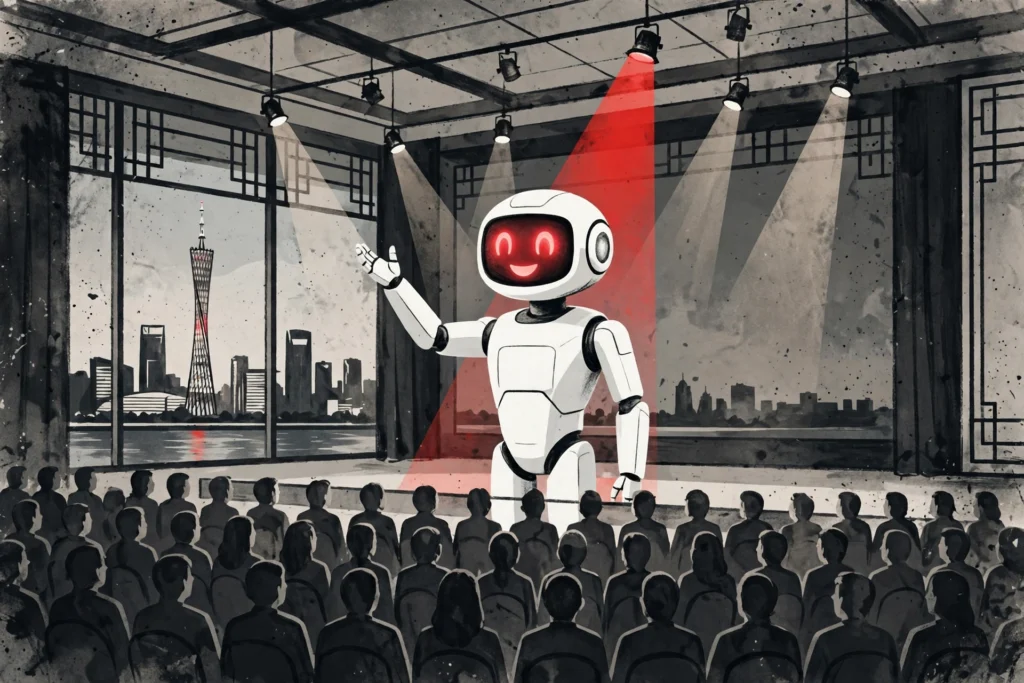
The lights dimmed in Guangzhou, and seven humanoid robots walked onto the stage. Two thousand people in the audience watched as the machines took turns speaking — in two languages — answering questions, greeting the crowd, and, in the words of XPENG’s chief executive, shaking hands and high-fiving the guests who came to meet them.
It was the first public appearance of the XPENG IRON humanoid robot, unveiled on November 25 at the company’s eighth AI Day.
And if the applause in the hall was anything to go by, the robot’s debut landed exactly the way XPENG wanted it to.
The XPENG IRON humanoid robot is the Chinese carmaker’s boldest step yet beyond cars. XPENG, best known for its electric vehicles, now calls itself a “Physical AI” company — and IRON is the centrepiece of that pitch.
The company says the robot is built to work alongside people, not just to impress them on a stage.
XPENG IRON’s First Public Appearance: Seven Robots on One Stage
Seven IRON robots appeared together at the Guangzhou event, taking part in what XPENG described as the robot’s first speech and first group interview. The machines fielded bilingual questions from the audience, switching between languages as the conversation moved around the room.
For XPENG chairman and CEO He Xiaopeng, the moment carried a personal charge. A year ago, he said, people wondered whether the company had simply hidden a human inside the robot. This time, he watched guests chat freely with the machines, shake their hands, and high-five them without a second thought.
“Seeing IRON on stage today, exactly one year later, really brings back so many feelings,” He wrote after the event. He also admitted the robot’s physical design and intelligence still need further development — a rare note of caution on a day built for celebration.
A short film released the day before the event showed what XPENG wants IRON to do when nobody is watching. In it, the robot handles a book, pours a drink, and plugs itself into a charger.
These are small, ordinary tasks — and that is precisely the point. A robot that can manage the everyday is worth more than one that can only perform on a stage.
Inside XPENG IRON: 76 Joints, 1,500 Sensors and Three AI Chips
The headline numbers behind IRON are striking. The robot has 76 degrees of freedom, giving it a range of movement far beyond the stiff, shuffling machines of a few years ago.
Its dexterous hand alone accounts for 21 of those degrees, letting it grip, hold and manipulate objects with something approaching human finesse.
Touch is the other half of the story. IRON carries more than 1,500 tactile sensing points across its body, covering over 80 percent of its key body areas.
That skin of sensors tells the robot how hard it is gripping, when it has made contact, and whether something is slipping from its grasp.
The robot also sees in three dimensions and senses its surroundings in 360 degrees. Its IRON VLM system blends visual, audio and contextual understanding, so the machine can recognise people, remember the thread of a conversation, and respond in a way that fits the moment.
All of this runs on board. IRON OS is powered by three proprietary Turing AI chips, delivering 2,250 TOPS of effective computing power.
That onboard muscle means the robot does not have to wait on a distant cloud server to decide what to do next — a crucial difference when a machine is moving through a room full of people.
Turing Physical AI: The Brain Behind XPENG IRON
IRON does not arrive alone. It is the showcase for XPENG’s new Turing Physical AI Architecture, also known as VLA 3.0, unveiled at the same event.
The framework links three layers of intelligence: high-level cognition that plans what to do, real-time decision-making that reacts in the moment, and a hardware layer that manages power, energy, communication and physical execution.
The idea, according to XPENG, is that the next breakthrough in physical AI will come from advancing intelligence and physical ability together, rather than treating them as separate problems. A robot that can think brilliantly but move clumsily is no more useful than one that moves beautifully but understands nothing.
Behind the architecture sits another piece of the puzzle: WorldGPT, a cloud-based teacher model that learns across six categories of machines, including cars, drones, robotic arms and humanoids. Knowledge gathered in the cloud is distilled into smaller models that run on individual machines, so lessons learned by a car can, in principle, help a robot.
XPENG is developing IRON around five priorities: foundational capabilities, safety and reliability, emotional value, round-the-clock operation, and business capability. The inclusion of “emotional value” is telling. This is a robot designed to be liked, not just tolerated.
From Showroom Floor to Your Home: XPENG IRON’s 2027 Roadmap
XPENG has laid out a clear path from stage to shop floor. Hardware mass production of IRON is scheduled to begin in January 2027, drawing on the manufacturing infrastructure the company built for its cars.
Then, in the first quarter of 2027, IRON will begin training as a store assistant in XPENG’s own retail stores. There it will greet customers, guide them around products, and learn the rhythms of a real working day — with real people, real questions, and real mistakes to recover from.
The official public release is targeted for the second quarter of 2027. XPENG has not announced a price, and it has not said which markets will get the robot first. The commercial model, the company says, will combine hardware sales with software subscriptions.
That store-training phase matters more than the launch date. A robot that works in a controlled demonstration is one thing; a robot that can greet a customer, understand a request, and find the right product is quite another.
It must also recover gracefully when it gets something wrong. XPENG’s own stores will be the proving ground.
What XPENG IRON Means for the Humanoid Race
IRON enters a race that is suddenly crowded. Tesla’s Optimus, Figure’s humanoids, and a wave of Chinese rivals are all chasing the same prize: a general-purpose robot that can do useful work in the real world.
XPENG’s advantage is that it already builds machines at scale — cars — and it is applying the same integrated approach to robots, developing AI models, computing, perception, motion control and hardware together.
The company’s pitch is that a carmaker knows how to manufacture, how to manage a supply chain, and how to sell and service complex machines. Those are exactly the skills that robotics startups have struggled to build from scratch.
Yet the scepticism is fair. Stage demonstrations and short promotional films show selected moments, not sustained performance. The abilities IRON showed in Guangzhou — conversation, navigation, gentle manipulation — must still prove themselves across full working days, in messy environments, with people who have not read the script.
That is why the next test is not another stage show. It is the store floor in early 2027, where IRON will have to earn its keep one customer at a time.
What Happens Next
For now, the countdown is on. Mass production begins in January, store training follows in the first quarter, and the public release is set for the second quarter of 2027. If XPENG hits those dates, IRON will be one of the first general-purpose humanoids to go on sale from a major manufacturer.
The robot that walked onto a Guangzhou stage and spoke to two thousand people will soon have to prove it can do something harder: work a shift. The whole industry will be watching to see whether it can.
According to RobotsBeat, XPENG plans to start training IRON as an assistant in its own retail stores in Q1 2027, providing a setting for learning customer-facing work before the targeted Q2 public release.
Related reading: Google’s Gemini Robotics 2.5 is already putting humanoid robots to work on Mercedes-Benz production lines, while NVIDIA’s GR00T 2 robot brain learns by watching humans. And for a look at how AI models are learning to improve themselves, see Hedra’s Model Factory.