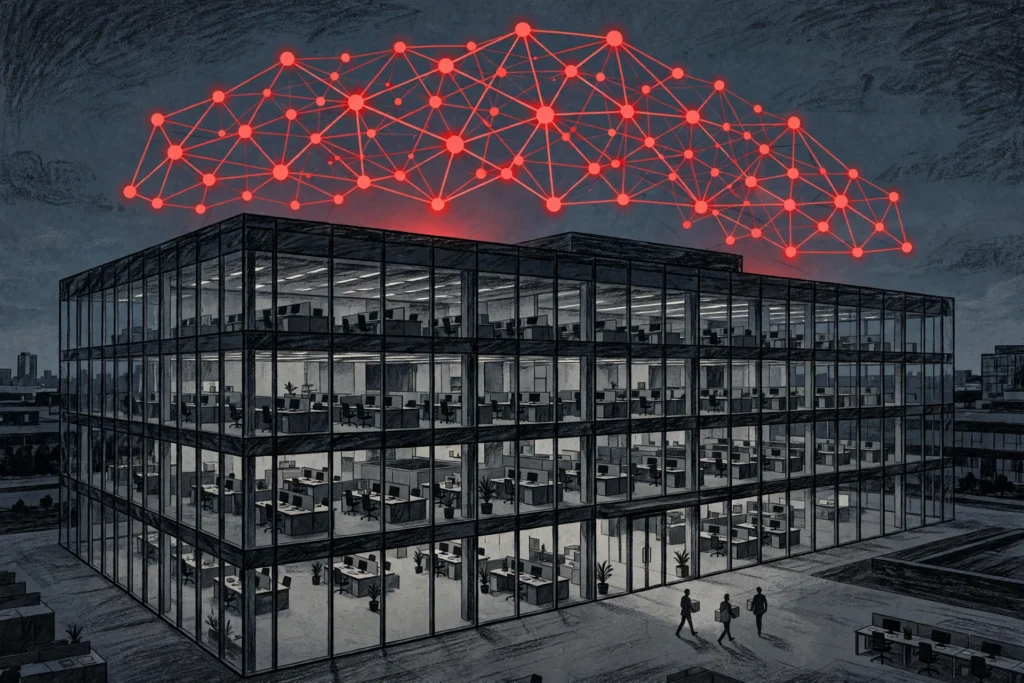
Picture a Monday morning in Walldorf, Germany. Thousands of SAP employees file into the glass headquarters of Europe’s most valuable software company, badges in hand, coffee in the other.
For most of them, it is just another workday. For at least 10,000 of them, according to a new report, the ground beneath that routine may be about to shift.
SAP is preparing a plan to eliminate at least 10,000 positions as it reshapes its business for the artificial intelligence era, Bloomberg reported on Thursday, November 26. The cuts would affect at least 9% of the company’s global workforce of more than 110,000 people.
The report, citing people familiar with the matter, makes SAP the latest — and one of the largest — software giants to redraw its workforce around AI. And it comes less than three years after the company last cut roughly the same number of jobs.
What Bloomberg Reported About the SAP Job Cuts
The plan is not final. That is the first thing to understand about the SAP job cuts, because the distinction matters to the people whose jobs are on the line.
According to Bloomberg, the total number of positions affected has not been finalised and could still change after negotiations with employee representatives. The discussions are ongoing, and the people who described them asked not to be identified.
What is clear is the scale being discussed. At least 10,000 roles are under review — more than one in every eleven SAP employees worldwide. Every department has been asked to identify areas where positions could be eliminated.
SAP itself declined to confirm or deny the reported cuts. “SAP continuously reviews its organization to ensure it remains aligned with its strategy and customer needs,” the company said in a statement to Bloomberg.
Reuters, which also reported the story, said it could not independently verify the Bloomberg report. This is a plan under discussion, not a finished decision.
Why SAP Is Restructuring Around AI
The driving force behind the SAP job cuts is a strategy set at the very top of the company. Chief Executive Officer Christian Klein is pushing to turn SAP into an AI-first company, embedding artificial intelligence more deeply into its enterprise software.
That means changing how SAP develops its products and how it sells them. Under the reported plan, the company’s leadership will continue to redesign both sides of the business, with AI tools woven into the applications that millions of workers use every day.
The timing is telling. SAP has historically announced major restructurings in late January, alongside its full-year results. If that pattern holds, a formal announcement could arrive in a matter of weeks.
The 2024 Restructuring: A Blueprint for What Comes Next
SAP has been here before, and recently. The 2024 restructuring eliminated around 10,000 positions and cost the company roughly €3 billion — about $3.3 billion — and took more than a year to complete.
But the 2024 exercise was handled largely through voluntary departures and retraining. SAP moved many affected workers into new roles, and its total headcount stayed relatively flat because it hired for new positions at the same time.
That history offers some comfort, and some warning. The comfort is that SAP has managed a cut of this size before without mass compulsory layoffs. The warning is that the company is now doing it again, barely three years later.
Workers in Germany have one layer of protection that colleagues elsewhere may not. The labour council there negotiated an employment guarantee running through 2028, covering SAP’s largest concentration of employees.
Who Is Most at Risk in the SAP Job Cuts
Not every department faces the same pressure. According to the report, product and engineering teams and sales are in particular focus as managers hunt for savings.
That focus makes sense given what Klein is trying to do. If AI is going to write more code, test more software and draft more sales materials, the teams that build and sell the product are where the overlap is greatest.
The leadership churn around Klein adds to the picture. SAP reorganised its executive board twice this year as part of the AI-first push, and two of its six board members will leave the Walldorf-based company in March.
Klein himself took over most of the responsibilities of product lead Muhammad Alam this year, after Alam did not renew his contract, which ends in March. Sales chief Thomas Saueressig said last week he will leave to become chief executive of Ionos Group SE.
The Money Behind the Move
Restructurings of this size are never only about technology. They are also about the numbers on the balance sheet, and SAP has set itself an ambitious target.
The company is targeting more than $2.19 billion in annualised efficiency gains by the end of 2028, according to the New York Post’s coverage of the report. Cutting at least 9% of the workforce is one of the fastest ways to get there.
Chief Financial Officer Dominik Asam hinted at the direction of travel just last week. Speaking at a Morgan Stanley conference, he said SAP’s headcount had increased “a little bit” over the course of the year — and added that he “would be really surprised” if that trend didn’t reverse.
It was, in hindsight, a clear signal. The headcount growth of 2026 is about to give way to the contraction of 2027.
The Bigger Picture: AI Is Rewriting Tech Employment
SAP is not an outlier. It is the latest name on a list that has grown steadily through 2026, as the biggest technology companies in the world use AI as both a tool and a reason to shrink their workforces.
Just weeks ago, Canva cut 1,271 jobs — 22% of its workforce — as the design giant restructured around AI. Intel has continued cutting IT jobs through November as chief executive Lip-Bu Tan reshapes the chipmaker. Qualcomm has put 1,000 jobs at risk in India as part of its own restructuring.
Microsoft, meanwhile, has taken a different route to a similar destination. As Satya Nadella defended Microsoft’s 60,000 buyouts, he warned that the agentic web is coming — a world in which AI agents do work that people used to do.
The pattern is now unmistakable. In 2024 and 2025, tech layoffs were mostly about correcting pandemic-era overhiring. In 2026, they are increasingly about AI itself: companies are rebuilding themselves around a technology that changes what human workers are for.
SAP’s case is especially striking because of what the company sells. Its software runs the back offices of the world’s biggest businesses. If AI reshapes SAP, it will eventually reshape the companies that run on SAP too.
What Happens Next for SAP
The next milestone is likely to be late January, when SAP reports its full-year results. That is when the company has historically announced major restructurings, and it is when the plan now under discussion would probably become public.
Before then, the negotiations matter most. In Germany, employee representatives will have a say in how any cuts are handled. The employment guarantee through 2028, the precedent of voluntary departures in 2024, and the company’s need to keep the engineers who build its AI products will all shape the final number.
There is also the question of whether the plan survives contact with reality. Ten thousand is a figure under discussion, not a promise. It could shrink. It could grow. What seems unlikely is that it disappears entirely.
For the 110,000 people who work at SAP, the weeks until January will be filled with uncertainty that no corporate statement can fix. They know the company they work for is changing.
What they do not yet know is whether they will be part of the change — or part of the cost of it.
And for the rest of the tech industry, SAP’s decision is a signal worth watching. When Europe’s most valuable software company decides that AI means 10,000 fewer people, every other enterprise software company hears the message loud and clear.
According to Reuters, which reported the Bloomberg story on November 26, the restructuring would be SAP’s second major workforce reduction of around 10,000 positions in less than three years.


