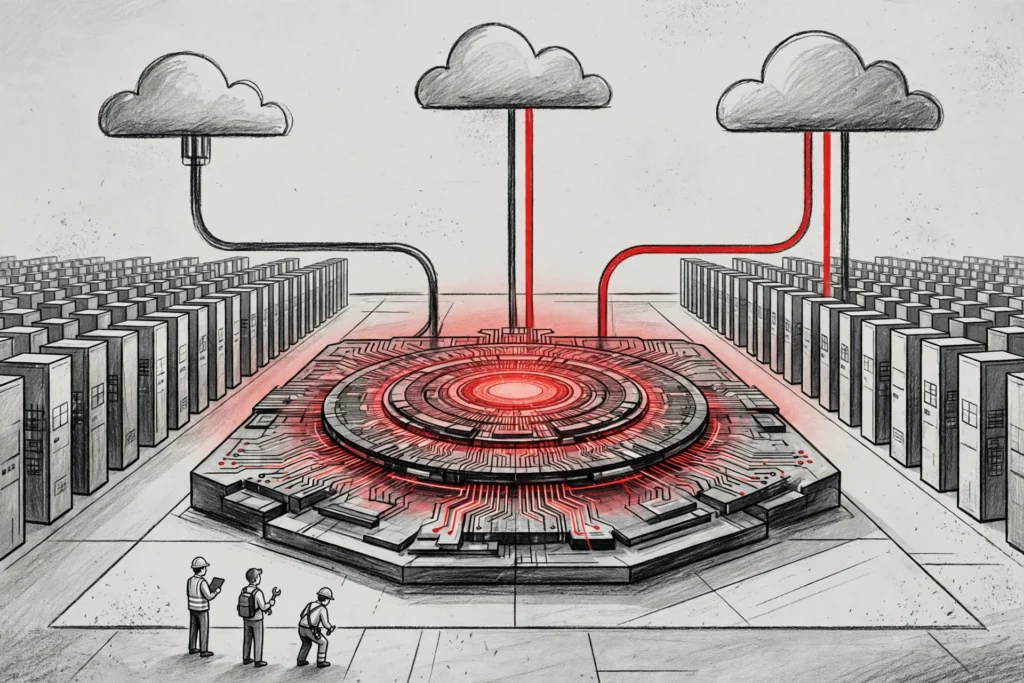
Somewhere inside a data centre, a single silicon wafer the size of a dinner plate is doing the work of hundreds of graphics cards. It is the whole wafer, uncut, packed with cores and memory that talk to each other at speeds a rack of separate chips cannot match.
That wafer belongs to Cerebras Systems, a chipmaker from Sunnyvale, California, that has spent years arguing the future of AI is not more GPUs, but one giant chip. On Thursday, November 12, the company gave the market its strongest evidence yet that somebody big believes it.
Cerebras reported a record third quarter, raised its outlook for the year, and revealed it has signed Microsoft as a customer. The Cerebras Microsoft deal makes the software giant the company’s third hyperscaler client, after Amazon Web Services and Oracle, and its shares jumped more than 17 percent in after-hours trading.
What Cerebras announced on November 12
For the three months ended September 30, Cerebras posted core revenue of $230.9 million, up 70 percent from $135.7 million a year earlier. The figure beat the $214.7 million analysts had expected, according to LSEG data cited by CNBC.
Core revenue is the company’s adjusted number. It strips out items such as stock-based compensation and customer-warrant amortisation. Under standard accounting rules, reported revenue was $210.8 million, up 55 percent, and the company recorded a net loss of $161.2 million, or $0.67 a share.
The core operating loss narrowed to $33.1 million, and core gross margin stood at 41 percent. For a company still burning cash to build data-centre capacity, the direction of travel matters more than the bottom line.
Chief financial officer Bob Komin said the quarter brought new marquee customers, “including hyperscalers, neoclouds and large enterprises”. The numbers back him up: cloud and other services revenue surged 272 percent to $144.9 million, about 63 percent of core revenue.
Hardware sales, by contrast, shrank year over year. Cerebras is becoming less a company that sells chips and more one that rents out the computing power of its own chips. That shift is the story of the quarter.
The Cerebras Microsoft deal: a third hyperscaler signs on
Cerebras said in its earnings release that it had signed “an important cloud deal with a top three hyperscaler”. It did not name the customer in the document. Chief executive Andrew Feldman did it instead, telling CNBC the customer is Microsoft.
The agreement was signed in October. Feldman said revenue from it should begin to show up in the first quarter of 2027. Neither side has disclosed the value or the terms, and Cerebras said it would share more details in the first half of next year.
Microsoft joins Amazon Web Services, which signed a commercial agreement with Cerebras in June, and Oracle, which plans to offer Cerebras inference inside Oracle Cloud Infrastructure in 2027. Three of the world’s biggest cloud companies now have Cerebras on their books.
For Cerebras, the name matters as much as the money. A hyperscaler deal is a stamp of approval that smaller customers notice. It also diversifies a business that has leaned heavily on one very large customer: OpenAI.
Cloud revenue now does most of the heavy lifting
Two years ago, Cerebras was mainly a hardware company. The third quarter shows how far that has changed. Cloud revenue of $144.9 million is nearly two-thirds of the business, and it grew almost fourfold in a year.
The reason is inference. Training a giant AI model gets the headlines, but running it — answering millions of user prompts every day — is where the steady money is. Cerebras built its wafer-scale chips for exactly that job, promising answers in milliseconds.
That promise is what cloud customers are paying for. When a chatbot or an agent needs a fast answer, the chip that returns it first wins the workload. Cerebras says its systems do that better than racks of conventional GPUs.
The trade-off is cost. Building the data centres to rent out that compute is enormously expensive, and it is why the company still loses money. The bet is that the rental income will eventually outgrow the building bill.
The $26.1 billion backlog — and the OpenAI question
Cerebras ended September with $26.1 billion in remaining performance obligations, the contracted work it has not yet delivered. That is up from about $25.4 billion the previous quarter, and it is more than 100 times the revenue the company reported in the quarter.
Much of that backlog is tied to a multiyear agreement with OpenAI. The deal is the foundation of the business, and it is also its biggest concentration risk. If OpenAI ever slowed its spending, Cerebras would feel it immediately.
That is why the Microsoft signing carries weight beyond its own value. A second hyperscaler — and a third, counting Oracle — is the first real evidence that the OpenAI contract is not the whole business. Investors read it that way, which helps explain the 17 percent jump in the share price.
Still, the backlog is not cash in hand. It is work promised, not work paid for, and delivering it depends on data-centre capacity that is still being built. The next few quarters will show how much of it turns into real revenue.
700 megawatts under contract, but a flat quarter ahead
Cerebras said it now has 700 megawatts of gross data-centre capacity under contract for delivery by the end of 2027. Power is the currency of the AI build-out, and 700 megawatts is enough to run a small city.
But the company warned that cloud revenue will stay roughly flat this quarter. The new capacity only starts ramping in December, so the fourth quarter will lean on what is already running.
The guidance still points up. Cerebras raised its full-year core revenue outlook to between $940 million and $960 million, up from $880 million to $890 million. For the fourth quarter it guided core revenue of $310 million to $330 million.
That midpoint, about $320 million, would be roughly 39 percent above the third quarter. It would also be a sharp acceleration from the growth rate of a year ago. The company added that it expects revenue to triple in 2027.
Manufacturing is expanding through partners Flex and Sanmina to meet the demand. The question is whether the power, the chips and the customers all arrive on the same schedule.
What the Cerebras Microsoft deal means for Nvidia
Nvidia still dominates AI computing, and nobody at Cerebras pretends otherwise. But the week has been unusually kind to its challengers. AMD unveiled its MI450X accelerator with 288GB of memory, aimed squarely at Nvidia’s Vera Rubin systems, just a day before Cerebras reported.
Nvidia itself is in turmoil. Jensen Huang resigned as chief executive on November 11, and the board has named finance chief Colette Kress as interim chief executive while it searches for a permanent successor. The company’s shares have lost more than a trillion dollars in value since November 3.
Into that gap step the alternatives. Cerebras, AMD and the neoclouds that rent out AI compute — CoreWeave reported revenue up 168 percent in its own third quarter — are all pitching the same idea: there is room for more than one supplier of AI horsepower.
Microsoft’s decision to buy from Cerebras fits that pattern. The cloud giants do not want a single supplier setting the price of the most important input in technology. Every alternative they qualify is leverage in the next negotiation.
What happens next for Cerebras
The Microsoft revenue does not arrive until the first quarter of 2027, so the first real test of the deal comes in next year’s opening results. Until then, investors will watch the fourth-quarter numbers against the $310 million to $330 million guide.
They will also watch the capacity. Seven hundred megawatts under contract is a promise; delivering it on time, with power and cooling and customers attached, is the hard part. Cerebras has said more details on the Microsoft agreement will come in the first half of 2027.
For now, the company has what it wanted from this earnings report: a record quarter, a raised forecast, and the name of the world’s second-largest cloud provider on its customer list. The wafer-sized chip has found a very large believer.