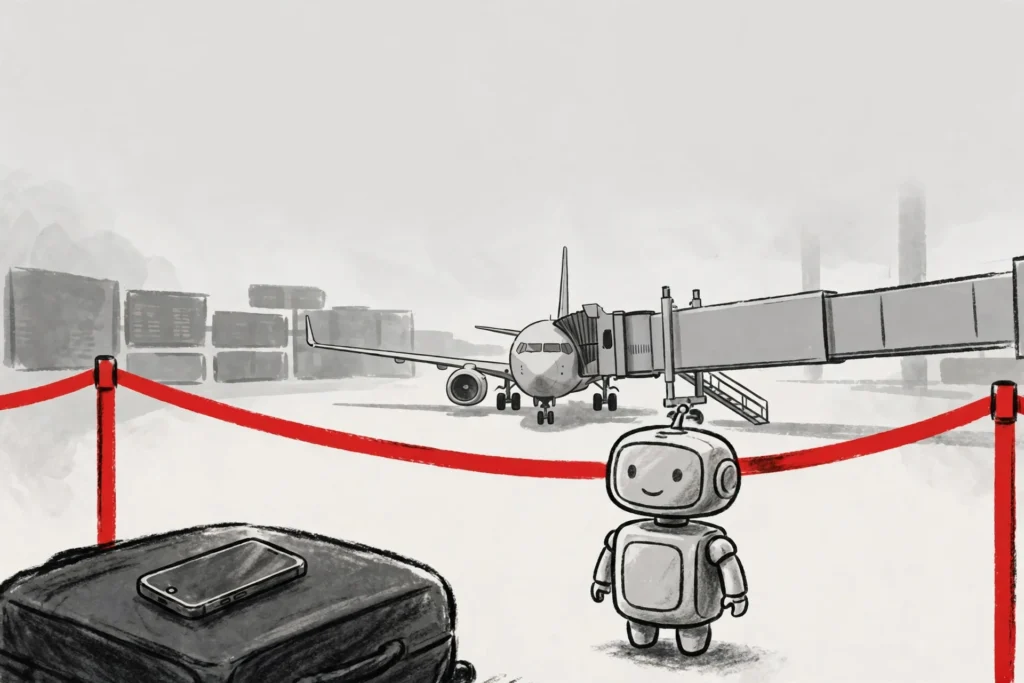
The Trip That Books Itself
Picture the scene. You are packing a bag for a weekend trip, and instead of opening ten browser tabs, you simply tell your AI assistant: “Book me the cheapest United flight to Chicago on Friday, window seat, and use my miles.” A minute later, everything is done. No forms, no queues, no seat-map clicking.
That little scene is exactly what United Airlines has just said no to.
On November 11, 2026, United became the first airline in the world to formally ban personal AI agents from booking its flights. The rule is now written into the airline’s Contract of Carriage, the legal document that governs every ticket it sells.
It is a small change to a long legal document. But it could become one of the biggest fights in travel technology, because it asks a question nobody has answered yet: when an AI assistant acts for you, who is actually making the purchase?
What United Airlines’ AI Agents Ban Actually Covers
United did not just issue a press statement. It rewrote its Contract of Carriage, the document headed “revised November 11, 2026,” which applies to every passenger and bag on United Airlines and its United Express partners.
The new Rule 6.J.6 puts AI agents on the airline’s list of prohibited ticketing practices, right next to hidden-city and throwaway ticketing. It bars “the use of AI Agents to make, modify or service a Ticket, and/or to purchase any service or product.”
A companion change to Rule 5.H goes further. It adds reservations made, modified or serviced by AI agents to the bookings United says it may cancel without notice. In other words, an agent-booked ticket can be wiped out even if you watched and approved every step.
The definition is deliberately wide. In the contract’s Rule 1, an AI agent means software or a service that takes autonomous or semi-autonomous action, even when a passenger or another person supervises or approves what it does.
That covers assistants built into search engines, messaging apps and browsers, AI-enabled browsers, standalone agents, and third-party assistants that reach United through travel agencies or other intermediaries. It covers discovering, searching, booking, purchasing, ticketing, servicing and managing flights, seats, upgrades, ancillary products and partner products.
The ban reaches beyond United’s own website and app. It also applies indirectly, through travel agencies and aggregators that sell United tickets on the airline’s behalf.
Why United Airlines Banned AI Agents From Booking Flights
United gave three reasons, and each one points at a different risk.
The first is data security. Handing your account credentials to a third-party AI assistant can expose sensitive information, according to the airline. Your MileagePlus login is not just a password. It holds your payment details, your travel history and your personal information.
The second is money. United warned that an assistant’s actions could lead to unintended purchases, account changes, or the use of MileagePlus miles. An agent that misreads a prompt could book the wrong date, the wrong cabin, or spend miles you meant to keep.
The third reason is regulation. Automated actions may conflict with Federal Aviation Administration and Department of Transportation rules. Online check-in, for example, requires a passenger to personally acknowledge rules on prohibited items such as explosives.
If a machine clicks that box on your behalf, who has actually made the legal acknowledgement? United says that question alone creates compliance risk it does not want to carry.
There is also a business reason, and United’s chief executive did not hide it. Scott Kirby has said, “To be honest, I don’t want to create another middleman.” An AI agent sitting between the airline and the traveller is a new gatekeeper, and gatekeepers eventually charge rent.
What AI Tools Can Still Do for United Flyers
The ban is not a ban on AI in travel. It is a ban on AI doing the buying.
Travellers can still use AI tools to research and plan trips, as long as those tools do not touch united.com or the United app. An assistant can still show United flight options and prices, compare times, and suggest the best connection. The purchase itself has to be completed by the customer.
Bookings an AI agent made before November 11, 2026 will not be canceled. United says it recommends that travellers review recent plans to confirm they were ticketed correctly, just in case an agent made a mistake along the way.
United also says it does not yet work with any third-party AI agents. Instead, the airline wants to build “standardized, secure technology integrations” with privacy, authorization and accountability protections first, and only then let approved assistants transact.
That leaves the door open. United is not saying AI agents will never book its flights. It is saying they will only do so on United’s terms, through integrations the airline controls.
For now, United flights remain bookable through familiar channels such as Kayak, Hopper and Google Flights. The ban targets the agent, not the aggregator.
The Bigger Fight: Who Owns the Traveller?
United’s move lands in the middle of a much larger shift. AI assistants are no longer just answering questions. They are starting to do things: booking, buying, scheduling and managing on their owner’s behalf.
Anthropic has just launched an office suite built around Claude, and OpenAI is putting businesses directly inside ChatGPT. The whole industry is racing to turn chatbots into agents that act, not just talk.
At the same time, companies that sell things are asking who controls the customer. When an assistant books your flight, does the airline still own the relationship with you? Or does the company that built the assistant own it?
That is the fight United has opened. The airline’s position is that a traveller’s permission is not the same as the airline’s permission. You may authorise an assistant, but United is not required to let it transact on its platform.
Other industries have already taken similar measures, according to USA Today, which first reported the ban. United is simply the first airline to put it in writing.
There is a parallel in the enterprise world. Databricks has turned its Genie assistant into an always-on AI coworker that works unsupervised in the background, and companies are still deciding which of its actions need a human to approve them. The same question now faces every airline, hotel and retailer.
What Happens Next for AI Agents and Airlines
The timing matters. United announced the ban just ahead of the holiday travel season, when millions of Americans book flights and when mistakes are most expensive. A wrong booking in December is not a minor inconvenience.
Other airlines are watching. If United’s ban holds without a backlash from travellers, expect rivals to copy it. If travellers complain, or if regulators push back, the industry may be forced toward the standard integrations United says it wants.
Regulators have not weighed in yet. The FAA and the Department of Transportation did not immediately respond to requests for comment, according to USA Today. But a rule that touches how millions of people buy tickets will not stay unexamined for long.
The agent companies are watching too. OpenAI and Meta are both building assistants that can handle increasingly complicated tasks for users, and travel booking is one of the most obvious uses. A world where every airline writes its own rules would be a nightmare for them.
The most likely outcome is a negotiation. Airlines want control, security and their direct relationship with passengers. Agent makers want their assistants to be useful everywhere. Somewhere between those two positions sits a standard for how an AI agent proves it is acting with your real permission.
Until that standard exists, the safest advice for travellers is simple. Use your AI assistant to find the flight, compare the price and plan the trip. Then book it yourself.
Your assistant can still be your travel planner. It just cannot be your travel agent, at least not on United, and not yet. USA Today reported the ban on November 11, 2026.