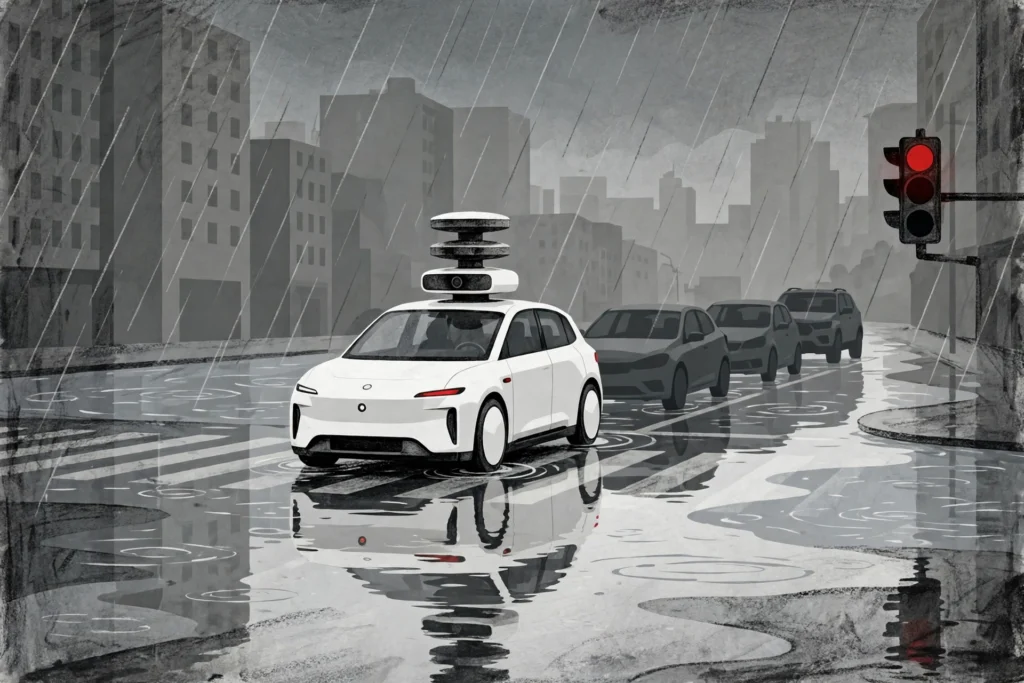
The rain was coming down in sheets over San Francisco, and the intersection ahead was already under water. The Waymo robotaxi rolled forward anyway, eased into the flooded crosswalk, and then simply stopped — the first sign of the Waymo Bay Area pause.
There was no driver to wave through the window. No one to reverse out of the puddle or edge around it. The car sat there, hazard lights blinking, while traffic piled up behind it and drivers leaned on their horns.
Inside, the passenger got a message on the screen: stay in the car. Help was on the way. Somewhere in a control centre, a human was watching a driverless car that had run out of answers.
That scene played out more than once across the Bay Area on Wednesday, November 18, 2026. By around 11 a.m. local time, Waymo had pulled its entire Bay Area fleet off the road.
The Waymo Bay Area pause lasted through the afternoon, with no restart time given. It was the latest setback for a company that has spent years insisting its cars can handle whatever the road throws at them.
The Storm That Broke a 108-Year Record
The storm was an atmospheric river, a narrow band of moisture pulled in from the Pacific that parked itself over Northern California and refused to move. Forecasters had warned it was coming.
Downtown San Francisco recorded 2.28 inches of rain by mid-afternoon on Wednesday, breaking the daily record of 2.24 inches set in 1918. Streets turned into streams. Underpasses filled. Intersections that drivers cross without thinking became ponds with kerbs hidden somewhere underneath.
Waymo said it had tracked the storm hours in advance and had already scaled back its fleet before the worst of it arrived. The company then suspended the rest of its Bay Area service, from San Francisco down the Peninsula and into the South Bay.
Riders who opened the Waymo app were greeted with a short message: “we’re paused for now due to weather.” Service would return, it said, “when road conditions improve and the forecast looks clear.”
As of mid-afternoon on Wednesday, the pause was still in force. Waymo gave no time for a restart, and the rain kept falling.
Robotaxis Stuck Where the Water Was
The pause followed a string of embarrassing incidents that were filmed, photographed and shared within minutes. At Oak Street and Cole Street, next to the Panhandle park, a Waymo stopped in the middle of a flooded intersection and blocked traffic while other cars picked their way around it.
On Bayshore Boulevard at Industrial Street, another Waymo was left disabled in a flooded stretch of road, sitting in the water as traffic backed up behind it. A third car idled in the middle of a road and told its rider to stay inside while it waited for help.
None of the cars crashed. No one was reported hurt. But the pictures told their own story: a fleet of cars built to drive themselves, defeated by a few inches of standing water, blocking the very streets they were supposed to move through.
The videos spread fast. Within hours, the stalled robotaxis had become the defining image of the storm.
What the Waymo Bay Area Pause Means for Riders
For Bay Area riders, the pause meant no driverless rides at all for the rest of the day. The app would not accept a booking, and cars already on the road were being pulled back. Anyone who needed to get across town had to find another way — a bus, a train, a human-driven car.
The timing could hardly have been worse for Waymo. The flood pause came just one day after California’s Department of Motor Vehicles barred the company’s robotaxis from the state’s freeways. That restriction took effect on November 11 but was only made public on November 17.
Waymo responded by pulling its driverless cars off freeways in every market where it operates, not just California. That means no freeway rides in the San Francisco Bay Area, Los Angeles County, Phoenix, Miami or Austin.
Street-level service in those cities continued. But the combination of the two pauses left Waymo’s most advanced driving — the fast, long-distance kind — off the table, and its everyday city service in the Bay Area shut down too.
One Day After the Freeway Ban
The freeway ban had its own trigger. On November 5, three Waymo cars drove into an active construction closure on US Route 101 near Burlingame, putting road crews and equipment at risk.
The next day, a viral video showed a Waymo trying to pass California Highway Patrol cruisers during a traffic break on Interstate 280 in San Francisco.
The DMV called the company’s freeway driving “an imminent hazard to public safety due to recurring incursions by its vehicles into active construction zones.” The restriction stays in place until Waymo demonstrates what the regulator calls “effective corrective actions.” No date has been given for a return.
That was the second time this year Waymo had been forced off the freeways. In May, after similar construction-zone incidents, the company paused highway service and recalled roughly 3,800 vehicles for software updates. Freeway rides returned in July. They lasted four months.
Read the full story of that ban in our earlier report: Waymo Freeway Ban: California Calls Robotaxis an ‘Imminent Hazard’.
Waymo’s Flood Problem Is Not New
The flooded-street problem has followed Waymo for years, and Wednesday was not the first time it forced the company to stop. In December 2025, Waymo paused service in San Francisco when a power outage left robotaxis stranded at dark intersections, blocking city streets in much the same way.
In May 2026, the company recalled nearly 4,000 vehicles and paused service after a robotaxi drove into a flooded road in San Antonio. It issued a software update meant to fix the problem. Weeks later, it had to pause service in Atlanta when a Waymo drove into a flooded street again.
That history is what makes Wednesday’s pause so awkward. Waymo has had more than a year of warnings, recalls and software updates on this exact issue, and a storm in its home city still left its cars sitting in the water.
Why Water Is So Hard for a Driverless Car
Standing water is a special kind of problem for a self-driving car. A human driver can see a flooded stretch of road, guess at its depth from the kerb or the cars ahead, and decide whether to risk it.
A robotaxi has to make the same judgement from sensors that were never designed to measure water.
Lidar and cameras can struggle to tell a shallow puddle from a deep pool. Reflections off the surface confuse the sensors. Once a car is in the water, the safe choice is often to stop — which is exactly what Waymo’s cars did, in the worst possible places.
What Happens Next for Driverless Cars
The Waymo case will now become a test of how quickly a driverless company can diagnose a failure, prove a fix, and win back trust — twice over. The freeway ban demands proof the cars can handle construction zones. The flood pause demands proof they can handle weather.
Both problems are the same problem in different clothes: the messy, unplanned situations that fill real roads. A closed lane. A flagger waving a car the wrong way. A crosswalk full of rainwater. The easy miles are done. What remains is the long, unglamorous work of proving safety where nobody planned for it.
Waymo built its reputation by driving millions of miles without a human at the wheel, and its cars still run on city streets in thirteen American cities. But the company has now lost its freeways and, for a day, its home city — and the next storm is already on the forecast.
The driverless future is still coming. Wednesday showed that it still stops for rain.
Source: Engadget, reporting on Waymo’s Bay Area service pause and the California DMV freeway restriction. For a look at how driverless rides are expanding elsewhere, see Zoox Robotaxis on Uber: Driverless Rides Land in Las Vegas.


