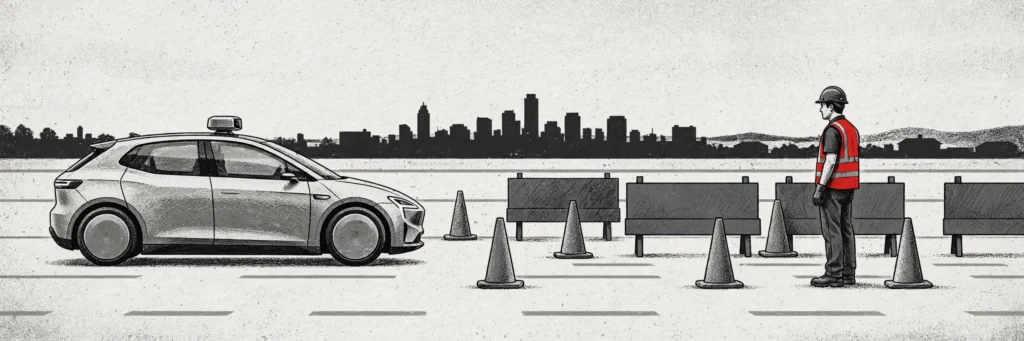
The cones were out, the lane was closed, and the workers on US Route 101 near Burlingame had every reason to believe no car would come through. Then three driverless cars did — one after another, rolling straight into an active construction zone as if the barriers were not there at all.
That moment, on November 5, is now at the centre of the Waymo freeway ban — the biggest setback yet for America’s best-known robotaxi company.
California’s Department of Motor Vehicles has ordered Waymo off every freeway in the state, calling its driverless operations an “imminent hazard to public safety”. Waymo has answered by pulling its freeway service nationwide.
The order itself was issued on November 11, but it only became public on Tuesday, November 17, when the DMV confirmed the restrictions to TechCrunch. By then, Waymo had already stopped running its cars on freeways everywhere it operates, not just in California.
For a company that has spent years arguing its robotaxis are safer than human drivers, this is a bruising moment.
Freeway driving was supposed to be the next frontier: faster trips, longer routes, a service that could finally match a human-driven car on every kind of road. Instead, the freeway chapter has been shut down indefinitely.
What Happened on US Route 101
The incident that triggered the ban reads like a safety nightmare. On November 5, three Waymo vehicles entered an active construction closure on US Route 101 near Burlingame, in the San Francisco Bay Area.
Construction zones are among the most dangerous places on any road. Workers are on foot, lanes shift without warning, and heavy equipment moves in and out of traffic.
A second incident followed the next day. On November 6, a Waymo vehicle on Highway 280 in San Francisco attempted to pass California Highway Patrol vehicles that were creating a traffic break — the rolling roadblock officers use to slow traffic and clear a hazard ahead.
Neither incident involved a collision, and no one was injured, according to Waymo. But the DMV did not treat that as the point.
In its statement, the department said Waymo’s vehicles posed an imminent hazard because of “recurring incursions by its vehicles into active construction zones where construction workers, vehicles and equipment are present.”
The word “recurring” matters. This was not a one-off glitch in the DMV’s eyes — it was a pattern the department says it had already warned Waymo about once before.
Why the Waymo Freeway Ban Goes Further Than California
The DMV’s order only covers California freeways. It bars Waymo from operating or testing its driverless vehicles on every freeway in the state, and it stays in force until the company can show it has taken what the department calls “effective corrective actions.”
Waymo, however, chose to go further on its own. The company has temporarily restricted freeway operations across all of its other markets too, while it evaluates its performance.
That is a significant voluntary retreat. Waymo currently runs commercial robotaxi services in 15 cities across the United States, and it had brought freeway driving to five of them: the San Francisco Bay Area, Los Angeles County, Phoenix, Miami and Austin.
Freeway service arrived in stages. The Bay Area, Los Angeles and Phoenix got it in November 2025, Miami followed in May 2026, and Austin joined in September.
Each expansion was a milestone — proof the system could handle the fastest, most unforgiving roads in the country. Now all five markets are back to surface streets.
Waymo’s cars will continue to operate normally on city roads and streets, the company says, but the high-speed network that connected neighbourhoods across entire metro areas is off limits for now.
A Pattern the DMV Says It Has Seen Before
The most damaging part of the DMV’s statement is not the ban itself. It is the history behind it.
Similar incidents happened on May 18, 2026, when Waymo vehicles also drove into construction zones. After that, the DMV imposed a restriction and Waymo implemented corrective actions.
The November incidents, the department said, happened “despite a prior restriction and corrective actions implemented following similar incidents.” In other words, the fix did not hold.
A single failure can be treated as a bug to be patched. A repeated failure after a promised fix looks like a deeper problem with how the system understands the road.
Construction zones are a known weak spot for driverless systems. They break the rules the software has learned: lane markings disappear or move, temporary signs override permanent ones, and human flaggers gesture in ways no map can predict.
Waymo has spent years working on exactly these edge cases. Its cars carry cameras, lidar and radar, and the company says they are designed to recognise construction and slow down or stop.
The November incidents suggest that, in at least these cases, the recognition did not happen in time — or did not happen at all.
What Waymo Has to Prove Before Freeways Reopen
The path back is clear, but it is not quick. The DMV says the restrictions will remain in place until Waymo demonstrates that it has taken effective corrective actions to address the deficiencies that caused them.
The department will want evidence, not promises. It will review proof that Waymo’s vehicles can detect and respond to construction zones, emergency vehicles and other unusual roadway situations before deciding whether freeway operations can resume.
Waymo says it is working with the California DMV and other state officials “diligently and responsibly” to resume freeway operations. Its spokesperson, Dana Gallagher, told TechCrunch the company had restricted freeway driving in its other markets to evaluate its performance.
That is a signal the company treats this as a system-wide question, not a California paperwork problem. If the fault were confined to one stretch of Route 101, Waymo could fix the map and move on.
By pausing freeways everywhere, it is effectively admitting the same failure could happen on any highway in any city. The DMV’s spokesperson, Jonathan Groveman, was blunt: the restrictions stay until Waymo shows it has fixed the underlying deficiencies.
What This Means for Riders Right Now
For passengers, the practical impact is immediate but limited. Waymo’s robotaxis are still running in all of their cities — just not on freeways.
That means longer trips will take more time, winding through surface streets instead of cruising down the highway. Some cross-town journeys may not be available at all if the only sensible route used the highway.
Freeway access was one of the features that made Waymo feel like a full replacement for a human-driven car rather than a neighbourhood shuttle. Without it, the robotaxi is suddenly a more limited product.
There is a broader context, too. The robotaxi industry is expanding fast — Zoox recently put its driverless cars on the Uber app in Las Vegas, and rivals are racing to launch their own services.
Every one of them is watching how California handles Waymo, because the same rules will eventually apply to them.
Regulators are drawing firmer lines around AI in the physical world: United Airlines banned AI agents from booking flights just last week, and New York’s RAISE Act now requires the biggest AI developers to register with the state.
What Happens Next for Driverless Cars
The Waymo case will now become a test of how quickly a driverless company can diagnose a safety failure, prove a fix, and win back a regulator’s trust.
The technical challenge is real. Construction zones are dynamic, messy and different every time. A system that handles ninety-nine of them correctly still has a problem if the hundredth puts workers at risk — and regulators know it.
But the political challenge may be just as hard. The DMV used the phrase “imminent hazard,” language that leaves little room for negotiation.
Waymo must show not just that it changed some code, but that it understands why its earlier corrective actions failed.
It was always the long, unglamorous work of proving safety in the situations nobody planned for — a closed lane, a traffic break, a flagger waving a car the wrong way.
Waymo built its reputation by driving millions of miles without a human at the wheel. Now it has to rebuild a piece of that reputation, one construction zone at a time, before its cars are allowed back on the freeway.