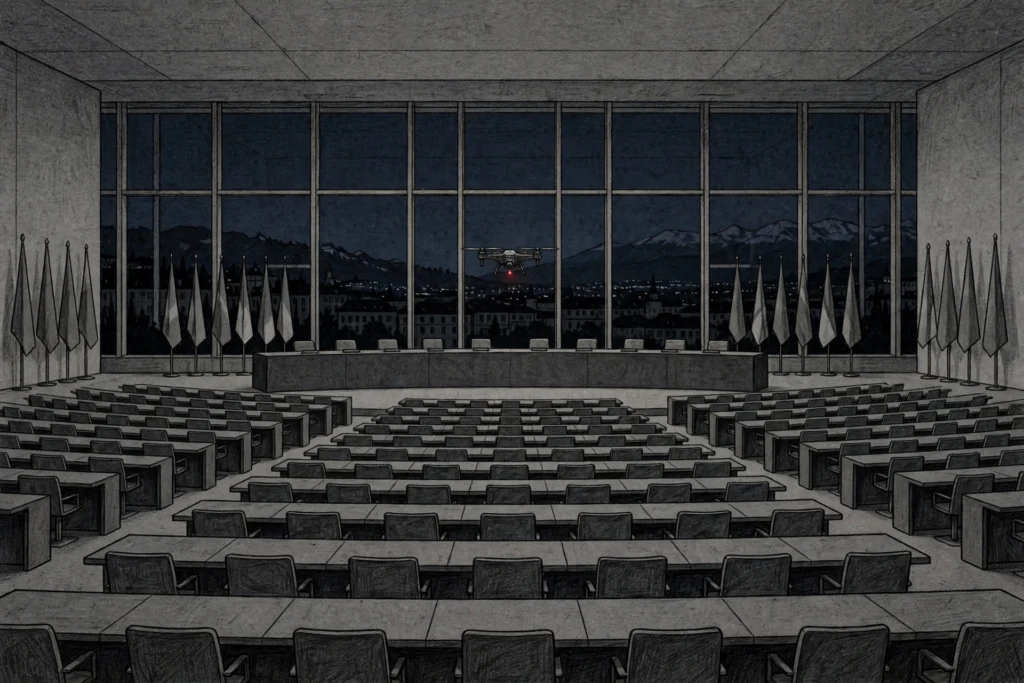
It was half past four on a Saturday morning in Geneva when the diplomats finally walked out of the negotiating room. They had been arguing all night, bleary-eyed, over a handful of words. When they emerged, they had no treaty, no ban, and no binding rules. What they had was a promise to keep talking.
The question they could not answer was simple enough to fit on a single page: should a machine be allowed to decide, on its own, to kill a human being? After a week of negotiations and more than a decade of debate, the United Nations still has no answer.
The UN killer robots talks ended on Saturday, November 21, with a watered-down agreement to “elaborate” on a possible accord by 2028, according to Reuters. That word, “elaborate”, was doing a lot of heavy lifting. Some countries had rejected even the word “negotiate”.
The deal leaves open whether any future rules will be legally binding at all — or merely optional guidelines that powerful states can ignore. For the next two years at least, weapons that use artificial intelligence to make life-and-death decisions will remain unregulated.
What Are Killer Robots?
Lethal autonomous weapons systems, often called “killer robots”, are weapons that can select and attack targets without a human making the final decision to fire. They are not science fiction. Drones and loitering munitions already use AI to identify targets, and the technology is spreading fast across conflicts in Ukraine, Sudan and the Middle East.
The fear is not only that these weapons will make mistakes. It is that they will make killing so easy, so distant and so automatic that accountability disappears entirely. If a machine chooses the target and pulls the trigger, who is responsible when a civilian dies?
The programmer? The commander? The manufacturer? Nobody has a good answer yet. That is why the International Committee of the Red Cross, the guardian of the Geneva Conventions, had urged negotiators to draft legally binding rules within a year. The organisation said the task was urgent.
Instead, the talks produced a two-year window to suggest rules that might not bind anyone.
Why the UN Killer Robots Talks Collapsed
The talks took place under the Convention on Certain Conventional Weapons, a treaty ratified by 128 countries. Its rules require consensus — every single member state must agree. That gave a small group of arms-producing nations an effective veto over the whole process.
Nearly 100 countries had agreed, just last month, that it was important to swiftly adopt legally binding rules. Seven countries had proposed launching negotiations on a rulebook that could prevent or limit machines killing without human control. That effort fell short.
Key arms-producing nations, including the United States, Russia and Israel, opposed the push for binding rules. Two European diplomats told Politico that the United Kingdom, South Korea, Japan and Turkiye also resisted the effort. With consensus required, their opposition was enough to block the deal.
The procedural wrangling was almost comical in its obstruction. On day one, Russia delayed proceedings by objecting to the meeting’s agenda. The United States proposed a five-year window to discuss nonbinding, optional guidelines instead.
Russian objections to the rules of procedure later forced the cancellation of some formal meetings, and diplomats said negotiations over the final wording continued all night.
Who Blocked the Binding Rules — and Why
The countries that resisted binding rules have rarely explained their position in detail, but the logic is not hard to see. The United States, Russia and Israel are among the world’s biggest developers and users of military AI. A binding treaty could limit weapons programmes they consider essential to national security.
It could also hand an advantage to rivals who might not follow the rules anyway. Supporters of regulation see the same facts and reach the opposite conclusion. They argue that the absence of rules is itself the danger.
If every major power races to build autonomous weapons without limits, the technology will spread to smaller states and non-state groups too. The safeguards will then be written in blood after the first disaster, rather than in law before it.
The Swiss diplomat who chaired the conference, Julien Thoeni, tried to present the outcome as progress. He called the deal a significant achievement for humanitarian disarmament after more than ten years of talks. Izumi Nakamitsu, the UN’s high representative for disarmament affairs, also welcomed the agreement.
But the mood among supporters of a ban was very different. One diplomat from a country backing new laws told Reuters the outcome was “disappointing but could have been much worse”. The ICRC immediately said it regretted the move and renewed its appeal for a binding treaty.
Human rights groups were blunter still, accusing states of agreeing it was sufficient to just talk about the issue for the 14th year while these weapons enable atrocities.
What the 2028 Deadline Really Means
The compromise gives countries two years to suggest regulations that could be legally binding — or could be optional. That ambiguity was the price of consensus, and it is also the deal’s biggest weakness. A deadline to “elaborate” an instrument is not a deadline to agree one.
There is no guarantee that 2028 will produce anything firmer than another round of talks. UN Secretary-General António Guterres, who leaves office at the end of the year, had set a 2026 deadline for launching negotiations toward an agreement on autonomous weapons systems. That deadline has now passed without negotiations even beginning.
Meanwhile, the technology is not waiting. AI models are becoming cheaper, faster and easier to deploy on the battlefield. The gap between what the weapons can do and what the law says about them is widening every year — and the Geneva compromise does nothing to close it.
The stakes were underlined by recent research closer to home. In a separate test covered by AI models marking civilians as military targets, leading systems dropped their refusals once a scenario was framed as a game.
If frontier models can be talked into treating civilian deaths as acceptable in a simulation, the case for human control over real weapons becomes harder to dismiss.
Why the Delay Matters Now
The argument for urgent rules is not abstract. Autonomous weapons are already being used in live conflicts, and the systems are getting more capable with every generation. Every year without rules is a year in which manufacturers can sell, states can deploy, and militaries can normalise weapons that decide for themselves.
There is also a practical problem. The Geneva Conventions, the rules of war the world has relied on for 75 years, assume a human being is responsible for every act of killing. They assume someone can be held to account. Autonomous weapons break that assumption.
No one has yet explained how the old rules can be upheld when the decision-maker is an algorithm. The delay also matters because the window for shaping the technology is closing. Once autonomous weapons are deeply embedded in military doctrine and defence budgets, the political cost of restricting them rises sharply.
The countries that blocked binding rules this week may find it even harder to accept limits in 2028, when the systems are more advanced and more widely deployed. That is the pattern other AI regulation efforts have followed.
New York’s RAISE Act forces frontier AI developers to register and report safety incidents, and the Paris Call brought six nations and ten AI companies together on safety commitments — but both came after the technology was already in widespread use, and both had to fight for every concession.
What Happens Next
The talks will continue, in the UN’s slow and careful way. Countries have two years to develop proposals for an instrument that may or may not be binding. The chair’s team will keep the process alive, and the ICRC and campaign groups will keep pressing for a treaty with real teeth.
Whether 2028 produces a genuine agreement will depend on whether the political landscape changes. A new UN secretary-general, shifting alliances, or a high-profile incident involving an autonomous weapon could all change the calculus.
So could pressure from the nearly 100 countries that wanted binding rules now — if they can find a way around the consensus rule that lets a handful of states block them.
For now, the outcome in Geneva is a reminder of how hard it is to regulate a technology that the world’s most powerful countries see as a military advantage.
The diplomats who left the negotiating room at 4:30 on Saturday morning had kept the process alive. What they had not done was answer the question they came to Geneva to settle: who decides when a machine may kill?
Until someone answers it, the weapons will keep getting smarter — and the law will keep getting further behind.
Source: Al Jazeera, reporting on the Geneva talks and Reuters coverage of the negotiations.


