Three Sunday shows, one blunt admission
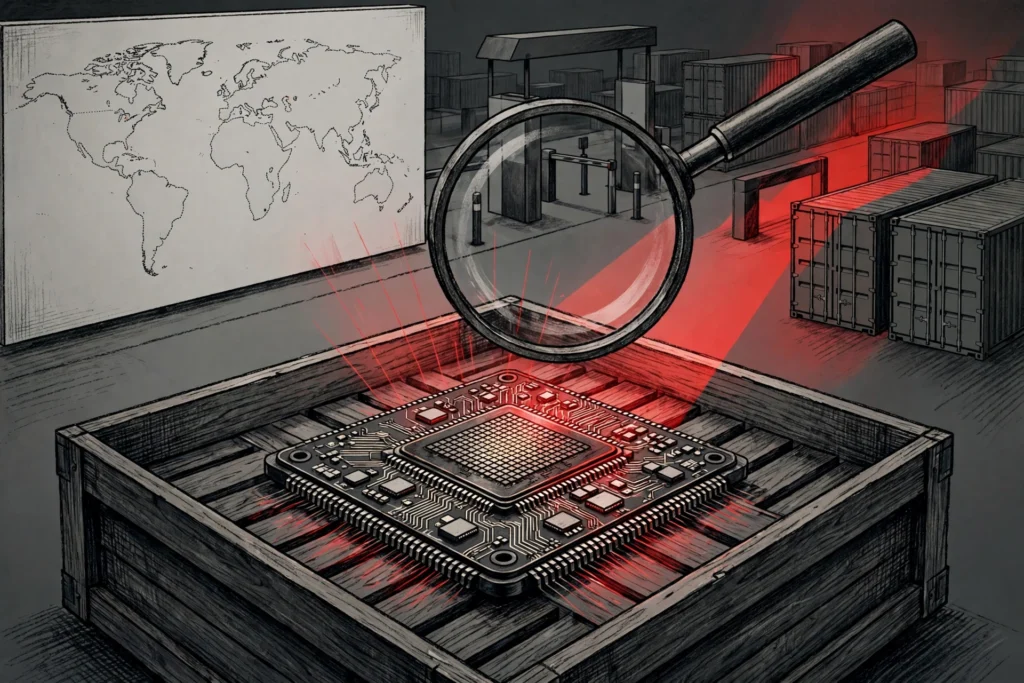
On Sunday morning, America’s top intelligence official sat down in front of three television cameras and said out loud what Washington had spent two weeks dancing around. The most advanced computer chips on earth — Nvidia chips — reached China anyway, despite years of export controls meant to keep them out.
“Nvidia chips, they are the jewel,” Director of National Intelligence Jay Clayton said on ABC’s This Week. “They are the absolute top that everybody wants. That’s why we’re focusing on this. People will do a lot, they will break the law.”
By the time Clayton finished his round of interviews, the picture was clear. Nvidia chips reached China through illicit channels, the Justice Department is investigating the people and the company at the centre of the scheme, and the man who used to run Nvidia will be answering questions about it in Congress on December 1.
What Clayton actually said about Nvidia chips reaching China
Clayton was careful with his words, but the meaning was hard to miss. On CNN’s State of the Union, he pointed to an indictment brought by the US attorney’s office in Manhattan, where he used to work, and said the facts in it spoke for themselves.
“I expect that there are channels through which China was able to get a hold of them,” he said. “It appears, based on the facts alleged in the indictment, that there was access to those chips.”
On Fox News Sunday, he was even more direct. “There are chips that have ended up in places that they should not,” he said. For a spy chief speaking on the record, that counts as a confirmation, not a hint.
Clayton also confirmed that the investigation into Alice Huang, the former Megaspeed executive at the heart of the scandal, is very much alive. “There is an investigation into her company, and there is an investigation into her,” he said. “That is going to play out.”
The Megaspeed network, mapped by the Wall Street Journal
Clayton’s interviews landed one day after The Wall Street Journal published a detailed report on the network that allegedly moved the chips. At the centre of that report is a name that had barely been mentioned before: Li Ming, a 52-year-old Chinese national who is out on bail in Singapore.
According to the Journal, Li played a central role in a network of companies that smuggled restricted Nvidia chips into China. He was also deeply involved in Megaspeed’s operations and its major decisions.
Singapore prosecutors charged him and others with fraud in February 2025 over the alleged transshipment of servers containing Nvidia chips, although Megaspeed itself was not named in those charges.
Chinese corporate records cited by the paper show that Li, Alice Huang and her husband Kang Wei set up a cloud-computing joint venture called Century Longteng in 2021. The venture was one piece of a wider web of partners across Southeast Asia, built to move hardware to Chinese customers while hiding where it was really going.
The report also traced how Megaspeed got its hands on the newest chips in the first place. The company joined Nvidia’s cloud partner programme in November 2023 after naming Alibaba as an anchor customer.
That status gave it priority access to Nvidia’s latest hardware. Some of those servers were then allegedly sent on to a Shanghai company, Century Litong, in violation of US export controls.
A new venture, $300 million in hardware, and a year of secret contacts
The Journal also reported that a new venture linked to the network, Novagate Cloud, had received at least $300 million worth of Nvidia-chip hardware in Malaysia during the first five months of 2026. That figure, if accurate, suggests the pipeline was still running at industrial scale long after the export rules were supposed to have shut it down.
Meanwhile, The New York Times reported on Sunday that Alice Huang remained in contact with an official from China’s ministry of state security for more than a year, from spring 2025 to autumn 2026. The report added another layer to a scandal that already combined corporate intrigue, an intelligence investigation and a boardroom drama.
Huang, also known as Huang Le, was the executive director of Megaspeed International, the Singapore-based firm that facilitated about $12 billion in chip sales now under scrutiny for breaching US export controls. She was also at the centre of the affair that ended Jensen Huang’s career as Nvidia’s chief executive.
Jensen Huang faces Congress on December 1
The former Nvidia chief, who resigned on November 12 after admitting an extramarital affair with Alice Huang, is now scheduled to face lawmakers. He will appear on December 1 before a joint meeting of the House Intelligence, Foreign Affairs and China Select committees, where he is expected to be questioned about the company’s ties to China.
Republican Representative Michael McCaul, who will be among those asking the questions, left little doubt about the line of attack. “Did he know that these advanced chips that he was selling to Mega Speed were being sent into China in violation of export control laws?” McCaul said in an interview with Bloomberg on Sunday.
McCaul added that the broader concern was whether Nvidia understood where its most advanced chips were ending up. For a company that has spent the past two weeks insisting it knew nothing, the hearing promises to be an uncomfortable afternoon.
Treasury Secretary Scott Bessent, speaking on CBS’s Face the Nation on Sunday, said he presumed the ousted chief executive was not aware of the spy allegations against Alice Huang.
But he added that the United States had taken steps to close the policy loopholes that allowed high-end AI chips to reach Chinese entities, and that Nvidia needed to conduct a robust internal investigation.
Why the Nvidia chips reaching China matters beyond one company
The stakes here go far beyond one firm’s reputation. The export controls on advanced AI chips are the centrepiece of America’s technology strategy against China, the tool Washington uses to slow Beijing’s progress in artificial intelligence while keeping the most powerful hardware for itself.
Clayton framed it exactly that way on ABC. “We want to lead the globe in the build out of this infrastructure, but we also want to keep the most exquisite capabilities for America,” he said. Every chip that slips through the net weakens that strategy and hands a rival a shortcut.
The scandal has already triggered a cascade of official action. The US Commerce Department’s Bureau of Industry and Security has tightened the rules on remote access to AI chips, Malaysia has opened its own probe into Megaspeed’s activities, and California’s attorney general has served Nvidia with an investigative subpoena.
Now the Securities and Exchange Commission is also reported to be scrutinising potential accounting issues at the company, and a shareholder class action filed within minutes of the market close on the day the scandal broke is still working its way through the courts.
What happens next in the Megaspeed probe
The next milestone is December 1, when Jensen Huang sits before Congress. His testimony will be the first time he has spoken publicly under oath about the affair, the company and the chips, and lawmakers from both parties are preparing to press him hard.
Behind the scenes, the investigations continue on several fronts at once. The Justice Department is pursuing the case against Alice Huang and Megaspeed, Singapore’s courts are handling the fraud charges against Li Ming and his associates, and regulators in Washington and California are examining what Nvidia knew and when it knew it.
Clayton, for his part, promised answers. “The American people will get answers regarding this matter,” he said on Fox News. After two weeks of resignations, subpoenas and Sunday-show revelations, the public may finally be about to get them.
The question that will hang over all of it is the one Clayton himself raised on Sunday morning: if the jewel of American technology could be smuggled out through a network of shell companies and friendly cloud partners, how many other channels are still open?


