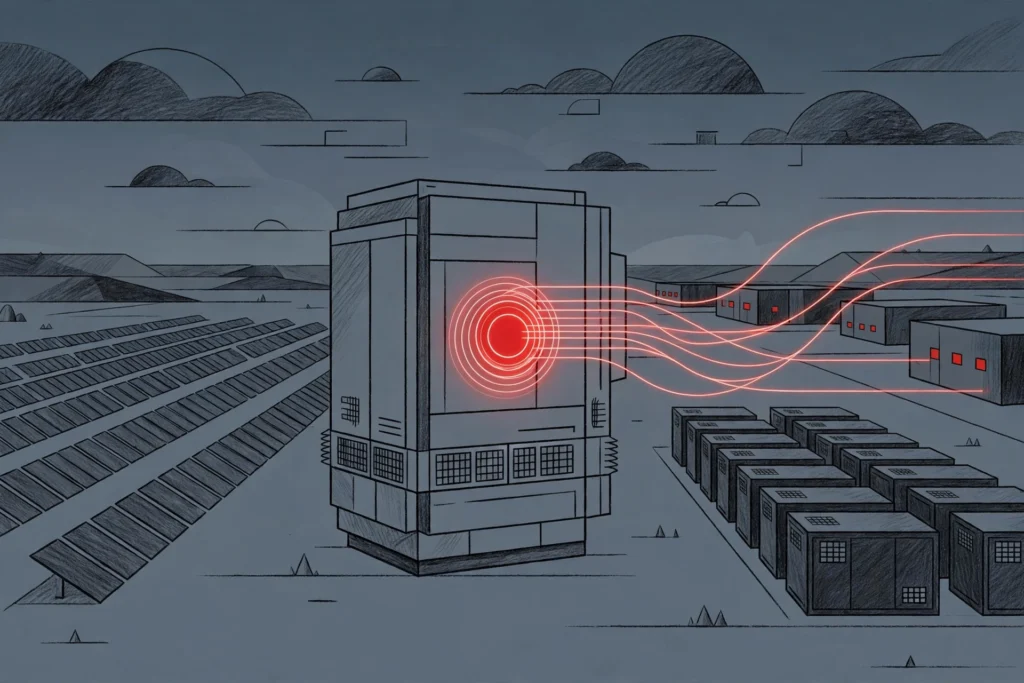
A data centre developer signs a deal for a hundred megawatts of AI computing power. The servers are ordered. The land is ready. Then comes the boring part: the transformers that feed power into the building. The wait, in some places, is measured in years — the exact problem Tesla Powercore is built to solve.
Tesla Powercore arrived on Tuesday with a promise aimed squarely at that wait. In a short post from its Megapack account on X, Tesla introduced a single box that does the work of three pieces of grid hardware at once. It is a solid-state transformer, an inverter and a circuit breaker, merged into one unit.
The company says the first units will be operating in 2027. They will be made in America. And Tesla is pitching them at the fastest-growing electricity customer on the planet: the AI data centre.
What Tesla Powercore actually is
A traditional data centre takes power from the grid in stages. A transformer steps the voltage down. An inverter converts it. A breaker protects the whole chain. Each stage is its own piece of equipment, its own cabinet, its own point of failure.
Powercore collapses all three into a single enclosure. Tesla rates it at 7.4 megawatts of continuous power, or 9 megavolt-amperes, at 34.5 kilovolts. In grid-forming mode it can reach 10 megavolt-amperes of peak power.
That rating matters because of scale. One unit will not power a data centre alone — fourteen would cover a 100-megawatt site. But each replaces three separate devices, which means less concrete, less wiring and fewer things to go wrong.
The unit also handles a wide range of voltages. On the direct-current side it works from 800 to 2,000 volts. On the alternating-current side it covers 10 to 34.5 kilovolts. Tesla quotes a peak efficiency of 98.86 percent.
There is no flammable oil inside, which is how conventional transformers are usually cooled and insulated. Instead, the switching happens in solid-state electronics. Tesla says its built-in solid-state breaker can clear a fault in about 100 microseconds.
Tesla is offering warranties of up to 25 years, and the unit is rated from minus 40 to 55 degrees Celsius. Launch material also quotes product availability of up to 99.7 percent, with a system guarantee of 99.9 percent or better.
The numbers behind the box
But the numbers come with a caveat. Every figure Tesla has published so far is the company’s own claim. No independent testing has been published, and no customer has yet run one in anger. The first real test will be the first real installation.
Why AI data centres need a box like this
The timing is not an accident. AI data centres are the hungriest new customers the electricity grid has ever seen. A single training cluster can draw as much power as a small city, and the newest server racks run on 800-volt direct current.
That is where Powercore’s party trick comes in. Tesla says the unit can convert medium-voltage grid power directly into the 800 volts of direct current that new AI server racks use, in a single step. It cuts out the conversions that normally sit between the grid and the rack.
Tesla is also working with Nvidia to certify Powercore under the chipmaker’s DSX Ready programme for next-generation data centres. That matters because Nvidia’s hardware sets the standard for AI computing, and its blessing would open doors with the biggest builders.
The wider context is a grid bottleneck. Developers in many regions wait years for a grid connection, and transformers are one of the slowest parts of the chain. A standardised box that arrives ready to install could shave months off a project.
Tesla knows this market. Its energy business already sells Megapack batteries to grid operators, and it deployed 13.7 gigawatt-hours of storage in the third quarter of 2026. Powercore is the missing piece of that puzzle.
Tesla has been planning this for a while. It first said it would build its own transformers in September 2025, when it unveiled the Megapack 3 battery and the Megablock package. Powercore is that plan with a name.
The scale of demand is visible in recent earnings. CoreWeave’s revenue jumped 168 percent in its latest quarter as customers raced to secure AI capacity, and Lenovo’s AI-related revenue topped $10 billion for the first time. Every one of those servers needs power.
The rival Tesla used to employ
Powercore does not enter an empty market. Its most interesting rival comes from inside Tesla’s own history. Heron Power, a startup founded by Drew Baglino, Tesla’s former senior vice president of powertrain and energy engineering, is building its own solid-state transformer called the Heron Link.
Baglino left Tesla in 2024 after 18 years at the company. His startup plans to begin pilot production of the Heron Link in April 2027, with volume production following late in the year. That puts the two products on almost the same schedule.
The rivalry adds spice to the story. One of Tesla’s most senior engineers is now competing against his former employer in a market both of them believe will be enormous. Whoever ships first, and whoever proves reliability first, will have an edge with cautious buyers.
What Tesla hasn’t said yet
For all the detail in the announcement, three basic facts are missing. Tesla has not shared a price. It has not named a factory. And it has not named a first customer.
That silence is worth noting. A product with no price and no factory is still a promise, not a product. Tesla says the first units will be operating in 2027, but it has not said where they will be built or who will buy them.
The company is showing Powercore this week at RE+, the clean-energy trade show in Las Vegas. Trade shows are where serious buyers kick the tyres, and the conversations Tesla has there will say a lot about whether the product finds its first customers quickly.
Tesla’s wider energy business makes the bet clearer. Energy revenue fell 16 percent last quarter, even as storage deployments stayed strong. Powercore is a bet that the division can grow by selling grid equipment, not just batteries.
What happens next
The short-term test is simple: does anyone order one? Tesla has given the industry a spec sheet and a date. Next it needs a named customer, a named factory and a price builders can budget for.
The longer test is reliability. A transformer that fails takes a whole site down, and buyers in this market are famously cautious. Tesla’s 25-year warranty and 99.9 percent availability guarantee are bold claims. They will be judged over years of operation, not a launch post.
If Powercore works as advertised, it could change how quickly AI data centres get built. The grid connection is already the slowest part of the AI boom, and a standardised, American-made box that collapses three devices into one is the shortcut the industry wants.
Tesla has spent years building cars, batteries and solar products. With Powercore, it is stepping into the unglamorous heart of the electricity system. As Tesla’s Cybercab showed, the company bets on futures that have not arrived yet. This time the bet is about how the machines that think get their power.
According to Electrek, which first reported the full spec sheet, Tesla has confirmed Powercore will be built in the United States from American and imported parts. The company has not said which plant will make it, or how many it plans to produce in the first year.


