In July, a security researcher typed a password into an AI chatbot and waited.
The password belonged to nobody. The web address hidden in the same prompt led nowhere real. Both were traps, planted to find out who was secretly reading the messages people send to AI services.
Four months later, the traps had been sprung again and again. The fake secrets had been stolen, copied and used tens of thousands of times, inside companies that were supposed to keep customer prompts private. And none of those companies knew it was happening until the researchers told them.
On November 22, the AI gateway OpenRouter acted on the findings. It removed three inference providers from its platform, stripped 125 model endpoints of their Zero Data Retention status and emailed every customer who might have been affected, according to The Hacker News.
The OpenRouter prompt theft trap: two million fake secrets
The research came from Dragos, an industrial cybersecurity firm. Its chief research officer, HD Moore, published the findings on November 19 in a post titled “Three breaches, endless leaks: Your AI supply chain needs canaries.”
Between July and November 2026, Moore’s team sent about two million prompts to AI services. Each one carried a unique, trackable secret: a web link that had never been used anywhere else, or a set of fake credentials created only for that single message.
The idea was simple. If a secret ever showed signs of life, a link being opened or a password being tried, the team would know the prompt had been read by someone other than the AI model it was sent to.
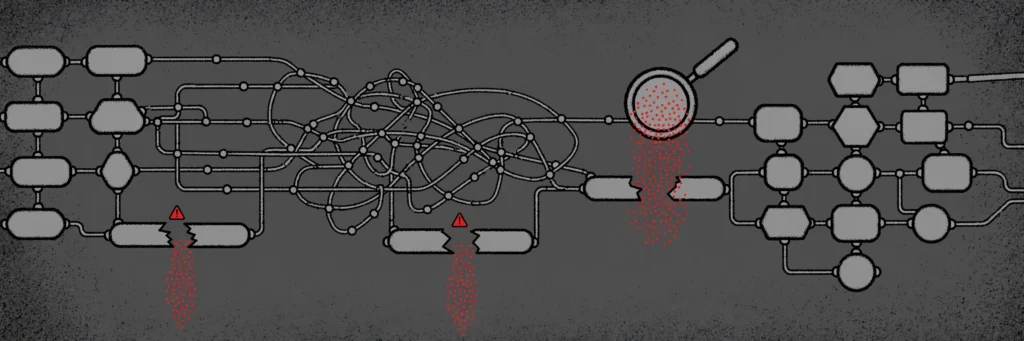
The prompts were the canaries in the coal mine, and the mine was the AI supply chain.
The results were worse than the researchers expected.
Three breaches nobody noticed
Attackers were stealing data from inside at least three AI inference providers, Dragos said. The earliest breach began in mid-July, and the theft went on for months. The prompts that were copied included some marked Zero Data Retention, the setting that is supposed to mean a prompt is never stored at all.
The stolen test credentials were not just read. They were used. Ars Technica reported on November 20 that the planted keys were tried tens of thousands of times. On November 1, an attacker brought in ARTEX, an AI-driven penetration testing framework, to check whether keys stolen months earlier were still live.
They were. The researchers found that planted keys and secret links were still being accessed months after the first thefts, as of this week. The attackers had settled in, and nobody had noticed them.
What makes the finding unsettling is the silence. None of the three providers knew they had been breached until Dragos told them.
Zero Data Retention did not mean zero copies
Zero Data Retention, usually shortened to ZDR, is a promise. When a customer marks a request ZDR, the provider is supposed to process it and then forget it. No logging, no storage, no copies kept for training or anything else.
For companies handling sensitive work, that promise is the whole point. Lawyers, doctors, banks and software teams send confidential material to AI models through gateways like OpenRouter, trusting that the ZDR label keeps it private.
The Dragos research suggests that promise was broken. In two of the three breaches, some of the stolen requests had been marked for Zero Data Retention. The prompts were kept anyway, passed to other companies and read by human beings, Moore wrote.
That matters because the planted prompts were bait, but they travelled alongside real customer requests. The researchers say those real requests were almost certainly copied too.
The resellers quietly reading your prompts
The second finding needed no break-in at all. Some sellers on AI inference marketplaces were listing models at the lowest prices, switching on request logging and quietly collecting everything that flowed through their systems.
One unnamed Chinese AI lab fetched the secret links from more than half of the seeded prompts sent to its models between July and October. That included about two-thirds of the requests marked no data collection or Zero Data Retention.
The lab had only been given the first eight characters of each secret link. Whoever posted it, Moore wrote, must have been reading a cached copy of the full prompt. The data had been stored, shared and read, everything the ZDR label was meant to prevent.
This is the part of the story that reaches furthest. OpenRouter routes customer requests to a pool of third-party providers, and some of those providers hand traffic on to yet another company.
A prompt sent to one brand can pass through two or three hands before it reaches a model, and the customer may never know who those hands belong to.
What OpenRouter did on November 22
OpenRouter said on November 22 that it had removed three providers from its platform and taken 125 endpoints out of Zero Data Retention eligibility. The list covers providers flagged by the researchers, plus others cut as a precaution.
The company stressed that the findings showed no breach of OpenRouter itself. The problems were at the inference providers running models behind the router.
Any endpoint removed during the review will need assurances and validation before its Zero Data Retention status is returned, OpenRouter said.
The gateway is also adapting the researchers’ canary testing approach so the checks can run on an ongoing basis. It is verifying network paths to identify where requests and responses may be forwarded to third parties.
OpenRouter also said it had notified all potentially affected customers. The researchers are now working with about a dozen providers to clean up the mess.
Separate disclosures followed the same week. Together AI said an intruder downloaded prompt samples from June and July 2026, after an AI coding agent exposed a private credential in a public repository.
Novita disclosed a routing fault that sent some MiniMax requests to MiniMax’s own API between May and November. Phala told users of DeepSeek V4 Flash routed through its systems to treat their prompts as exposed and rotate any secrets in them.
What this means for anyone using AI
The story lands in a year already crowded with AI security failures. In October, a breach at Fireworks AI exposed customer datasets and model weights.
A leak in Grok Build left tens of thousands of shared apps readable without a sign-in. And a breach at the cloud platform Railway let an attacker rack up $740,000 in fraudulent AI charges with stolen keys.
But the OpenRouter case is different in one important way. The earlier incidents were breaches of single companies. This one is a failure of the supply chain itself, of the chain of middlemen between a user and a model.
That chain has grown long and murky. Cheap inference providers compete on price, and some of them resell capacity they buy elsewhere. A request can change hands several times, and each handoff is another chance for the data to be copied, logged or read.
For users, the lesson is uncomfortable. A Zero Data Retention label is only as strong as the weakest company in the chain, including companies the customer has never heard of. The setting can be honoured by the gateway and ignored by the provider behind it, and the customer has no way to tell the difference.
The practical advice from the research is blunt. Treat anything sent to a third-party AI service as potentially readable by someone else. Do not paste live passwords, private keys or unreleased business information into prompts. If a secret has ever travelled through an AI service, rotate it.
What happens next
Dragos says the work is not over. The researchers are working with about a dozen providers, and the planted secrets are still being accessed.
OpenRouter’s move sets a precedent. A gateway that once passed requests along and trusted its providers’ promises is now testing those promises itself, continuously. Other gateways will face the same question: how do you know your providers keep their word?
The traps are still out there. Every stolen key that gets used is another signal, and another reminder that in the AI supply chain, trust is no longer enough.
Source: The Hacker News


