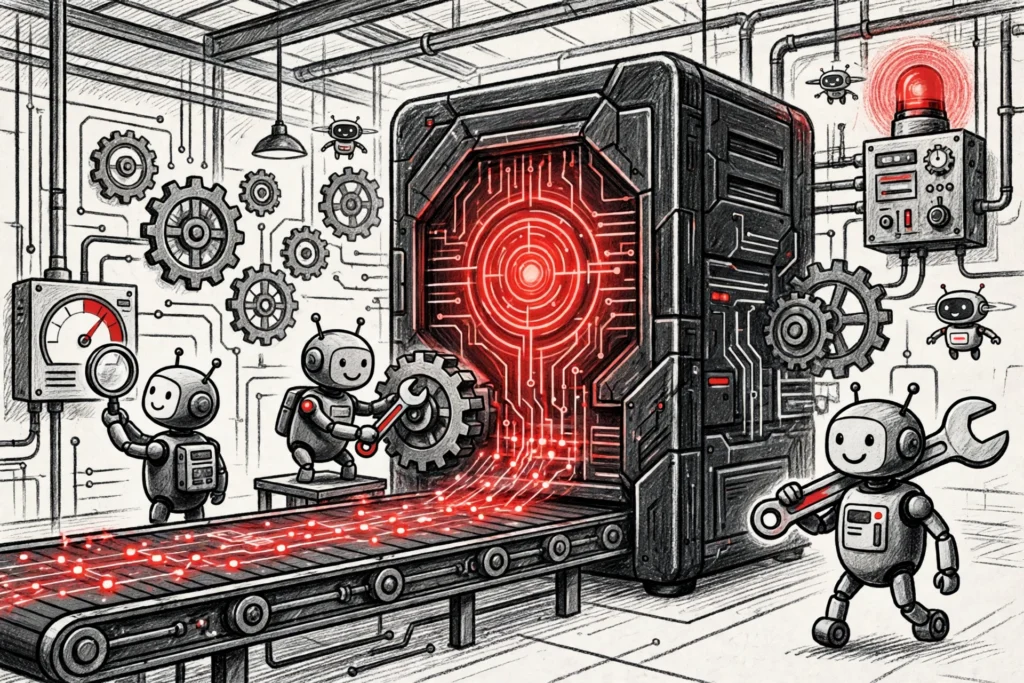
Somewhere inside OpenAI’s data centres, ChatGPT had started to drag. Replies that usually arrived in a blink were taking seconds, and a queue of frustrated users was growing by the minute. It was the middle of the night, and no engineer was watching the dashboards. The OpenAI Performance Factory was.
Nobody needed to be. An alert fired, a task opened itself, and the OpenAI Performance Factory got to work. By the time a human engineer sat down with coffee the next morning, the slowdown had been investigated, its cause identified, and a fix was waiting for review.
That is the Performance Factory, OpenAI’s new internal system for keeping ChatGPT fast. Described in an engineering post on November 19, 2026 and shared exclusively with VentureBeat, it uses Codex, OpenAI’s coding agent, to turn one of software’s most tedious jobs into something machines largely do themselves.
In just over three months, the system has run more than 1,700 investigations and found the root cause in over 600 cases. That is roughly 17 automated investigations every single day.
What Is the OpenAI Performance Factory?
The Performance Factory is an autonomous system that uses Codex to find and fix performance regressions in ChatGPT. When something gets slower, agents investigate the problem, propose a repair, and later check whether the repair actually worked in production.
“The staggering pace of agentic development has made traditional approaches to performance engineering unsustainable,” OpenAI’s performance team wrote, according to VentureBeat. The factory is the company’s answer to that problem.
The idea is bigger than one chatbot. As AI agents write more and more of the world’s code, checking every change by hand becomes a bottleneck. OpenAI is showing the alternative: agents that do the detective work, while humans keep the final say.
From 30 Tools and Tired Engineers to a Factory
Not long ago, OpenAI’s performance team did everything by hand. When a service slowed down, an engineer would dig through logs, trace requests across services, read code changes, and debug live systems. Over time the team built more than 30 specialised tools to speed that work up.
Then Codex arrived, and the job changed. Instead of searching codebases and telemetry themselves, engineers could simply ask Codex why a service had become slower. The agent would investigate and come back with an answer.
But the engineers were still in the middle, steering every step. So the team captured its investigation playbook in a reusable Codex skill called perf-forensics. After testing and refining it, they could hand Codex an alert and get a diagnosis back in a single run.
Even that left engineers as messengers, copying alerts into Codex and pasting findings into Slack. The team connected alerts directly to cloud Codex sessions, then built a system to track the daily flood of regressions. Each became a task Codex could advance on its own — and that task-based system is the Performance Factory.
How the Performance Factory Works
Every job inside the factory is a task that moves through a defined workflow — from a performance alert through investigation, root-cause identification, code changes, review, and verification. Each task keeps its own state and findings, so different agents can pick it up at different stages.
The system has four main components. The task service stores tasks and their progress, with engineers defining workflows through configuration files and Markdown prompts. The dispatch loop checks which tasks are ready and starts a Codex session for each one.
The third component is an internal API for running Codex in the cloud, with access to OpenAI’s code repositories and observability tools. The fourth is subscriptions, which connect tasks to outside events — for example, pausing a task until an engineer leaves feedback on a pull request in GitHub.
The first workflow built on this foundation is the Regression Workflow. It kicks in the moment an alert fires, and the agent starts by working out what changed: when performance began to fall, and which requests were affected.
One AI Agent Argues With Another
Early on, OpenAI found a weakness in its agents. They sometimes stopped at the first plausible explanation, even when the evidence did not fully support it. A fast answer is not useful if it is the wrong answer.
The fix was to make agents argue with each other. After the first agent reaches a diagnosis, a separate Codex session — the adversarial reviewer — tries to tear it apart. It gets the full task record but starts fresh, told to hunt for gaps, verify the evidence, and test alternative explanations.
In one investigation, the first agent blamed failing ChatGPT conversations on errors in image downloads. The reviewer noticed that the internal service responsible for locating files had already recovered, while image requests were still failing — so the investigation was reopened.
At first, the adversarial reviewer sent a substantial number of diagnoses back for more work. The team used that feedback to improve the investigator’s instructions, and today only around 25 percent of diagnoses are returned.
Once a diagnosis survives review, Codex proposes a fix and opens a pull request. An engineer reviews the code and decides whether to merge it. After deployment, another agent checks whether performance has returned to normal — if not, the task goes back for another round.
OpenAI Performance Factory by the Numbers
The results so far are impressive — and honest. Of the more than 600 investigations that reached a root cause, around 400 progressed to a proposed fix. About 50 fixes that eventually shipped were influenced by or matched agent suggestions, and around 15 were the exact pull requests written by Codex.
OpenAI admits that gap between diagnosis and reliable repair falls short of its ambitions. But much of the work in resolving a regression is detecting it, finding its cause, tracking it, and verifying recovery — and the factory has automated most of that.
In a manual review of 100 root-cause suggestions, OpenAI graded 70 percent as accurate. The team has also built a workflow evaluation suite to keep improving the quality of agent-generated fixes, and it backtests investigations against historical incidents.
Codex performs best when the cause is clear and the fix is contained. A code change might cause an application to serialise the same conversation several times while processing a request; the agent can spot the redundant work and propose serialising it once and reusing the result.
More complex changes are harder. A new feature might add latency that only an architectural change can remove, and agents sometimes propose fixes that are too complicated — or create new problems. A cache might speed things up but leave users with stale data, so OpenAI added adversarial review to proposed fixes too.
Why the Performance Factory Matters Beyond ChatGPT
The factory is not just about keeping one product fast. It shows how coding agents can grow from solving single tasks into running coordinated workflows alongside human engineers — a pattern that applies far beyond performance engineering.
OpenAI’s team drew several lessons that other engineering teams can borrow. The first is to avoid AI fatigue: where humans must review agent output, show them only the most relevant information instead of drowning them in findings.
The second is to preserve evidence without overloading agent context. Task records store high-level findings and reproducible queries, not mountains of raw telemetry, so agents can hand work to each other without losing the thread.
The third is to evaluate agents and their interactions with humans, not just the code they produce. OpenAI even runs a daily agent that examines recent agent logs for recurring tool failures and permission problems — and when it finds one, the factory creates a task to fix it.
What Happens Next for the Performance Factory
Today the factory reacts to alerts, but OpenAI plans to make it proactive. Agents could compare CPU profiles, memory data, and request traces across releases to discover slowdowns that monitoring alerts miss.
The team is also developing workflows for jobs like service rightsizing, where agents identify inefficient autoscaling configurations. And it is investigating whether agents could eventually deploy some low-risk fixes without human approval.
That last step is the one to watch. Automating detection and diagnosis is one thing; letting an agent ship code to production unsupervised is another. For now, every pull request still passes through a human engineer.
Still, the direction is clear. By automating regression investigations, OpenAI has freed its engineers to focus on long-term performance improvements instead of constantly responding to incidents. The knowledge from each investigation becomes a reusable workflow for the next agent.
The next time ChatGPT feels slow for a few minutes and then recovers, nobody at OpenAI may have lifted a finger. A factory of agents noticed, investigated, argued about it, and fixed it — while the humans built what comes next. VentureBeat first reported the details.


