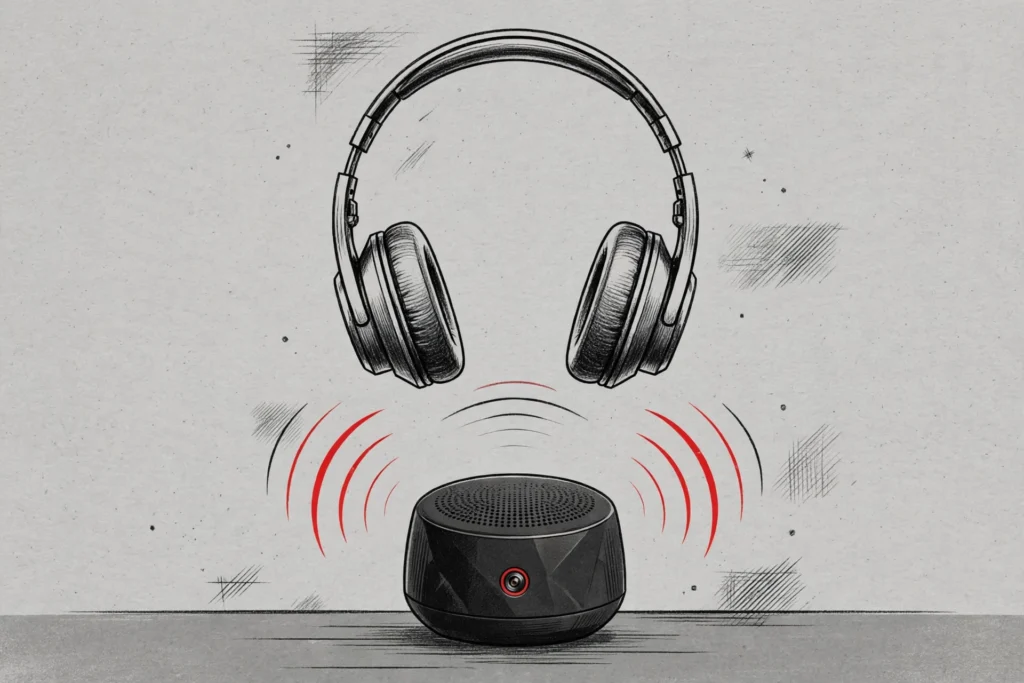
Picture this: you are cooking dinner, hands covered in flour, and you need a recipe step read back to you. You speak into the room, and a small device on the counter answers — no screen to tap, no phone to unlock, no wake word repeated twice.
That is the world OpenAI seems to be building toward. Its first piece of consumer hardware is reportedly taking shape in factories right now, and according to fresh supply-chain reports, it could reach customers far sooner than anyone expected.
The latest twist is the shape of the thing itself. A new report says OpenAI’s first device will be an audio headset, not the screenless speaker or the AI pen that earlier rumours had pointed to. And the company has reportedly already settled how many it plans to ship in its first year.
What OpenAI’s first AI device reportedly looks like
The headset claim comes from a report published on November 20, which says OpenAI will soon begin mass-producing the hardware once it finalises its manufacturing vendor. The same report says the first-year shipment volume has already been decided, though the number itself has not been made public.
That is a notable shift from what earlier reporting had suggested. For months, the most detailed accounts described a small, screenless speaker — Bloomberg’s Mark Gurman called it doughnut-shaped — with microphones, speakers, cameras and sensors, controlled mainly by voice.
The Information reported in February that the speaker would cost between $200 and $300 and would not ship before February 2027 at the earliest. A headset would be a different bet entirely: something worn on the body, closer to the ear, and built around conversation rather than a room.
OpenAI has not confirmed any of this. The company has said nothing publicly about the device’s form, its price, or when it will go on sale. Every detail so far comes from unnamed supply-chain sources and industry reporting, which is why the picture keeps changing.
Luxshare, Foxconn and the factory question
The manufacturing story is just as unsettled. On November 19, China’s National Business Daily reported, citing supply-chain sources, that several Chinese manufacturers were already involved in the project and that Luxshare Precision would exclusively handle final assembly while also supplying core components.
The same report said shipments could begin before the end of this year. That would be a remarkable acceleration from the February 2027 earliest-shipping date that The Information had reported — and it would put a real OpenAI gadget in people’s hands within weeks, not months.
But a newer round of reporting, published on November 22, says the plan may already be changing. According to accounts cited by TrendForce, OpenAI could shift its first major hardware order from Luxshare to Foxconn, the giant assembler formally known as Hon Hai Precision Industry.
If that happens, final assembly could take place outside China, with Vietnam and the United States among the locations discussed in supply-chain reports. Neither OpenAI, Foxconn nor Luxshare has confirmed any of it, so for now the factory question has two competing answers.
What is clear is the calibre of partner OpenAI is shopping for. Luxshare is a major Apple supplier that assembles iPhones and AirPods; Foxconn builds a large share of the world’s iPhones. OpenAI is not building a hardware supply chain from scratch — it is buying into the one that already makes the world’s most popular gadgets.
The Jony Ive connection
The device is the first fruit of OpenAI’s most expensive bet outside of computing itself: the roughly $6.5 billion acquisition of io Products, the hardware startup founded by Jony Ive, Apple’s former chief design officer.
Ive’s team has spent the year working on a family of devices, according to The Information, with more than 200 people on the project. The speaker was expected to be first, followed by smart glasses — not ready for mass production until 2028 — plus AI earbuds and a smart lamp further down the road.
OpenAI has already reshuffled its hardware bets once this month, disbanding its standalone robotics team after deciding that general-purpose models could run robots directly. The device programme, by contrast, appears to be accelerating.
That lineage matters because Ive’s products have always been defined by what they leave out. The iPhone removed the keyboard; the Apple Watch removed the need to take your phone out of your pocket. A screenless, voice-first device would follow the same instinct: the interface disappears, and the intelligence is the product.
Whether the first device is a headset or a speaker, the design brief appears to be the same — a gadget that listens, watches, and understands its surroundings, then answers in natural conversation. Cameras and sensors, according to earlier reports, would let it know what you are looking at, not just what you are saying.
Why a headset makes sense for OpenAI
There is a practical case for a headset, too. OpenAI’s models already handle real-time voice conversation, and a device worn on the head puts microphones centimetres from the mouth and speakers centimetres from the ear — ideal conditions for the kind of always-on assistant OpenAI wants to build.
It would also sidestep the hardest problem with screenless speakers: they have to hear you across a noisy room. A headset hears you clearly, works on a train or a street, and keeps your conversation private in a way a speaker in a shared room cannot.
And it would give OpenAI a foothold in a category its rivals are already circling. Meta has put its AI into smart glasses, Google has Gemini in eyewear, and Nothing is preparing its own screenless AI gadget for December. The race to own the device you talk to is already under way.
The counterargument is the graveyard. The Humane AI Pin and the Rabbit R1 both promised a post-phone future and both collapsed, because the phone they were meant to replace was already in everyone’s pocket and did the job better. OpenAI’s device will have to answer the same question: what can it do that a phone cannot?
What we still don’t know
The honest answer is: almost everything that matters to a buyer. There is no confirmed name, no price, no launch market, and no official shipping date. The reported $200–$300 range for a speaker and the roughly $400 figure attached to Gurman’s account may not apply to a headset at all.
It is also unclear what “shipping this year” would actually mean. A late-December shipment could mean the first units leaving a factory, not a product you can buy in a shop. And if assembly moves from Luxshare to Foxconn, the timeline could slip again.
Then there is the question of what the device actually does all day. Earlier reports suggest it would handle questions, media playback, messages and smart-home controls, using cameras and sensors to understand its surroundings. But until OpenAI shows it, that is a feature list assembled from leaks, not a product.
Safety is the other open question. OpenAI recently built a control room that can halt a rogue AI model in 35 seconds, a reminder that the company is thinking hard about what happens when its systems act in the world — and a device that listens all day will face far harder questions than a chatbot ever did.
What happens next
The next hard fact is likely to come from OpenAI itself. The company has kept the project almost entirely quiet, and the first official word — a name, a price, a date — will settle arguments that supply-chain reports have been having for months.
Watch the manufacturing trail in the meantime. If Luxshare stays the assembler, a year-end shipment remains plausible; if Foxconn takes over, expect a longer runway and a production base outside China. Either way, the supply chain is moving, which is more than could be said a year ago.
For now, the picture is this: OpenAI’s first gadget is real, it is being built, and the people building it cannot agree on what it looks like. A headset, a speaker, a doughnut — the shape keeps changing, but the direction does not. The company that taught the world to talk to AI now wants to sell you something to talk into.


